
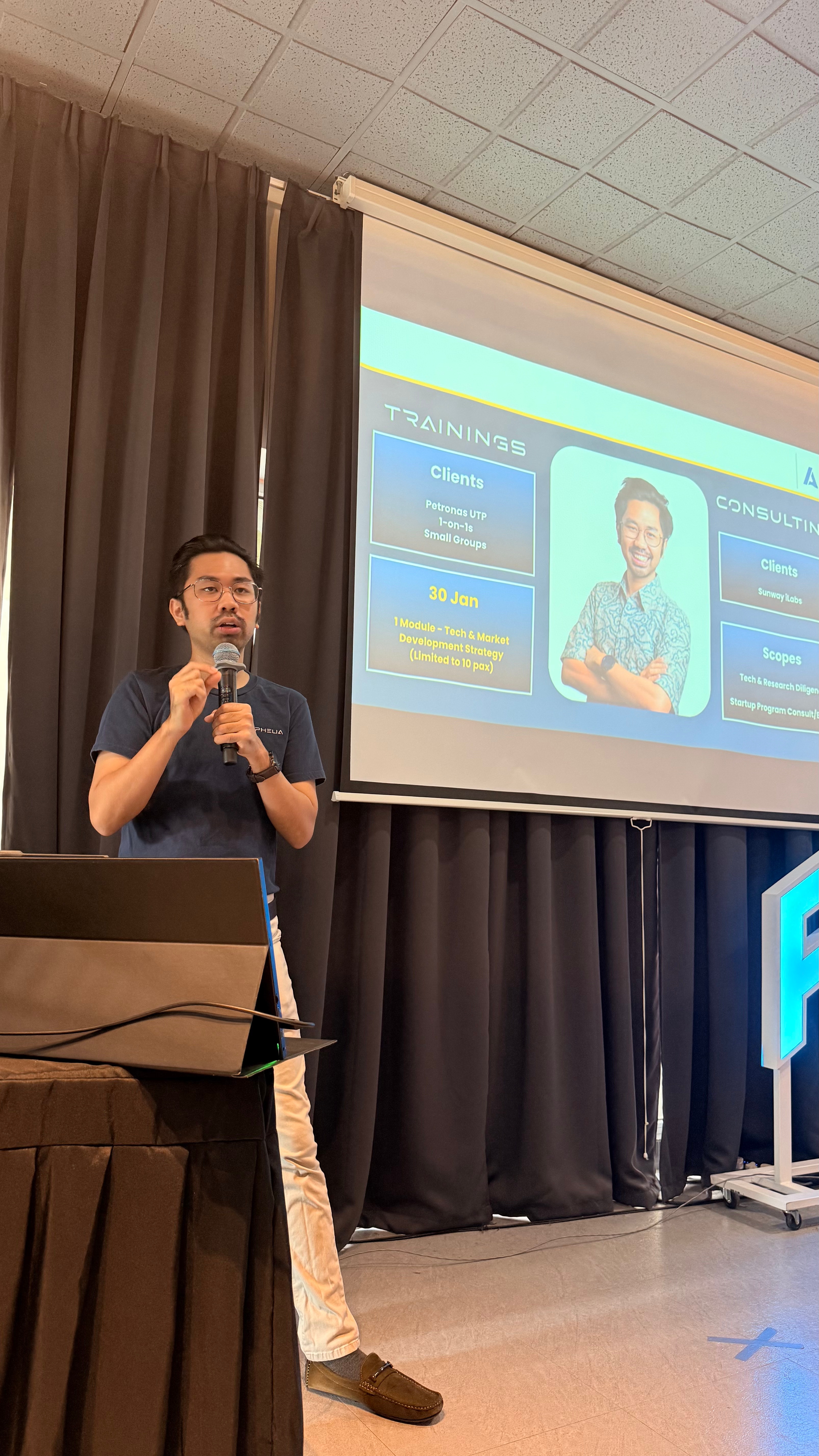
Techtamu Talk | 17 January 2026
M. Razlan Dhamir Hamdan stood before the room with a calm conviction that felt earned, not rehearsed. This was not a pitch about fast growth or flashy demos. It was a story about responsibility, patience, and scale. The lecture traced how Aphelia, a Malaysian deep-tech startup, chose to tackle one of humanity’s hardest problems: reliable energy beyond Earth, and what that decision demands in ethics, strategy, and execution.
A Moonshot with Purpose

Aphelia’s core ambition is bold and precise. Build kilometre-scale wireless power systems to form electrical grids on the Moon’s far side. Not the sunny postcard view, but the shadowed regions rich with ice. Those dark zones matter because they unlock water, oxygen, hydrogen fuel, and sustain human activity. Cables are impractical there. Wireless power changes the rules.
Within a European lunar program, Aphelia works alongside the European Space Agency and the Luxembourg Space Agency, defining power specifications and delivering power to multiple payloads. Rovers. Instruments. Infrastructure. Power is universal, Razlan reminded the audience, and universality makes it strategic.
Deep Tech Is Not SaaS
Razlan drew a sharp line between deep tech and software startups. In SaaS, teams learn by shipping, listening, and iterating. In deep tech, mistakes at the start can cost years and millions. That is why Aphelia obsesses over what Razlan calls “step zero.”
Before MVPs. Before market sizing. Step zero asks hard questions: Is the problem real in the future? Will regulation allow it? Can the solution survive near-term disruption? Does it make sense for civilisation, not just a quarterly report?
This thinking rejects tech-for-tech’s-sake. Razlan framed Aphelia’s approach through social constructivism, ethics, and storytelling. Technology does not shape society alone. People do. Values do. Narratives do.
When Ethics Force a Pivot
The room leaned in when Razlan described a defining moment. Aphelia received interest in a European defense-linked program tied to a proposed €1.75 million development associated with NATO. The opportunity was real. The capability fit. The discomfort was deeper.
Rather than drift into military applications that clashed with their values, Aphelia stepped away. That decision triggered a pivot toward civilian energy systems, where the same wireless power foundations could serve society at scale.
Space-Based Solar Power: From Orbit to Earth
That pivot sharpened Aphelia’s focus on space-based solar power. Razlan broke it down simply. Deep-sea power cables cost between $2 and $5 million per kilometre. A 600-kilometre link can approach $1.2 billion. Add maintenance, seabed risks, and geopolitics, and the numbers climb.
Space-based solar power flips the equation. Generate energy in orbit. Send it wirelessly to where it is needed. No seabed trenches. No land acquisition battles. New routes for regional energy sharing.
Aphelia’s early traction here is concrete. Engagements with Petronas Research. A Canadian client. A MoonPay customer in Los Angeles. A memorandum with a Swiss SBSP firm. Collaboration with Johor’s IRDA to explore powering the economic zone, with a future path to Singapore.
Building with Discipline, Not Excess
What surprised many listeners was how little money Aphelia used to reach this point. Antennas and semiconductors sit at the heart of wireless power. They are hard, unforgiving engineering domains. Aphelia developed its semiconductor capability with a budget of about $20,000. No luxury labs. Just systems thinking, careful benchmarking, and mission-style documentation borrowed from European space culture.
Advisory strength matters in such conditions. Aphelia brought in Les Johnson, formerly of NASA, alongside Malaysian engineers with ESA and UK spacecraft experience. The mix blends global credibility with local capability.
Malaysia on the Global Stage
Razlan spoke with quiet pride about representing Malaysia in rooms where Asian voices are rare. Aphelia’s presence at global forums, its recognition as a Payload Pioneers honoree, and its role in MADSE show that Malaysian deep tech can play at the highest level without losing its compass.
More than that, Razlan issued a challenge. Talent should aim at problems that matter. AI for cancer. Mechanical engineering for energy efficiency. Space systems for shared abundance. Think big, yes, but deliver outcomes that serve the nation today.
The Takeaway

Aphelia’s story is not about shortcuts. It is about choosing a future, then earning it step by step. A moonshot guided by ethics. Dual-use pathways that keep the lights on while the long game unfolds. Discipline over hype. Vision grounded in responsibility.
Razlan closed with a line that stayed with the room: Malaysia does not need to chase trends. It needs to decide what kind of future it wants to help build, then commit to it with clarity and courage.
That is how you wire the Moon. And maybe, in time, power the Earth.


Leave a Reply