
-
IoT World – September 2026 Compilation
September 2026 | IoT World Reading Edition IoT World. Monthly reading edition September 2026 Ideas for the connected world September. See it sooner. From successful pilots to everyday operations, this month’s reading asks what connected data helps people see, decide and do. Inside this edition Good technology needs a reason… Read More ⇢

-
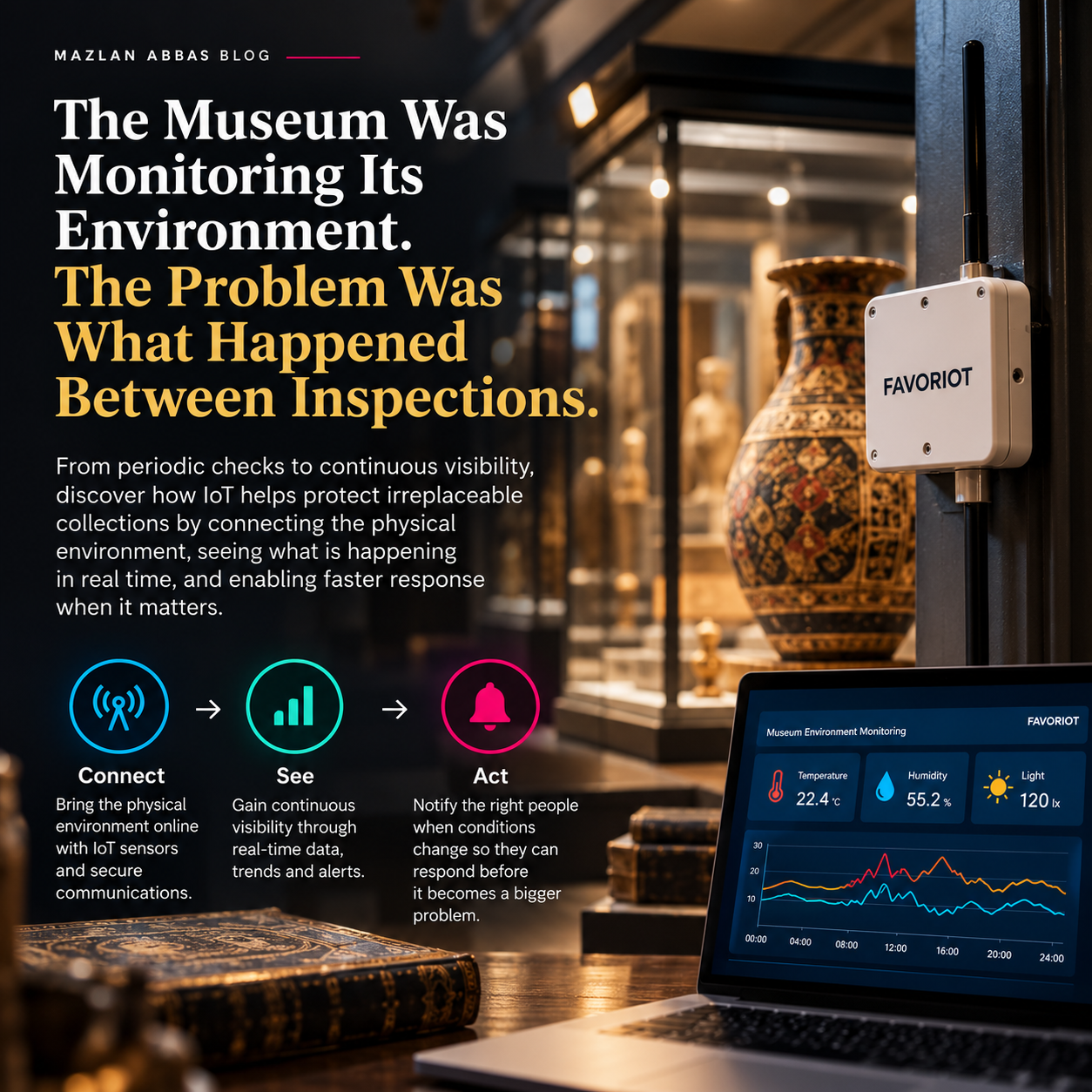
The Missing Hours: How IoT Changed Environmental Monitoring Inside a Museum
When evaluating an IoT deployment, four questions can reveal more than a long list of technical specifications: What problem was solved? How was it deployed? What changed for the customer? Did it reduce operational effort or cost? A national museum environmental monitoring project provides a useful example. The museum needed to… Read More ⇢
-
From Load Spikes to Action: How IoT Can Expose Hidden Energy Costs
Energy management is often treated as a reporting problem. Organisations receive electricity bills, analyse historical consumption and compare monthly figures. While this information remains useful, it has one major limitation: it describes events that have already happened. For facilities affected by Maximum Demand charges, that delay can become expensive. A… Read More ⇢

-
From Pump Motors to Operational Visibility: A Practical IoT Monitoring Model
Airports, factories, commercial buildings, utilities and industrial facilities depend on equipment that most people rarely notice. Pumps, motors, compressors, generators and electrical systems may operate quietly in the background, yet their failure can disrupt much larger operations. An airport water pump monitoring project provides a useful example of how IoT… Read More ⇢

-
The Case for Specialisation in IoT: Lessons from Taiwanese Companies
IoT depends on complementary expertise A series of recent meetings with Taiwanese companies highlighted a practical feature of the region’s IoT ecosystem: many firms understand their position in the technology value chain and build their business around a defined area of expertise. One company may focus on sensors, another on… Read More ⇢

-
“Send Me a Proposal”: Why IoT Projects Often Stall Before They Begin
A customer wants to monitor equipment across several sites. The conversation sounds promising. There may be sensors to install, networks to configure and a dashboard for the operations team. Then comes the request every solution provider wants to hear: “Send me a proposal.” It can feel like the project has… Read More ⇢

-
Your IoT Pilot Worked. So Why Did the Project Still Fail?
For years, I believed that one of the biggest barriers to IoT adoption was technology awareness. If organisations understood what IoT could do, surely more of them would adopt it. Later, I thought the challenge was technical knowledge. If more engineers, students and companies knew how to build IoT solutions,… Read More ⇢

-
What IoT World Published in August 2026
IoT World: August Digest IoT World · Monthly Digest What IoT World published in August Nineteen articles from the month, sorted into four threads: what to build versus buy, how cities and regions are wiring themselves up, how data becomes a decision, and the running series on why data alone… Read More ⇢

