
Executive Summary
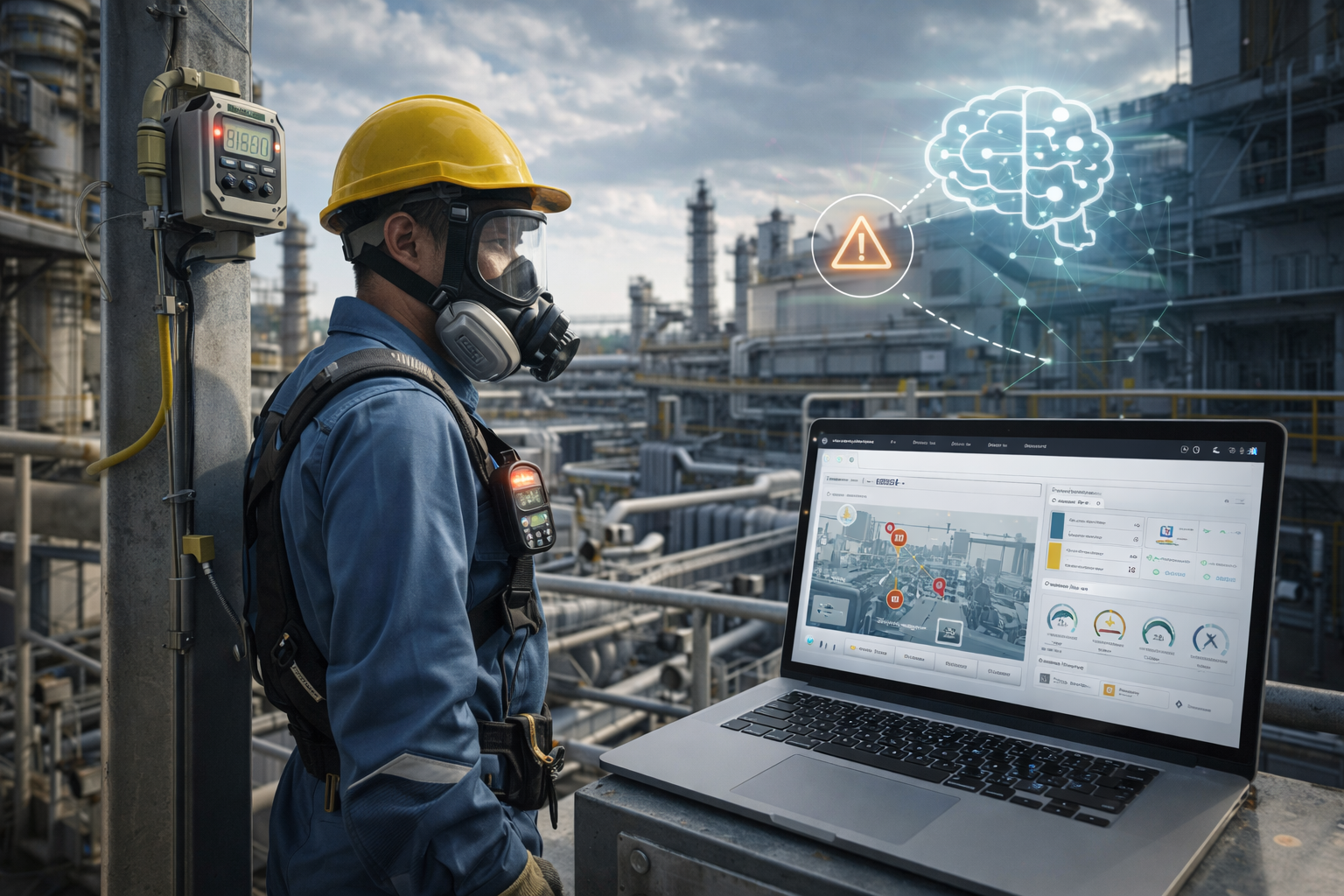
Many industrial workplaces expose workers to hazardous gases that are invisible and often undetectable by smell. Short exposure above safe limits can cause serious injury or worse. Traditional gas monitoring systems rely primarily on threshold alarms, which only react once conditions become unsafe. While this approach supports basic compliance, it does little to prevent incidents.
Smart gas monitoring combines certified gas sensors, continuous data capture, and machine learning to shift safety management from reactive response to early warning and prevention. By analysing behaviour patterns and trends, organisations gain better protection for workers, stronger compliance evidence, and clearer operational insight using a cloud-based IoT platform.
Why Gas Monitoring Remains a Safety Challenge
Industrial gas hazards are complex because they are:
- Intermittent and location-specific
- Influenced by ventilation, temperature, humidity, and work activity
- Often dangerous even at low concentrations
- Especially risky in confined or enclosed spaces
Common challenges with conventional monitoring include:
- Alarms trigger only after limits are exceeded
- Limited use of historical data
- Difficulty explaining repeated alarms or near-miss events
- High rate of nuisance alarms that reduces trust
Meeting regulations alone does not guarantee safer workplaces.
A Typical Smart Gas Monitoring Scenario
In a typical facility such as a factory, processing plant, or utility site, gas sensors are deployed across key areas, including:
- Production zones
- Equipment or utility rooms
- Storage and loading areas
- Confined or enclosed spaces
These sensors continuously measure hazardous gas levels and supporting environmental conditions. The sensors are safety-grade, calibrated, and suitable for occupational monitoring. Each reading is time-stamped, creating a continuous record of both normal operations and abnormal events.
System Architecture at a Glance
A smart gas monitoring system follows a layered structure:
- Gas sensors continuously collect readings
- A gateway aggregates data and handles secure transmission
- A cloud IoT platform stores and visualises the data
- An analytics layer applies rules and machine learning
- Alerts, dashboards, and reports support decisions
This structure allows safety-critical detection to remain independent while enabling advanced analysis at the operational level.
How Machine Learning Improves Gas Monitoring
Machine learning changes how gas data is interpreted by focusing on behaviour rather than limits.
Instead of asking:
- “Has the threshold been crossed?”
The system can ask:
- “Is this behaviour unusual for this place and time?”
Key ML-driven capabilities include:
- Anomaly detection
Identifies abnormal gas patterns even when readings are still within safe ranges - Trend monitoring
Detects gradual increases that signal leaks, ventilation decline, or process issues - False alarm reduction
Differentiates between harmless spikes and real risks - Predictive alerts
Estimates the likelihood of a future alarm based on current trends
This enables earlier intervention and more reliable safety decisions.
Benefits for Worker Safety and Compliance
A smart gas monitoring approach delivers value across multiple dimensions.
For worker safety:
- Earlier warnings reduce exposure risk
- Better awareness across zones and shifts
- Improved preparedness for confined space entry
For compliance:
- Continuous, auditable gas exposure records
- Automated reporting for inspections and audits
- Clear evidence of proactive safety management
For operations:
- Root cause analysis of repeated incidents
- Insight into ventilation and process effectiveness
- Data-driven safety improvements rather than assumptions
Visualisation and Decision Support
Modern IoT platforms turn raw gas readings into actionable insight through:
- Real-time dashboards by zone and gas type
- Historical charts showing exposure trends
- Alert timelines linked to operational activity
Platforms such as Favoriot support secure ingestion of sensor data using common protocols, rule-based alerts, visual dashboards, and data pipelines suitable for machine learning. This allows organisations to begin with monitoring and gradually introduce intelligence without replacing existing safety-certified equipment.
Key Implementation Considerations
Successful deployment depends on a few important principles:
- Clear separation of roles
Safety-certified sensors handle detection and alarms, while the IoT and ML layer focuses on insight and prediction - Scalable rollout
Start with high-risk areas, then expand as data volume and confidence increase - Data security and integrity
Encrypted communication, access control, and audit trails are essential
This approach supports innovation without introducing compliance risk.
The Road Ahead for Smart Gas Monitoring
Smart gas monitoring is moving toward systems that are:
- Context-aware and adaptive
- Integrated with ventilation and facility systems
- Linked to maintenance and operational planning
- Increasingly predictive as data accumulates
As machine learning models mature, safety teams can prevent incidents rather than respond after the fact.
Conclusion
Gas monitoring no longer needs to stop at alarms. By combining certified sensors, continuous data collection, and machine learning, organisations can better protect workers while strengthening compliance and operational understanding.
A cloud-based IoT platform with analytics and ML capability provides a practical path toward proactive safety. With the right architecture, smart gas monitoring turns data into foresight, supporting safer workplaces and more confident decision-making.



Leave a Reply