
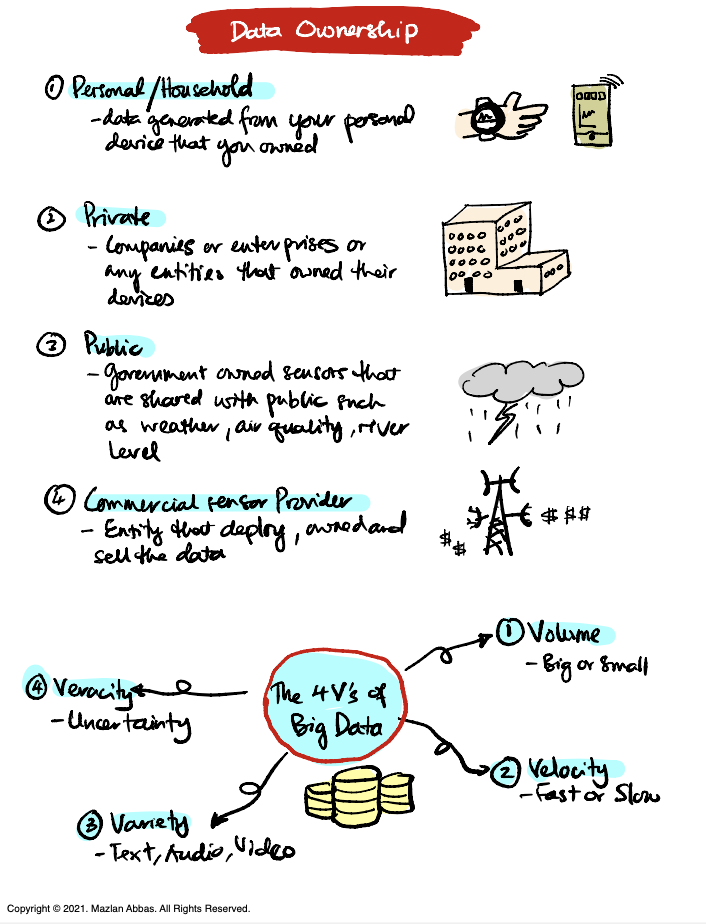
Today, we’ll discuss two critical topics in the digital age: data ownership and the 4 V’s of Big Data.
This diagram simplifies these concepts, so let’s break them down for better understanding.

1. Data Ownership
Data ownership refers to who has the rights and responsibilities over data. There are four main categories:
1. Personal/Household
This includes data generated from your personal devices, like your smartphone, fitness tracker, or smart home systems.Example: Steps tracked by your smartwatch, or usage data from your smart TV.You, as the owner of the device, own this data and can decide how it is used or shared.
2. Private
This is data collected and owned by companies or enterprises.Example: A company’s internal data about its operations, such as sales performance or employee attendance.Organisations use this data to improve their services, products, or strategies.
3. Public
Public data is owned by the government and shared for the benefit of society.Example: Data from weather sensors, air quality monitors, or river level gauges.This data is often accessible to the public for research, awareness, or planning purposes.
4. Commercial Sensor Provider
These are entities that deploy, own, and sell data collected from their sensors.Example: A telecommunications company selling location data collected from its network.They monetise the data by providing it to third parties, such as businesses or governments.
2. The 4 V’s of Big Data
Big Data refers to the massive volumes of data generated by digital devices and systems. It is characterised by the 4 V’s:
Volume
This is the amount of data, which can be massive in scale.Example: Social media platforms generate terabytes of data every day from user interactions.
Velocity
This refers to how fast or slow data is generated and processed.Example: Real-time data from stock markets or traffic monitoring systems must be processed quickly to be useful.
Variety
Data comes in different formats, such as text, audio, video, or images.Example: An IoT platform may process data from sensors (numeric values), surveillance cameras (video), and voice commands (audio).
Veracity
This addresses the uncertainty or trustworthiness of the data.Example: Ensuring the accuracy of user-generated reviews on e-commerce platforms can be challenging.
Why is This Important?
Understanding data ownership and the nature of Big Data is essential for:
Privacy and Security: Knowing who owns and controls your data helps protect your rights.Decision-Making: Leveraging the 4 V’s effectively enables organisations to make informed decisions.Innovation: Big Data drives advancements in fields like healthcare, transportation, and smart cities.
Final Thoughts
Data is the fuel of the digital economy, but with it comes the responsibility to manage it ethically and effectively. Whether it’s your personal data or public data shared by governments, understanding ownership and the dynamics of Big Data is crucial.
Let’s discuss: How can individuals and organisations ensure ethical data usage while maximising its potential? Share your thoughts!
[Note: Download the full eBook IoT Notes by Mazlan Abbas]


Leave a Reply