
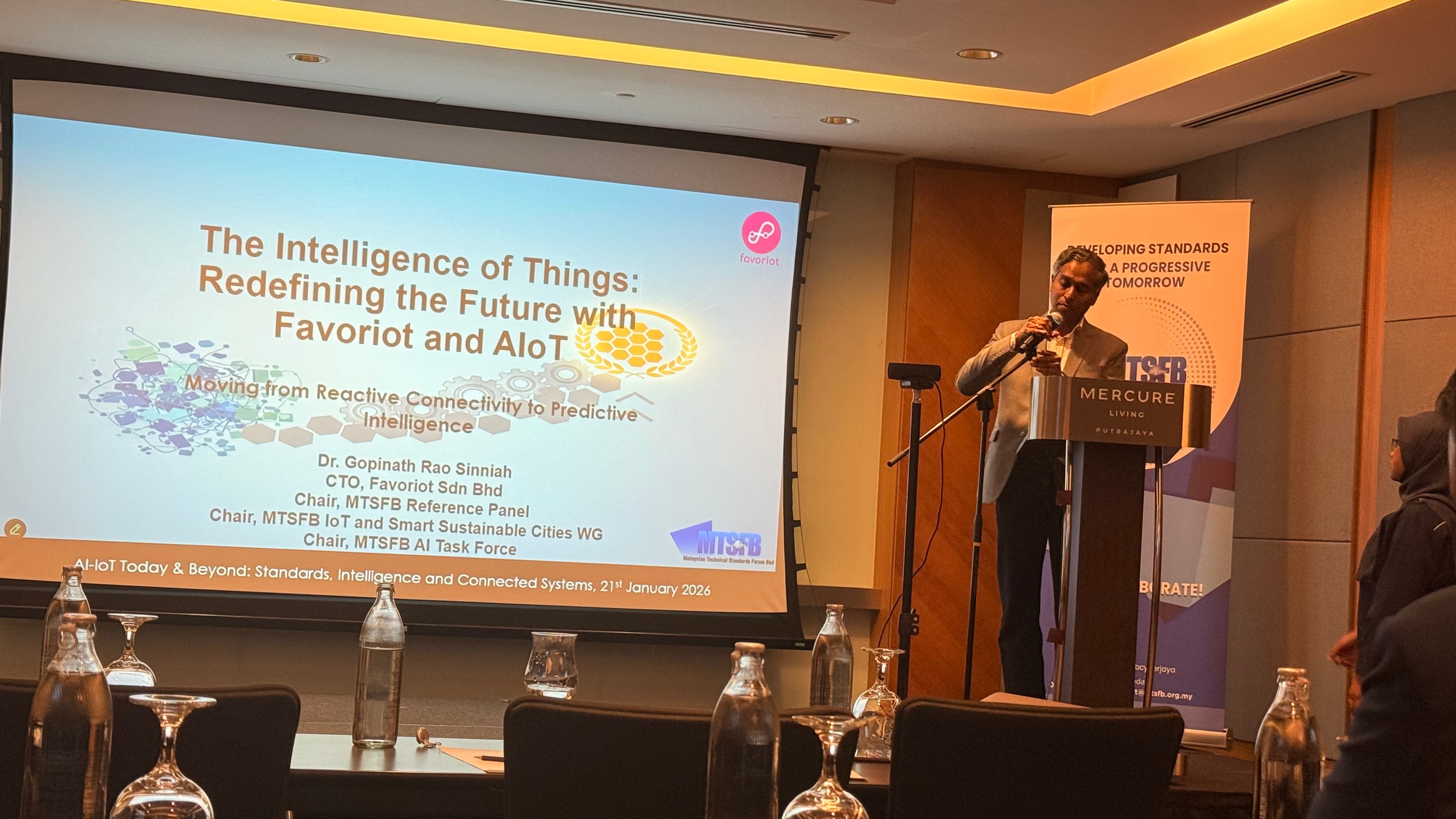
On 21 January 2026, the lecture hall was filled with more than technical curiosity. It carried a sense of responsibility. Dr Gopi stepped forward to deliver a session titled “Intelligence of Things: Redefining the Future with Cyber and AIoT.” What followed was not a routine technology briefing, but a clear invitation to engineers, researchers, and city builders to rethink how standards, platforms, and intelligence must come together if AIoT is to matter in the real world.
Speaking with the calm confidence of someone who has spent decades inside standards rooms and industry forums, Dr Gopi began by grounding the audience in a truth often overlooked. Technology does not scale on ideas alone. It scales on standards.
Standards Are Not Paperwork. They Are Power.
Dr Gopi traced the roots of Malaysia’s technical standards ecosystem through the MTSFB technical standards forum, a body that has quietly shaped industry practices for more than twenty years. In his view, standards should never be academic exercises. They must originate from industry pain points and return to industry as deployable technical codes.
He described how proposals are shaped by practitioners, refined by working groups, validated through deployment, and later formalised. This cycle ensures that standards are lived, not laminated.
International alignment, he stressed, is non-negotiable. Security work aligns with the International Telecommunication Union Study Group 17. Smart city frameworks align with Study Group 20. Regional engagement continues through ASTAP and other Asia-Pacific forums. This alignment is what allows a local solution to speak a global language.
What stood out was his emphasis on grants like the Industrial Promotion Development Grant. Funding, in his framing, is not about producing demos. It is about producing technical codes that can outlast the project itself.
Smart Cities Need Structure Before They Need Sensors
The lecture then moved into IoT Smart Sustainable City standards, an area Dr. Gopi has watched evolve for more than a decade. Early efforts focused on sensor networks. Today, the focus has shifted to intelligence.
He outlined three pillars that now define smart city standards:
- Devices must talk to each other across vendors.
- Security must be built in, not bolted on.
- Architecture must support intelligence, not just data flow.
AI, he explained, changes everything. Devices are no longer passive. They perceive, decide, and act. Autonomy becomes real. Systems learn how to improve performance. Trust and governance move from policy documents into system design.
He shared practical examples, including the updated technical code for smart towers. These towers are no longer simple structures. They are platforms supporting energy monitoring, connectivity, sensing, and services for local councils. In Malaysia’s smart city push, indicators matter, and standards must translate directly into what councils can deploy and manage.
Security Starts With Identity
One of the most sobering moments came when Dr. Gopi addressed IoT security. He estimated that fewer than a third of devices in the market genuinely comply with meaningful security standards.
The root problem, he argued, is identity. Without a shared device authentication framework, trust remains theoretical. His team is working on frameworks for testing, accreditation, and graduated certification. The goal is not perfection, but clarity. A device should prove who it is and what it can be trusted to do.
Data Is Everywhere. Insight Is Not.
As the talk shifted toward AIoT adoption, Dr Gopi named a frustration many in the room quietly shared. Organisations collect mountains of IoT data but struggle to turn it into answers.
Systems react to thresholds. Alerts create noise. Context is missing.
He also addressed the skills gap. AI knowledge evolves quickly, and while universities are updating syllabi, domain-specific AI talent remains scarce. Add to this the reality that many deployments remain one-off pilots, and it becomes clear why scale is elusive.
Another challenge he highlighted was uncertainty from customers themselves. Many know they want “AI” but cannot articulate the problem they want solved. Without clarity at the start, even the best technology struggles.
Favoriot’s Journey From Connectivity to Intelligence

Against this backdrop, Dr. Gopi introduced the evolution of the Favoriot platform.
Built since 2017, Favoriot began with a clear mission. Connect heterogeneous devices using standard protocols such as MQTT and CoAP. Make data reliable. Make diagnostics visible.
From there, the platform matured into a robust data management platform, handling large volumes of telemetry, transforming data formats, and presenting information through dashboards that make patterns visible.
The turning point came with the advent of native machine learning. Instead of stopping at alerts, Favoriot began learning from data. Patterns replaced thresholds. Prediction replaced reaction.
Dr. Gopi described scenarios such as vibration and temperature data predicting equipment failure within a defined time window. This shift marked the move from IoT to AIoT.
Removing the Friction From Machine Learning

Traditional machine learning pipelines, he explained, are fragmented. Data moves out of platforms, into external tools, through custom pipelines, and back again. Each step adds cost, time, and risk.
Favoriot takes a different approach. Machine learning lives inside the platform. Users with limited AI background can train models through simplified steps. There is no need to stand up separate infrastructure or stitch components together.
For Dr. Gopi, this matters because intelligence should not be reserved for elite teams. It should be accessible to engineers and solution builders who understand the problem domain best.
From Connection to Action
He framed Favoriot’s operational flow in four simple stages.
Connect devices and consolidate data.
Observe patterns through dashboards.
Predict outcomes using embedded learning models.
Automate responses through rules.
Automation, he showed, is not abstract. Notifications can be sent via email, SMS, or Telegram. Devices can be triggered. Actions follow insight.
Models trained in the cloud can also move closer to the field. Exported to edge gateways, they enable local inference while keeping data flows under control. Retraining can be scheduled, allowing systems to learn continuously as conditions change.
Toward Orchestration and Self-Driving Enterprises
Dr. Gopi closed with a forward-looking vision. He described Favoriot as more than a platform. It is becoming an orchestrator. A system that holds context, memory, and coordination logic.
The long-term ambition is multi-agent coordination and, eventually, self-driving enterprises. Organisations where data, intelligence, and action form a closed loop that improves with time.
He was careful not to oversell. This future is not fully here yet. But the direction is clear.
A Quiet Challenge to the Audience
As the lecture ended, the inspiration did not come from bold promises. It came from clarity. Standards give technology direction. Intelligence gives data meaning. Platforms succeed when they respect both.
Dr. Gopi left the audience with an unspoken challenge. Build systems that scale beyond pilots. Ground innovation in standards. Design intelligence that people can trust.
In the world of AIoT, the future will not belong to the loudest ideas, but to the most disciplined ones.


![[Project Challenge #13] Smart Library Behaviour Monitoring Using the Favoriot Insight Framework](https://iotworld.co/wp-content/uploads/2026/03/image-1.png)


![[Project Challenge #12] Smart Pedestrian Safety and Monitoring Using the Favoriot Insight Framework (FIF)](https://iotworld.co/wp-content/uploads/2026/03/Smart-Pedestrian-Safety-Framework-3.png)
Leave a Reply