
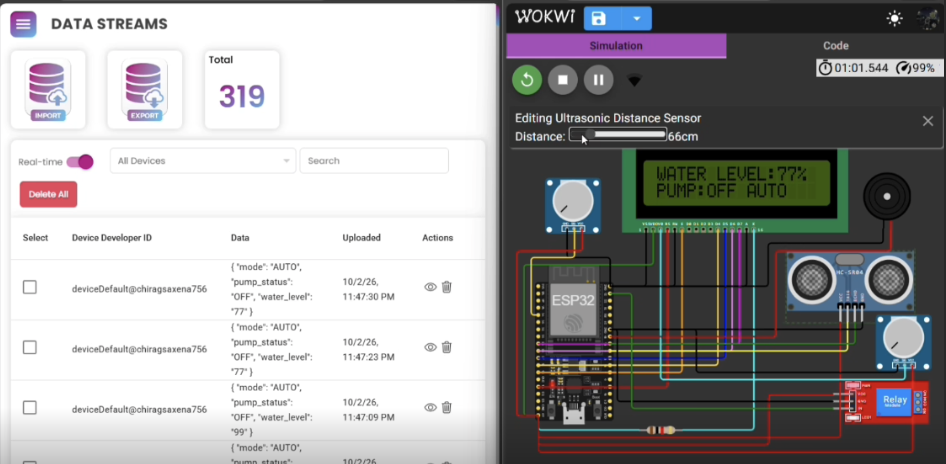
In engineering education, many projects begin and end at the prototype stage. A sensor is connected. A microcontroller processes data. A relay switches ON and OFF. The system works, and the assignment is complete.
However, occasionally, a student moves beyond functionality and begins to consider architecture, scalability, and long-term deployment.
This is the case of Chirag Saxena, a first-year Electronics and Communication Engineering student who is currently undertaking an ambitious “100 Projects Journey.” His sixth project, the AquaSence Automation System, demonstrates not only technical capability but also an evolving understanding of real-world IoT system design.
The Project Foundation: Smart Water Tank Automation
At its core, AquaSence is a smart water tank monitoring and control system built using:
- ESP32 WiFi microcontroller
- HC-SR04 ultrasonic sensor for water level detection
- 16×2 I2C LCD display
- Relay module for automatic pump control
- Buzzer for low-level alerts
- Water pump
The system implements automatic ON/OFF logic based on water-level thresholds, displays the tank status on an LCD screen, and activates audible alerts when the water reaches critical levels.
As an embedded systems project, this configuration is solid. It demonstrates understanding of sensors, signal processing, hardware interfacing, and basic control logic.
However, the real advancement came when the project evolved beyond a standalone system.
The Architectural Shift: From Local Control to Cloud-Connected IoT
Following feedback on a previous ESP32 project, Chirag upgraded the system into a cloud-connected IoT solution by integrating it with the Favoriot platform.
This transformation introduced several key capabilities:
- Real-time cloud telemetry
- Historical data logging and visualization
- Rule-based alerts and notifications
- Remote monitoring
- Multi-location scalability
With this integration, AquaSence transitioned from a single-node automation project to a scalable IoT-ready architecture aligned with industry and smart city use cases.
This shift is significant. It reflects an understanding that modern IoT systems are not defined solely by device-level control, but by how devices interact with data infrastructure, analytics layers, and remote management platforms.

Beyond the Dashboard: The Importance of System Thinking
Many student projects stop at visualisation. A working dashboard is often considered the final milestone.
In this case, the cloud integration serves a deeper purpose. By implementing telemetry pipelines, historical logging, and remote rule management, the project introduces architectural thinking.
The system can now answer broader operational questions:
- How does water usage vary over time?
- Can abnormal patterns be detected early?
- Can the same solution be replicated across multiple sites?
- What happens when devices scale from one tank to hundreds?
These questions are central to industrial IoT deployments and municipal smart infrastructure systems.
A simple water tank controller, when scaled across campuses, residential buildings, or municipal facilities, becomes part of a larger water resource management ecosystem.
Industry Relevance and Smart City Alignment
Water monitoring and automated pump control are not merely academic exercises. They are practical use cases within:
- Smart building management
- Campus infrastructure optimization
- Municipal utilities
- Industrial facility management
When extended with data analytics and remote access, such systems support:
- Operational efficiency
- Energy optimization
- Preventive maintenance
- Resource planning
By incorporating cloud connectivity and historical analytics, the project aligns with real-world IoT deployment patterns rather than remaining a classroom prototype.
What Was Done Well
Several design decisions stand out:
- Early cloud integration rather than treating connectivity as an afterthought.
- Historical data logging to enable trend analysis.
- Rule-based automation beyond basic threshold logic.
- Scalability consideration for multi-location deployment.
- Public documentation of progress, demonstrating transparency and iterative learning.
These choices indicate a shift from component-level thinking to system-level design.
Next-Level Opportunities for Technical Growth
While the project demonstrates strong architectural progression, there are several avenues for further development.
1. From Rule-Based to Predictive Intelligence
The current control logic is threshold-based. The next step would involve analyzing historical data to predict water consumption patterns.
Possible enhancements include:
- Predictive refill scheduling
- Peak and off-peak energy optimization
- Early detection of abnormal consumption
This introduces basic machine learning concepts into the IoT stack.
2. Anomaly Detection
Instead of relying solely on static thresholds, anomaly detection models could identify:
- Unusual water loss
- Pump overuse
- Sensor inconsistencies
Such capabilities significantly increase the system’s robustness.
3. Edge–Cloud Architecture Optimisation
A mature IoT system distributes intelligence strategically:
- Critical fail-safe logic remains at the edge.
- Aggregated telemetry and advanced analytics operate in the cloud.
Exploring this balance would further strengthen the system’s industrial relevance.
4. Cybersecurity Design
As IoT devices connect to cloud environments, cybersecurity becomes essential. Enhancements could include:
- Secure device authentication
- Encrypted data transmission
- Access control policies
- Firmware update mechanisms
Security-conscious design is increasingly expected in smart infrastructure deployments.
5. Deployment-Oriented Thinking
Transitioning from prototype to deployable solution requires consideration of:
- Installation simplicity
- Modular design
- Maintenance procedures
- Hardware packaging
This shift bridges the gap between academic projects and commercialisation potential.
Why Platform-Based Development Matters
Professional IoT environments rely on platforms to manage device provisioning, data ingestion, analytics, and alerting.
By integrating with Favoriot, the project exposed the student to:
- Real-time data pipelines
- Dashboard design
- Rule configuration
- Device management workflows
- Scalable cloud architecture
These are industry-relevant competencies that extend beyond microcontroller programming.
Platform familiarity is increasingly valuable for students preparing for internships, research roles, and product development careers.
A Model of Iterative Learning
Perhaps the most important aspect of this story is not the hardware configuration or the dashboard design.
It is the response to feedback.
Rather than maintaining the original project structure, Chirag applied recommendations, re-engineered the system architecture, and expanded its scope.
This iterative improvement cycle mirrors professional engineering practice:
Build
Evaluate
Refine
Scale
Students who adopt this mindset early position themselves strongly for long-term growth.
Looking Ahead
As part of a broader “100 Projects Journey,” this sixth project signals a promising trajectory.
If subsequent projects incorporate:
- Machine learning integration
- Multi-device orchestration
- Cross-domain system integration
- Advanced analytics
The cumulative portfolio will reflect not only technical proficiency but architectural maturity.
In a rapidly digitising world, the distinction between embedded engineering and IoT system design is increasingly defined by scalability, data intelligence, and infrastructure awareness.
This project demonstrates that even at the first-year level, students can begin thinking beyond isolated devices and toward connected ecosystems.
The future of IoT belongs to those who design systems, not just circuits.

![[Project Challenge #10] Smart Rock Melon Agriculture Using the Favoriot Insight Framework (FIF)](https://iotworld.co/wp-content/uploads/2026/03/Data-Driven-Rock-Melon-Framework.png)
![[Project Challenge #9] Smart Dump Site Monitoring Using Favoriot Insight Framework](https://iotworld.co/wp-content/uploads/2026/03/Intelligent-Waste-Site-Monitoring-Guide.png)
![[Project Challenge #8] Smart Pole (Intelligent Pole) for Smart Cities Using the Favoriot Insight Framework](https://iotworld.co/wp-content/uploads/2026/03/Evolution-of-Intelligent-Urban-Lighting.png)
Leave a Reply