
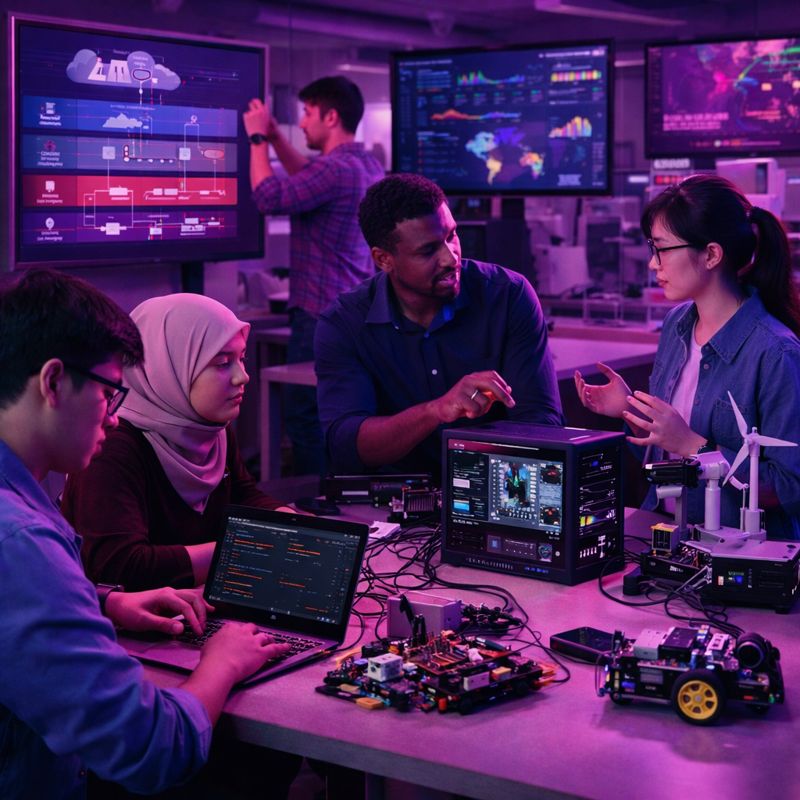
Universities across the region are proudly setting up what they call “IoT labs.” Walk into many of them, and you will see familiar sights. Arduino boards. ESP32 kits. LEDs blinking on cue. LCD screens showing temperature values.
These labs are not wrong.
But they are incomplete.
Most institutions are still teaching embedded systems, not the Internet of Things. And while embedded knowledge is essential, it is no longer sufficient to prepare students for how connected systems are built, deployed, secured, and trusted in the real world.
If universities want to produce graduates who can design systems people rely on, not just pass final-year projects, IoT labs must evolve.
Embedded Systems Are the Foundation, Not the Destination
Embedded systems teach students how to interact with hardware. Sensors, controllers, actuators, and firmware logic. These skills remain critical and should not be removed from any curriculum.
Traditionally, embedded systems operate as standalone devices. They log data locally. Someone retrieves that data manually. Processing happens later, offline.
This model made sense when connectivity was limited.
Today, it no longer reflects reality.
When connectivity exists, and in most places it does, systems should send data automatically. They should be monitored remotely. Their health should be visible. Failures should be detected early, not after complaints arrive.
This shift from standalone devices to connected systems is the defining difference between embedded systems and IoT.
A Real IoT Lab Teaches Systems Thinking

IoT is not a single technology. It is a system of systems.
A proper IoT lab must expose students to multiple layers of technology working together. Not as theory slides, but through hands-on design, deployment, and troubleshooting.
At a minimum, students should experience:
- Hardware and firmware, where devices sense and act
- Connectivity and protocols, where data moves across networks
- Platforms and middleware, where devices are managed, and data is processed
- Analytics and visualisation, where meaning is extracted
- Security is embedded across every layer
When one layer fails, students must know where to look.
Is the device offline?
Is the network unstable?
Is authentication failing?
Is data reaching the platform but not the dashboard?
Without this layered understanding, graduates struggle when systems behave unpredictably. And real systems always do.
Dashboards Are a Starting Point, Not the Outcome
Dashboards are attractive. They work well during demonstrations. They give quick visibility.
But they are not the goal of IoT.
The real value lies in understanding what happens behind the screen. How data flows. How delays occur. Why alerts fail. Why do devices stop reporting quietly at 3 a.m?
IoT education should prepare students for responsibility, not just presentation.
This is also where mature platforms such as FAVORIOT play an important role in education. Not as shortcuts, but as enablers that allow students to focus on architecture, data behaviour, and operational thinking rather than repeatedly rebuilding basic infrastructure.
From IoT Labs to AIoT Labs
Universities are not only training centres. They are research engines.
Meaningful research requires continuous, reliable data. IoT labs make this possible by enabling long-term data collection across real environments.
Once the data is available, students and researchers can apply machine learning techniques. Patterns become visible. Predictions become credible. Decisions become data-informed.
The next step is already here.
Edge computing and edge AI enable inference to occur near where data is generated. Latency is reduced. Bandwidth is conserved. Systems respond faster.
This is how IoT labs naturally grow into AIoT labs.
What Must Change Now
If universities want their graduates to thrive in connected industries, several shifts are needed.
IoT labs must move beyond isolated experiments and focus on teaching end-to-end systems.
Curricula must include connectivity, platforms, and security as core components.
Industry collaboration should shape lab design so students work with realistic architectures.
Assessment should reward understanding, troubleshooting, and resilience, not just working demos.
This is not about adding more tools.
It is about teaching better thinking.
A Call to Action
To university leaders: review your labs honestly. Do they reflect how systems operate outside campus?
To lecturers: ask which technology layers your students never get to touch.
To policymakers: ensure national talent strategies match the realities of connected infrastructure and AI-driven systems.
To students: challenge yourself. Learn how systems behave when they fail, not only when they work.
IoT education must mature if we want resilient, capable builders for the future.
If you are involved in teaching, designing, or using IoT labs, share your experience. What works today? What is missing? What needs to change?
The conversation matters. The future depends on it.


Leave a Reply