
Many people assume IoT is like WiFi. If it’s “IoT”, it should just connect. But the reality is messier.
Not all IoT devices can connect to any IoT platform. Here’s why.

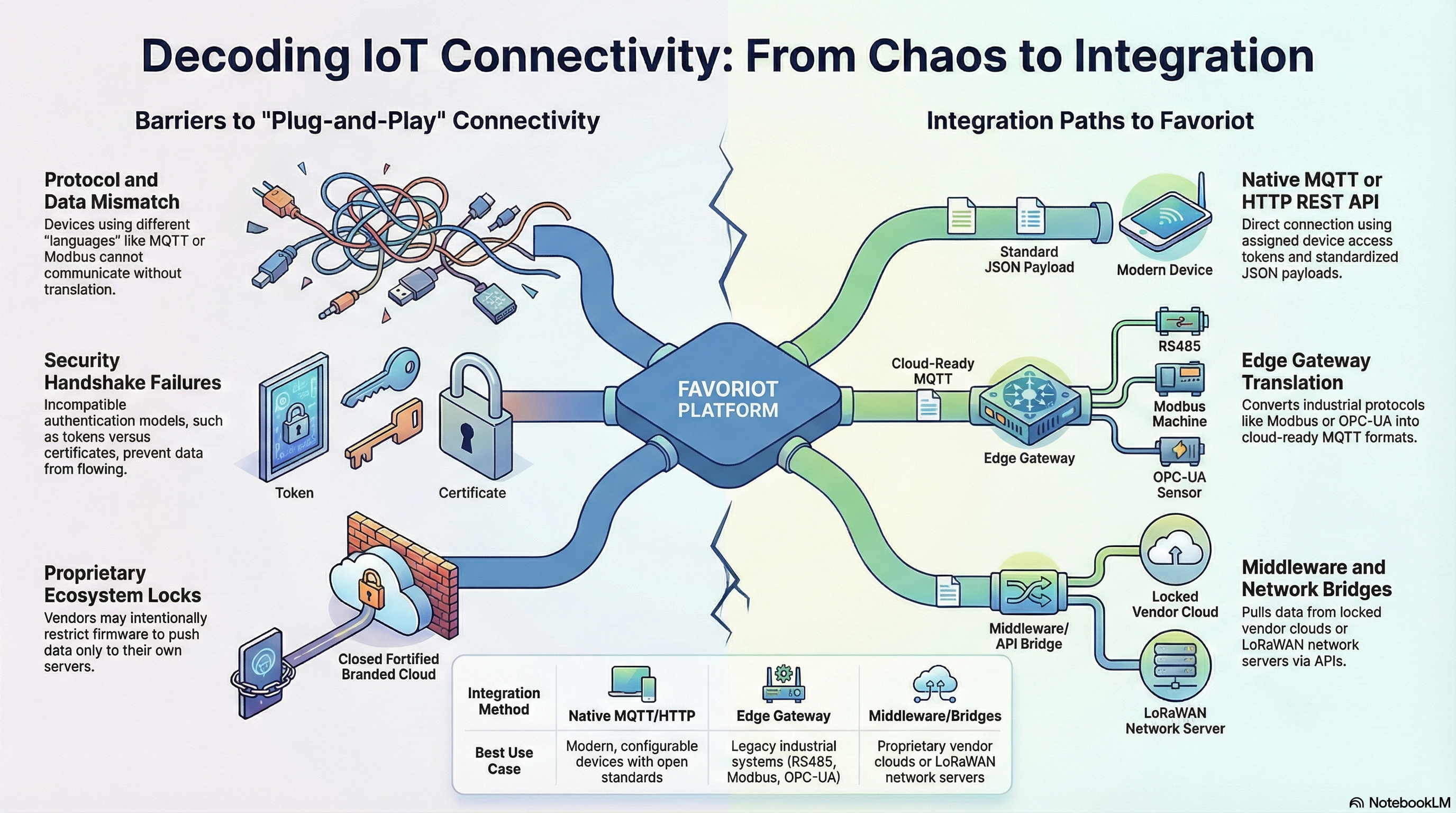
First, protocol mismatch.
Some devices speak MQTT. Others use HTTP. Some industrial devices use Modbus, OPC-UA, CoAP, or even proprietary binary protocols. If the platform does not support that protocol, they simply cannot “understand” each other.
Second, data format differences.
Even if two systems both use MQTT, the payload structure can be totally different. One device may send JSON. Another may send raw hexadecimal. Some embed metadata differently. The platform needs to know how to parse and map that data.
Third, authentication and security models.
Some devices use token-based authentication. Others use certificates. Some require TLS mutual authentication. If the security handshake is incompatible, the connection fails before data even flows.
Fourth, connectivity constraints.
Certain devices rely on LoRaWAN, NB-IoT, Sigfox, or private LTE. The data may go through a network server before reaching the application layer. Without proper integration between that network layer and the platform, the data gets “stuck” in between.
Fifth, proprietary ecosystems.
Some vendors intentionally lock devices into their own cloud. The firmware only pushes data to their server. No option to change endpoint. That is not a technical limitation. That is a business model decision.
Now the important part. How do we ensure devices can connect?
- Choose open standards from the beginning
Select devices that support open protocols such as MQTT or HTTP with configurable endpoints. Avoid devices that only talk to a fixed cloud server. - Check configurable parameters
Ensure the device firmware allows:
• Custom server URL
• Custom port
• Username and password or token
• Topic configuration for MQTT
Without this flexibility, integration becomes painful. - Standardise your data model
Define a clear JSON structure for your project. Map every sensor reading into a consistent format. This avoids chaos when scaling across hundreds of devices. - Use a gateway when necessary
If the device uses Modbus, RS-485, or OPC UA, you can place an edge gateway between the device and the network. The gateway translates industrial protocols into MQTT or HTTP before sending to the cloud.
Now specifically for connecting to Favoriot.
Favoriot supports MQTT and HTTP ingestion. So the easiest path is:
Option 1: Native MQTT connection
Configure the device to publish to the Favoriot broker with:
• Assigned device access token
• Proper topic format
• JSON payload
Option 2: HTTP REST API
Device pushes data via HTTP POST using API key. Useful for microcontrollers or simple firmware.
Option 3: Edge Gateway Integration (Refer to this documentation)
For industrial or legacy systems:
• Collect data via Modbus or OPC-UA
• Convert to JSON
• Publish to Favoriot using MQTT
Option 4: Network Server Integration
If using LoRaWAN:
• Integrate LoRa network server with Favoriot webhook or MQTT bridge
• Map uplink payload into readable fields
Option 5: Middleware Layer
If the device is locked into a vendor cloud:
• Use their API to pull data
• Build a middleware service
• Push cleaned data into Favoriot
This is the reality of IoT. It is not plug-and-play like USB. It is a system architecture.
The key lesson is this:
Before buying devices, design the architecture first. Define protocols. Define data models. Define ownership of endpoints.
If we treat IoT as just hardware, we will struggle.
If we treat IoT as an end-to-end system, integration becomes manageable.
If you want, we can walk through a specific device type you’re dealing with and map the exact integration path into Favoriot step by step.

FAVORIOT Resources
- General
- Pricing
- How to Choose the Right Favoriot Plan for Your IoT Project
- Favoriot Ecosystem Plan
- Why Universities Need an IoT Ecosystem, Not Fragmented IoT Accounts
- When IoT Builders Outgrow Dashboards: Why the Favoriot Platform Developer Plan Exists
- Favoriot Launches Lite Plan to Support Students, Beginners, and Early IoT Builders
- Faybee AI – IoT Copilot
- Favoriot Intelligence
- Favoriot Insight Framework
- What is Favoriot Insight Framework (FIF)?
- Favoriot Machine Learning
- Why Favoriot’s ML Infrastructure Reduces Costs
- Why Favoriot’s Built-in Machine Learning Matters for AI Researchers and IoT Developers
- Favoriot’s Rule Engine 2.0: A Structured Approach to IoT Automation
- The Key Differences: Favoriot’s Rule Engine 2.0 and AI Agents
- IoT & AIoT Labs
- Trainings
- Favoriot Partner Network
- Videos (Playlist & Highlights)
- How-To Use Favoriot Platform Playlist
- Favoriot IoT World Playlist
- IoT Deep Dive Playlist
- Favoriot Sembang Santai Playlist
- IoT Deep Dive – Episode 7 (FAVORIOT Insight Framework)
- IoT Deep Dive – Episode 4 (Favoriot Partner Network Solves IoT Fragmentation)
- IoT Deep Dive – Episode 5 (Building IoT Solutions With Favoriot Middleware)
- Favoriot IoT World – Episode 3 (Unboxing the AIoT Lab)
- Favoriot IoT World – Episode 6 (Favoriot AIoT Architecture – Data to Decision)
- Favoriot IoT World – Episode 4 (Favoriot’s IoT Pricing)
- FULL FAVORIOT RESOURCES
- Others



![[Project Challenge #15] Smart Shopping Behaviour Analytics Using the Favoriot Insight Framework (FIF)](https://iotworld.co/wp-content/uploads/2026/03/Project-Challenge-15-Decoding-Precinct-Shopping-Movement-Patterns.png)
Leave a Reply