
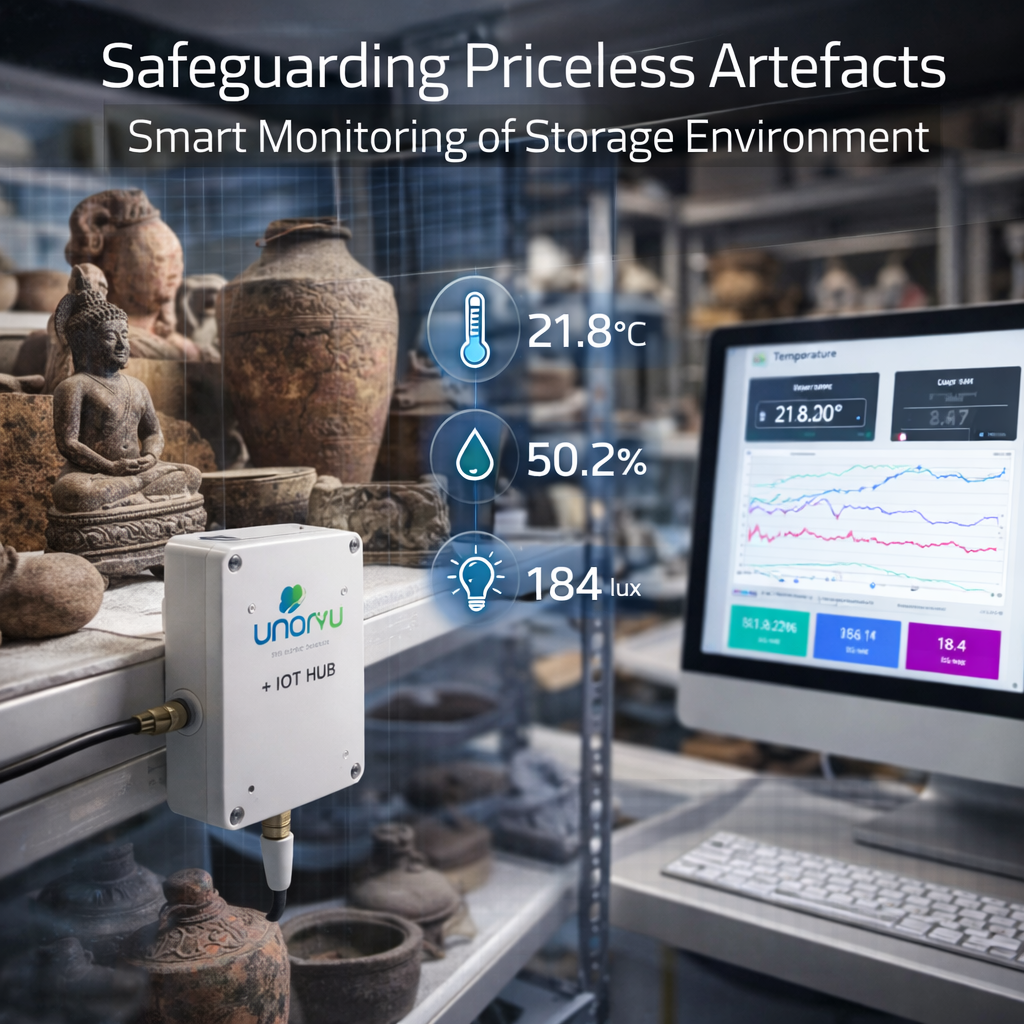
Preserving Heritage Requires Precision, Not Assumptions
Museums are entrusted with preserving artefacts that embody a nation’s identity and history. While public exhibitions often draw attention, the true responsibility lies behind the scenes, particularly within storage rooms where the most fragile and valuable artefacts are kept.
In these controlled environments, preservation is not a periodic task. It requires continuous management of temperature, humidity, and light conditions. Even slight deviations, if left unchecked, can gradually lead to irreversible deterioration.
Maintaining these environmental conditions in accordance with internationally recognised standards is critical. It is not only about preservation, but also about ensuring compliance, accountability, and long-term integrity of national collections.
This is where digital monitoring plays a crucial role.

The Limitations of Traditional Practices
Conventional preservation methods rely on scheduled inspections and manual data recording. While widely practised, these approaches introduce gaps that can compromise artefact safety.
Environmental changes may occur between inspection intervals. Minor fluctuations can go undetected until damage has already begun. In addition, manual processes can lead to inconsistent records and limited traceability.
For high-value artefacts stored under strict environmental requirements, these limitations present a significant operational risk.
A Focused Strategy for High-Value Environments
Favoriot collaborated with a national museum to address this challenge through a targeted and outcome-driven approach.
Rather than implementing a broad monitoring system across all areas, the solution focused specifically on storage rooms where precious and priceless artefacts are preserved. These environments demand the highest level of control and consistency.
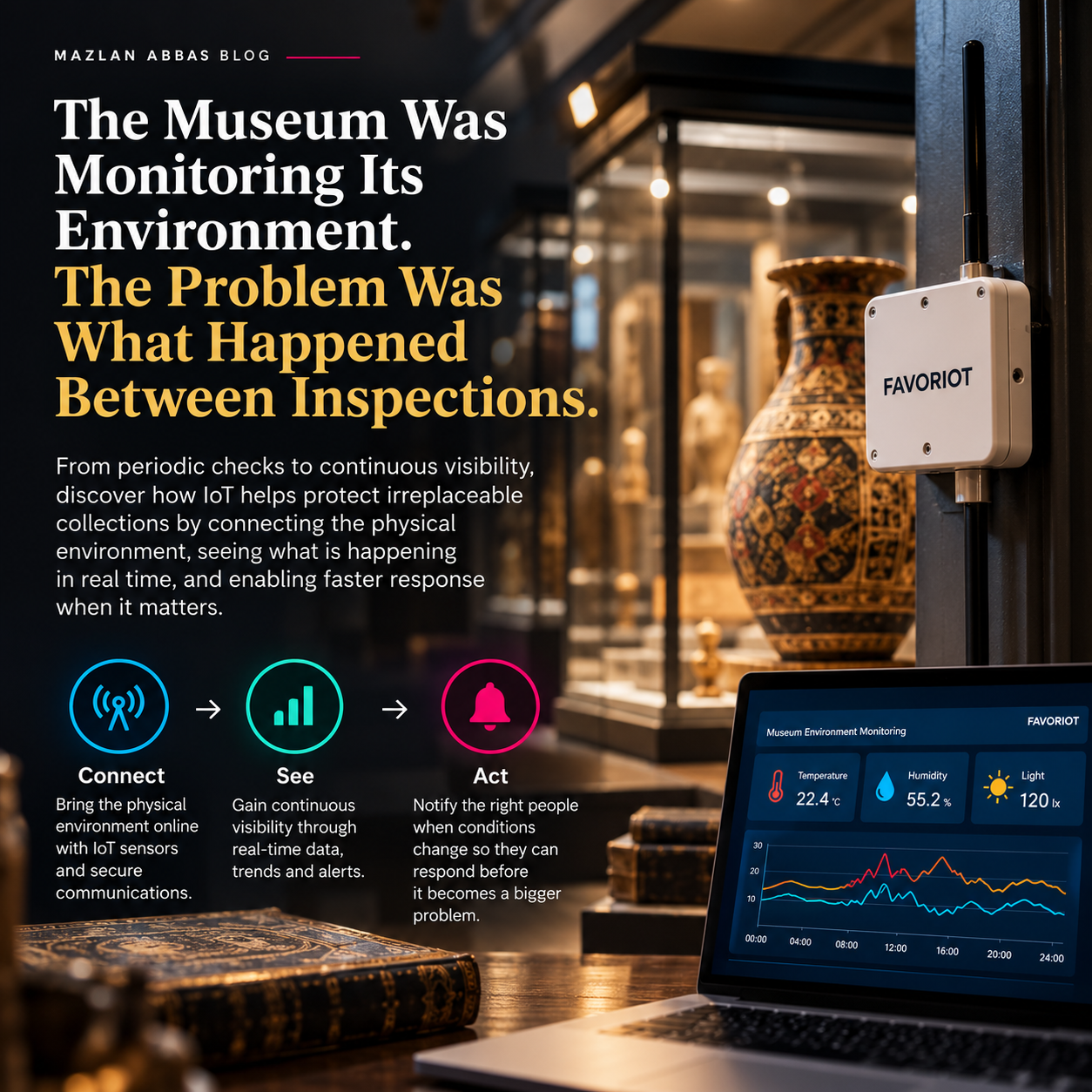
Environmental sensors were deployed within these storage areas to continuously monitor:
- Temperature
- Humidity
- Light intensity
All data is transmitted in real time to the Favoriot platform for processing and analysis.
Enabling Immediate and Informed Action
The true value of the system lies in its ability to move beyond monitoring into actionable intelligence.
The Favoriot platform continuously evaluates incoming data against predefined thresholds aligned with international preservation standards. When conditions deviate from acceptable ranges, alerts are triggered automatically and delivered to responsible personnel.
This ensures that corrective actions can be taken immediately, reducing the risk of prolonged exposure to harmful conditions.
The result is a shift from passive observation to active protection.
Measurable Operational Benefits
The deployment has delivered tangible improvements in the museum’s preservation practices:
Continuous Environmental Control
Storage conditions are monitored at all times, ensuring artefacts remain within optimal preservation ranges.
Rapid Response Capability
Real-time alerts significantly reduce response time to environmental changes.
Structured and Reliable Data
Consistent data collection supports trend analysis and informed decision-making.
Compliance with International Standards
Accurate and traceable records provide clear evidence of adherence to recognised environmental guidelines.
Enhanced Operational Efficiency
Automation reduces reliance on manual inspections, allowing staff to focus on conservation and curation.
Strengthening Institutional Confidence
Beyond operational improvements, the system reinforces institutional credibility.
Museums must demonstrate that artefacts are preserved according to strict standards. Continuous monitoring and comprehensive data records provide the necessary assurance to regulators, stakeholders, and the public.
This strengthens trust and reinforces the institution’s commitment to safeguarding national heritage.
IoT as an Enabler of Long-Term Preservation
This case reflects a broader shift in the application of IoT.
The value of IoT is no longer limited to connectivity or visualisation. Its true impact lies in enabling informed decisions, ensuring compliance, and protecting critical assets.
In environments where conditions must align with international standards, IoT becomes an essential layer of assurance.
The Favoriot Approach
Favoriot’s role in this deployment is guided by a clear focus on outcomes.
The solution is designed to:
- Provide continuous monitoring
- Detect deviations in real time
- Enable immediate intervention
- Support compliance through reliable and structured data
By aligning technology with operational needs, Favoriot delivers solutions that are both practical and impactful.
Moving Forward
As cultural institutions continue to expand their collections and face increasing regulatory expectations, the need for continuous environmental monitoring will become more critical.
The question is no longer whether such systems are necessary, but how quickly they can be implemented to ensure compliance and protect what cannot be replaced.
Take the Next Step
If your organisation manages environments that require strict control of temperature, humidity, and light in line with international standards, it is time to move from periodic monitoring to continuous assurance.
Contact Favoriot to explore how an AIoT-driven approach can help you build reliable, compliant, and scalable environmental monitoring solutions.



Leave a Reply