
I want to ask you something uncomfortable.
How many dashboards are running in your organisation right now? Five? Twenty? More than you can count?
And here is the follow-up question — when was the last time one of those dashboards actually made a decision for you?
I have been in the IoT space for decades. I have sat in boardrooms, demo halls, and operations centres across the region. And almost every time, someone proudly pulls up a screen full of charts, gauges, and blinking numbers and says: “Look. We are now data-driven.”
I always smile. But inside, I am thinking — no. You are dashboard-driven. That is not the same thing.
The Illusion of Insight
Here is what typically happens. An organisation deploys sensors. Data flows into a platform. Someone builds a beautiful dashboard. The CEO sees it. The board is impressed. The project is declared a success.
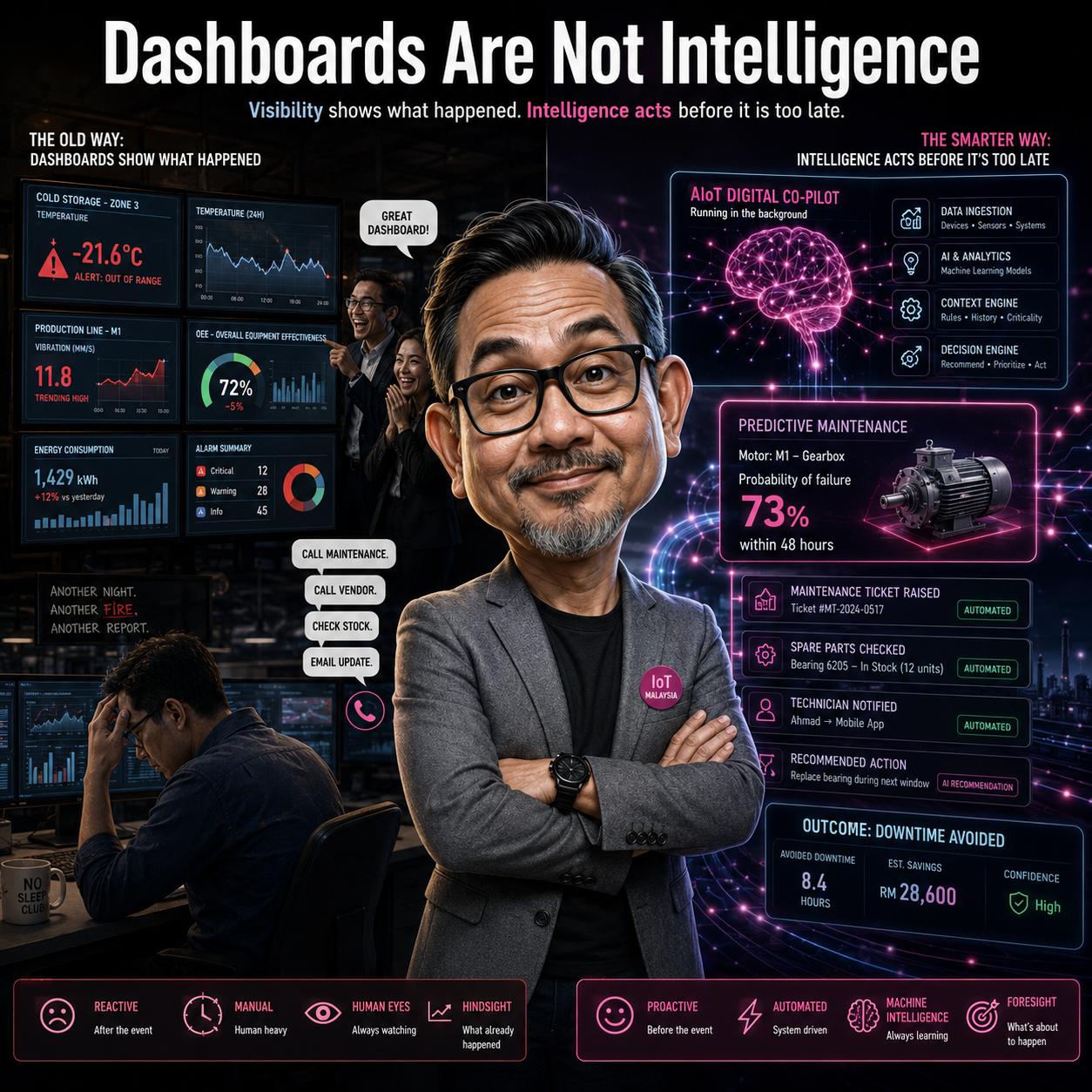
But who is watching that dashboard at 2am when a temperature sensor in a cold storage room crosses a critical threshold? Who sees the pattern when three machines in a production line start trending towards failure — not today, not tomorrow, but in eleven days?
Nobody. Because dashboards require human eyes. And human eyes sleep, get distracted, miss patterns, and above all — they react. They do not predict.
A dashboard shows you what happened. Intelligence tells you what is about to happen — and what to do about it.
I Learned This the Hard Way
In the early days of building FAVORIOT, we were obsessed with visualisation. We wanted the most beautiful, most customisable dashboards. And we built them. Our clients loved them.
Then we started asking a harder question: after the client sees the dashboard, then what?
We watched how operators actually used these systems. They would stare at the screen. They would notice something. They would call someone. That someone would go check. And by the time they confirmed the problem, the damage was already done — energy wasted, equipment degraded, SLA missed.
The dashboard told them the truth. But it told them too late, and it expected too much of them.
That is when I realised that data without action is just noise with a pretty face.
What Intelligence Actually Looks Like
Real intelligence in an IoT system does not sit on a screen waiting to be read. It runs continuously in the background, watching everything, learning patterns, and acting — or at minimum, alerting the right person at the right time with the right context.
It looks like this: instead of a gauge showing temperature is at 78°C, an intelligent system says — “Based on the rate of change over the past six hours and historical failure data, this unit has a 73% probability of failing within 48 hours. Maintenance ticket has been raised. Spare parts inventory checked. Technician notified.”
That is not a dashboard. That is a co-pilot.
And this is where AIoT — the convergence of Artificial Intelligence and the Internet of Things — stops being a buzzword and starts being genuinely transformative.
The Dangerous Comfort of Visibility
I think the reason dashboards became so dominant is because they feel intelligent. They feel like progress. The blinking lights, the live graphs, the colour-coded alerts — it all gives decision-makers a sense of control.
But visibility is not control. Knowing your blood pressure is 160/100 does not fix your blood pressure. The insight has to trigger an action. And in most IoT deployments today, that gap between insight and action is still filled by human beings who are already overloaded.
We are using twenty-first century sensors and nineteenth century decision-making processes.
What Needs to Change
I am not saying kill the dashboard. Dashboards have their place — for oversight, for executive reporting, for understanding historical trends. But they should be the last layer, not the primary intelligence layer.
What needs to come first is this:
Rules-based alerting that removes the burden from human eyes. Predictive analytics that surfaces patterns before they become problems. Automated workflows that close the loop between insight and action. And increasingly, AI agents that can reason across multiple data sources and make recommendations — or take actions — without waiting for someone to notice a colour change on a chart.
The goal of an IoT system is not to make data visible. The goal is to make operations smarter. Those are two very different ambitions.
A Question Worth Sitting With
So let me end with this.
If your dashboards disappeared tomorrow — if every screen went dark — how long would it take before something in your operations actually broke?
If the answer is “a few hours” or “a day or two,” then your dashboards are not intelligence. They are a crutch. And the moment you lose visibility, you lose control.
The organisations that will lead in the next decade are not the ones with the most beautiful dashboards. They are the ones who have embedded intelligence so deeply into their operations that the system acts before any human has to look at a screen.
That is the shift I am pushing for. That is what IoT should have been all along.
Are you still managing your operations through dashboards — or have you moved to something smarter? I would genuinely love to hear where you are in this journey.

Leave a Reply