
An Analyst Perspective on a Recurring Strategic Misstep in IoT Adoption
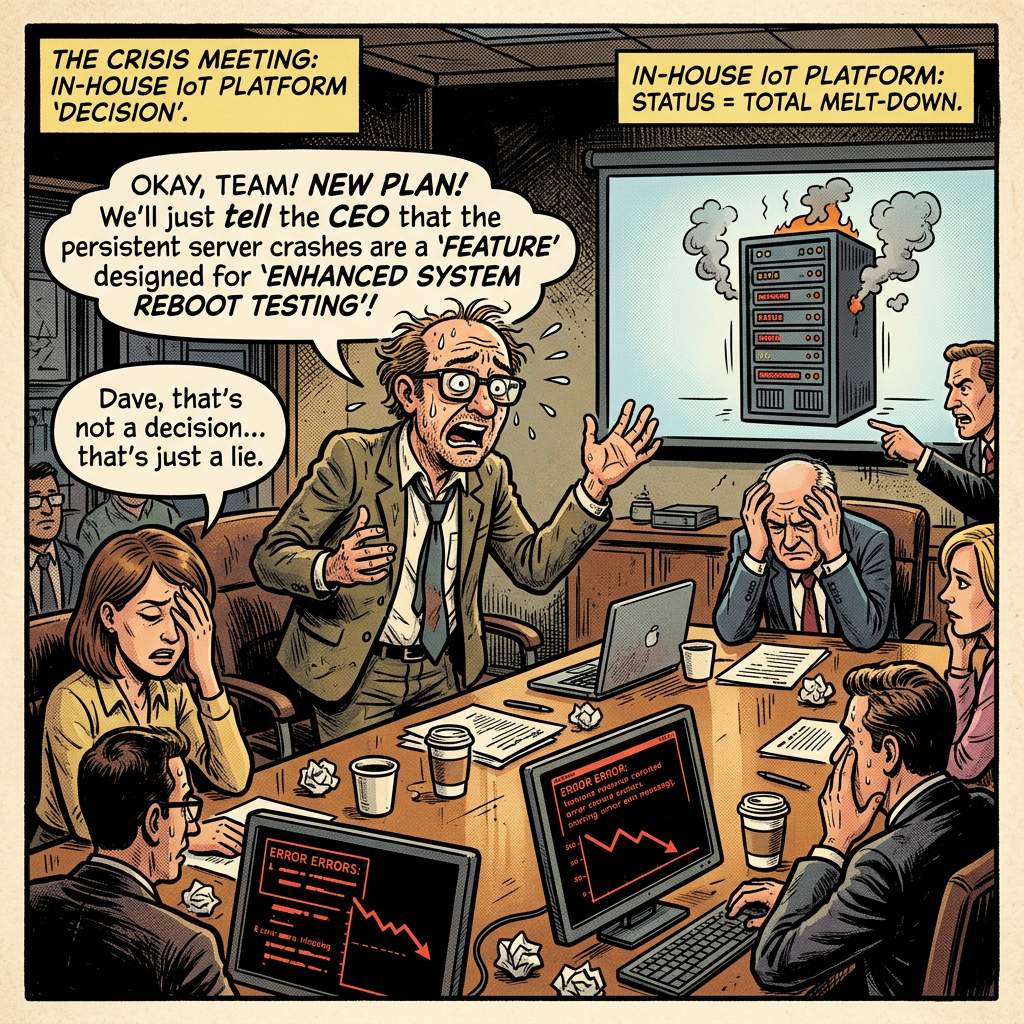
Despite the growing maturity of the commercial IoT platform market, a significant number of organisations continue to pursue the development of proprietary in-house IoT platforms.
The reasoning is often grounded in perceived strategic advantages: greater control, long-term cost ownership, and technical customisation aligned to specific operational requirements.
In practice, however, the decision to build rather than adopt frequently produces the opposite outcome. It introduces compounding costs, extended timelines, and resource misallocation that collectively delay or diminish the very business value the IoT initiative was designed to create.
This article examines why this pattern persists, what drives it, and why the case for leveraging established commercial platforms such as FAVORIOT has become increasingly difficult to dismiss.
A Recurring Pattern Across Industries
Across manufacturing, utilities, logistics, healthcare, and smart infrastructure, the same trajectory is observed repeatedly.
An organisation identifies a clear operational problem such as unplanned equipment downtime, inefficient energy consumption, or limited asset visibility, and determines that IoT is the appropriate solution.
What follows, however, is a decision that shifts the focus away from the problem entirely. The organisation elects to build its own IoT platform before deploying any solution.
Engineering teams are assembled. Architecture is designed. Protocols are evaluated. Months pass.
In many documented cases, 12 to 24 months elapse before a functional system is ready for deployment. And even then, the original operational challenge remains unaddressed.
The platform becomes the project. The business problem becomes secondary.
Why Organisations Choose to Build
Understanding why this decision continues to be made is as important as understanding why it is flawed. Several recurring motivations emerge across organisations that pursue in-house platform development.
The desire for control is the most frequently cited driver. Technology leaders express concern about dependency on external vendors, including fear of pricing changes, feature limitations, or service discontinuation. Building internally appears to eliminate this dependency and provide full visibility over the system.
The assumption of uniqueness is equally common. Many organisations believe their operational environment is sufficiently distinct that existing platforms cannot adequately serve their needs. This assumption is rarely validated against actual platform capabilities before the build decision is finalised.
The underestimation of complexity compounds both of the above. Decision-makers who lack direct experience in IoT platform development frequently underestimate the scope of what a production-grade platform requires. This applies not just to initial development, but to ongoing maintenance, security management, and protocol compatibility.
Institutional risk aversion also plays a role. Building internally is perceived as the more defensible decision in governance and procurement contexts. If a project fails, the organisation retains the assets it built. This perception does not account for the opportunity cost of what was not achieved during the development period.
The Real Costs of Building From Scratch
The financial and operational implications of in-house platform development extend well beyond initial engineering budgets.
Development scope is consistently underestimated. A production-ready IoT platform must address device connectivity across multiple protocols, real-time data ingestion, storage architecture, API management, security implementation, and user-facing tools for monitoring and analytics. Each of these components requires dedicated expertise and sustained engineering effort.
Talent costs are structural, not one-time. Maintaining an IoT platform requires a permanent team with competencies in cloud infrastructure, embedded systems, cybersecurity, and data engineering. These profiles are scarce and carry significant salary premiums. Organisations frequently discover that the ongoing staffing cost exceeds the initial development investment.
The opportunity cost is rarely accounted for. Every month spent building infrastructure is a month in which operational performance remains unchanged. In competitive sectors, this delay translates directly into lost efficiency, undetected failures, and deferred decision-making capability. These costs do not appear in engineering budgets but are nonetheless real and measurable.
Security and compliance exposure increases proportionally with complexity. IoT environments involve multiple attack surfaces including device firmware, network connectivity, cloud infrastructure, and data pipelines. Organisations building proprietary platforms assume full responsibility for securing each layer, often without the specialised expertise required to do so consistently.
What Organisations Are Actually Building
A critical observation in this area is that the majority of in-house IoT platforms replicate capabilities that are already available, tested, and continuously maintained in commercial platforms.
Device management, data ingestion, real-time dashboards, alerting, API integration, and multi-protocol connectivity are not differentiating capabilities. They are infrastructure.
Building them from scratch does not create competitive advantage. It creates a maintenance burden.
The genuine sources of competitive differentiation in IoT lie elsewhere: in the operational logic applied to data, in the decision-making frameworks built on top of insights, and in the domain-specific integrations that connect IoT outputs to business processes. These are the areas where internal engineering effort creates lasting value.
Organisations that build their own platforms typically delay their arrival at this higher-value layer by 12 to 24 months. This is precisely the period during which competitors who adopted commercial platforms have already progressed through initial deployment, iteration, and scale.
The Commercial Platform Advantage
Established IoT platforms such as FAVORIOT exist because the foundational challenges of IoT infrastructure have already been solved, and solved at scale.
These platforms offer organisations the ability to reduce deployment timelines from months to weeks, access proven security architecture, benefit from continuous protocol support and platform updates, and direct internal resources toward use-case development and business outcome realisation rather than infrastructure management.
Critically, the adoption of a commercial platform does not require the surrender of control that many organisations fear. Control over data, business logic, integration design, and operational workflows remains entirely with the adopting organisation.
What is relinquished is the burden of maintaining the infrastructure layer, a burden that carries no strategic return.
A Question of Strategic Clarity
The decision to build an in-house IoT platform is rarely framed correctly at the outset. It is typically positioned as a question of technical architecture, when it is more accurately a question of strategic priority.
The more precise framing is this: should the organisation invest its resources in building and maintaining infrastructure, or in deploying solutions that address the operational problems driving the IoT initiative in the first place?
Organisations that have accelerated their IoT adoption most effectively have consistently answered this question in favour of deployment and outcome realisation.
They leverage established platforms to compress timelines, reduce risk, and generate measurable value. They then scale from a position of validated learning rather than unvalidated infrastructure.
Conclusion
The persistence of in-house IoT platform development, despite the availability of mature commercial alternatives, reflects a set of perceptions about control, uniqueness, and risk that do not withstand scrutiny when measured against actual outcomes.
The evidence across industries is consistent. Organisations that adopt proven platforms deploy faster, realise value earlier, and allocate their engineering talent to higher-impact activities. Those that choose to build typically spend the first two years solving problems that have already been solved.
For decision-makers approaching this choice, the central question remains straightforward: is the objective to build a platform, or to solve a business problem?
The answer to that question should determine the path forward.
FAVORIOT is a commercially available IoT platform designed to accelerate deployment, reduce infrastructure complexity, and enable organisations to focus on operational outcomes. Learn more at favoriot.com.



Leave a Reply