
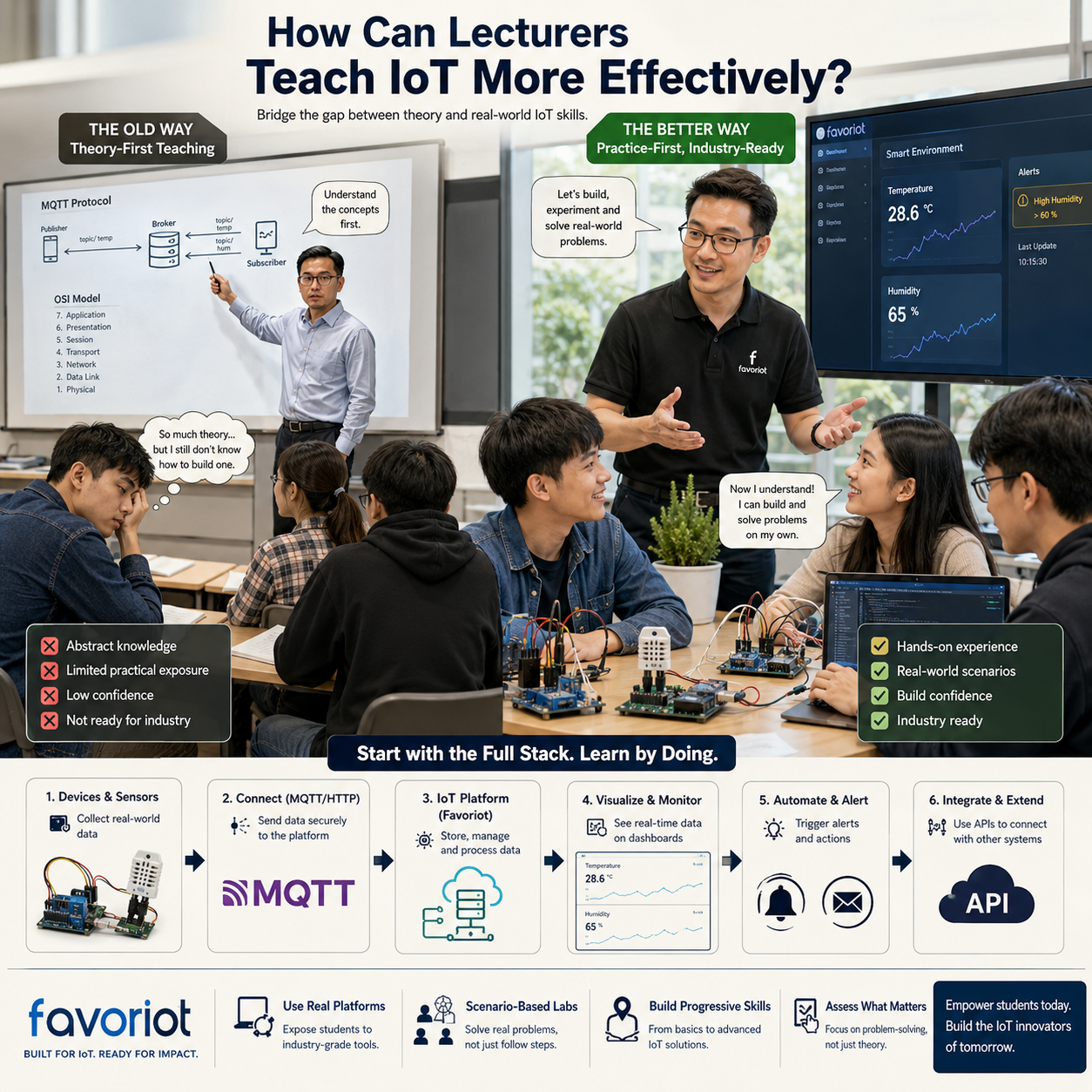
What if the biggest barrier to IoT education is not the technology itself, but the way it is being taught?
Walk into many university classrooms across Southeast Asia and what you will often find is a familiar scene. A lecturer stands at the front of the room, slides loaded with protocol diagrams, sensor specifications, and network architecture charts. Students copy the notes. The semester ends. There is a lab session or two. A project is submitted. Then it is over.
The students leave knowing what IoT is. But very few of them know how to actually build one.
This gap between knowing and doing is one of the most important challenges facing IoT education today. And closing that gap requires lecturers to rethink not just what they teach, but how they teach it.
The Problem with Theory-First Teaching
IoT is not a subject that responds well to a theory-first approach.
It is a discipline built on physical hardware, real connectivity, live data, and actual systems that either work or they do not. A student can memorise the OSI model, understand MQTT at a conceptual level, and explain the difference between edge computing and cloud computing in an exam. But without ever connecting a sensor, publishing data to a broker, or visualising a reading on a dashboard, that knowledge remains abstract.
Abstract knowledge does not build confidence. And without confidence, students are not ready for industry.
The IoT workforce does not need graduates who can describe what a temperature sensor does. It needs graduates who have already used one, debugged one, integrated it into a larger system, and understood what happens when the data is noisy or the connection drops.
That is a very different kind of readiness. And it only comes from practice.
What Industry Actually Expects
Before a lecturer can teach IoT more effectively, it helps to understand what industry actually expects from fresh graduates in this space.
Companies deploying IoT systems are not looking for theorists. They are looking for people who can configure devices, connect them to a platform, interpret data streams, and troubleshoot when something does not behave as expected. They are looking for people who understand how a real system is structured, from the device layer all the way up to the application layer.
They are also looking for people who understand constraints. Real deployments have limited power budgets, unreliable networks, security vulnerabilities, device failure scenarios, and user experience requirements. A graduate who has only been exposed to ideal conditions in a controlled classroom is not prepared for that reality.
The gap between what universities produce and what industry needs has been observed and discussed for years. The solution does not lie in more lectures. It lies in more structured, practical experience that mirrors the real conditions of IoT deployment.
Start with a Platform, Not a Protocol
One of the most practical decisions a lecturer can make is to choose a structured IoT platform before deciding what to teach.
Many lecturers begin with the hardware. They teach Arduino or ESP32 first, explain how sensors work, introduce the concept of microcontrollers, and eventually move toward connectivity and cloud. The intention is sound. But the journey is often long, fragmented, and confusing for students.
A better approach is to introduce the full stack early. Show students where data goes before explaining in detail how it gets there. Let them see a device publishing data, a platform receiving it, a dashboard displaying it, and a rule engine triggering an action. Give them that full picture in week one or week two.
Then go deeper.
When students see the complete system first, the individual components begin to make more sense. They understand why a protocol matters because they can see where it fits. They understand why data formatting is important because they can see what happens when it is wrong. They understand why security is critical because they can see how exposed an unprotected endpoint is.
Platforms like Favoriot were designed specifically for this purpose. They give students access to device management, data streaming, dashboard creation, rule-based alerts, and API integration in a single environment. Lecturers do not need to stitch together six different services to deliver a meaningful lab session. The infrastructure is already there.
Structure the Labs Around Real Scenarios

A lab session that asks students to blink an LED is a starting point, not a destination.
Effective IoT labs are structured around real-world scenarios. A student should not just be connecting a humidity sensor to read a value. A student should be asked to build a simple indoor comfort monitoring system, where the sensor data is published to a cloud platform, the dashboard shows historical trends, and an alert is sent when the humidity exceeds a defined threshold.
That scenario has a beginning, a middle, and an end. It has a purpose. It mirrors what happens in an actual building management deployment. It teaches multiple skills in a single session: hardware connection, firmware programming, MQTT or REST API communication, platform configuration, and data visualisation.
When labs are scenario-driven, students stop thinking about individual components in isolation. They start thinking like system builders. That is a critical shift.
Lecturers can build a progression of scenarios across the semester. Week three might focus on a single-sensor monitoring system. Week six might introduce multi-sensor integration. Week nine might add a rule engine and alert mechanism. Week twelve might challenge students to design a small-scale smart environment with defined objectives and measurable outcomes.
Each scenario builds on the last. Each session adds a new layer of complexity. By the end of the semester, the student has not just completed a set of labs. They have built a system, piece by piece.
Projects Should Be Designed to Continue
Perhaps the most underused principle in IoT education is continuity.
Most IoT projects are treated as standalone work. A student receives a project brief, builds a system for one semester, presents it, and moves on. The next batch starts from zero.
This approach wastes an enormous amount of accumulated knowledge. Every semester, students solve problems, discover workarounds, document edge cases, and build something with genuine effort. When that work disappears after the viva, nothing grows.
Lecturers can change this by designing projects that are built to continue. A Smart Campus project, for example, can be structured as a long-running initiative where every batch contributes a new module. One batch builds the energy monitoring system. The next batch adds occupancy sensing. The next adds air quality monitoring. The next improves the dashboard. The next builds predictive alerts using historical data.
Each student still has a clear individual scope. Each student can still be assessed fairly. But the system grows over time. The data becomes richer. The documentation becomes more complete. Students in later batches can actually study what earlier batches built, what worked, what failed, and why.
That is not just a project. That is an education in how real IoT systems evolve.
Assessment Must Reflect Real Competence
If a lecturer wants to teach IoT more effectively, the assessment design must also change.
A written exam can test theoretical knowledge. But it cannot test whether a student knows how to structure a device hierarchy, configure a data stream, build a meaningful dashboard, or respond to a failing sensor in real time.
Assessment for IoT courses should include components that directly measure hands-on competence. A working prototype evaluated on functionality, not just aesthetics. A system demonstration assessed on resilience, not just the best-case scenario. A technical report evaluated on the quality of documentation, not just the length.
Some lecturers have begun incorporating peer review, where students evaluate each other’s system documentation and flag gaps. Others include live debugging sessions as part of the assessment, where students are asked to identify and resolve an injected fault in their own system. These approaches push students to genuinely understand their work, not just deliver it.
The Role of the Lecturer Must Evolve
A lecturer teaching IoT effectively in 2026 and beyond cannot simply deliver slides prepared five years ago.
IoT is moving quickly. New protocols are emerging. Platform capabilities are expanding. Industry use cases are evolving. A lecturer who is not regularly engaging with the practical side of IoT, whether through research, industry collaboration, or hands-on experimentation with available platforms, will struggle to keep the curriculum relevant.
The good news is that resources are increasingly available. Platforms like Favoriot Academy provide structured lab guides, project frameworks, certification pathways, and community support specifically designed for lecturers and institutions. The infrastructure for better IoT education already exists. The decision now is whether to use it.
The Classroom Can Become a Testbed
The most effective IoT education happens when the learning environment itself becomes an IoT system.
A classroom where temperature, humidity, air quality, and occupancy are actively monitored is not just a room with sensors. It is a teaching environment where data is being generated, collected, and analysed in real time. Students in that classroom are not just hearing about IoT. They are living inside one.
That environment creates questions. Students begin to notice anomalies in the data. They ask why the temperature spikes at a certain hour. They wonder why the occupancy sensor gives inconsistent readings near the window. They start thinking like IoT practitioners, because they are surrounded by a real IoT system.
Building that kind of environment does not require a massive budget. It requires a decision.
A decision to treat the lab as more than a venue. A decision to keep the system running beyond the semester. A decision to document the problems, share the findings, and let the next batch continue.
That decision, more than any textbook or lesson plan, is what transforms IoT teaching from instruction into experience.
If you are a lecturer looking to redesign how IoT is taught at your institution, what is the one thing you would change first? Is it the lab structure, the project design, the assessment approach, or the platform your students are using? Share your thoughts below, or explore the structured resources available at Favoriot Academy to see how other educators are making that shift.
Dr. Mazlan Abbas is the CEO of Favoriot, an IoT platform company focused on helping organisations in ASEAN turn operational data into decisions. He writes on IoT strategy, AIoT deployment, and the future of intelligent infrastructure at iotworld.co.

Leave a Reply