
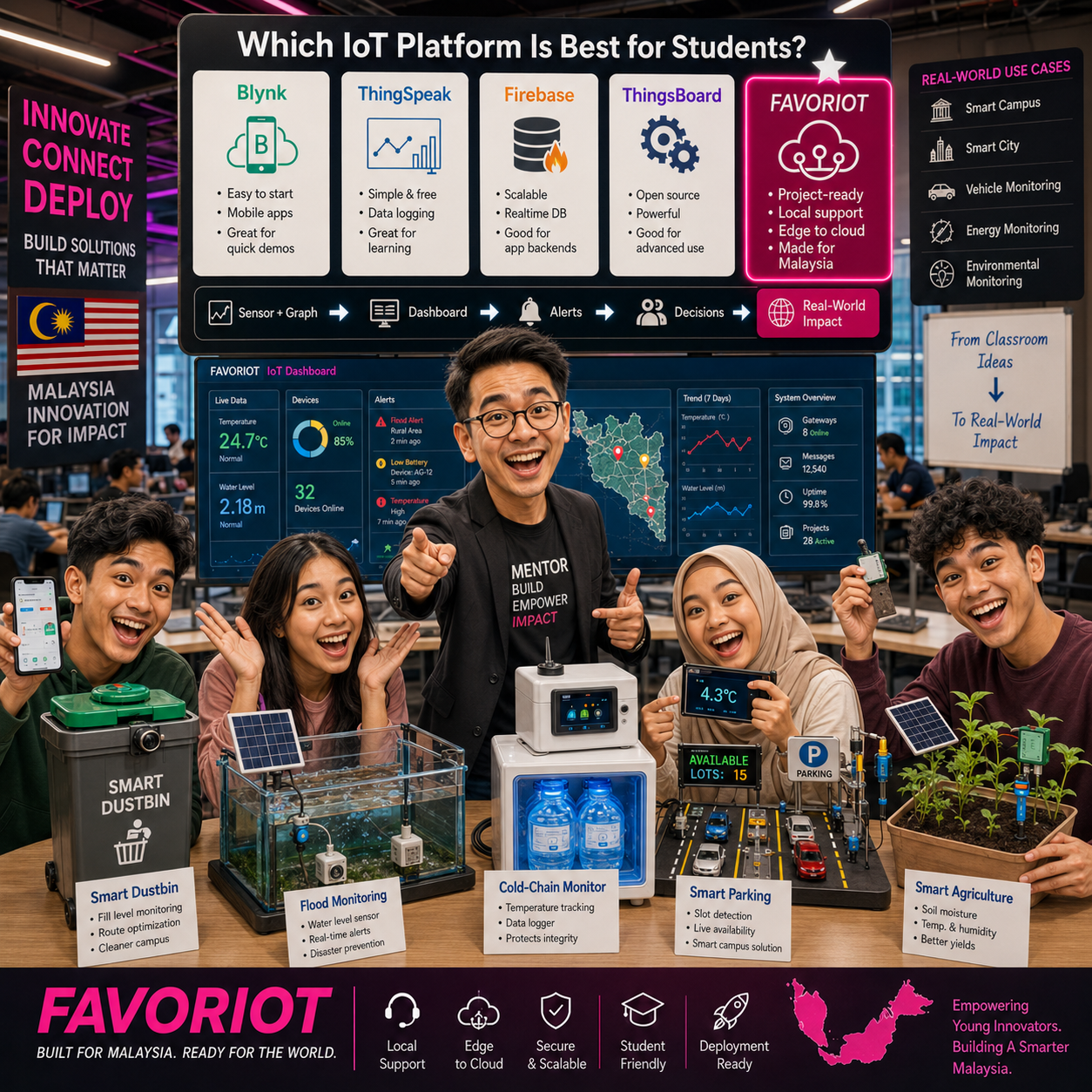
Which IoT Platform Is Best for Students?
What if the platform a student learns on today becomes the platform that defines how they think about IoT for the rest of their career?
That question is worth sitting with for a moment. Because the choice of an IoT learning platform is not just about connecting a sensor to a dashboard. It is about shaping the mental model a student carries into the industry. It is about whether they graduate with theoretical exposure or practical, deployable skills. And for universities building IoT curriculum, it is about whether the tools they choose actually serve the student or simply serve the course syllabus.
There are more IoT platforms than most educators have time to evaluate. AWS IoT, Microsoft Azure IoT Hub, Google Cloud IoT, ThingsBoard, Cayenne, Blynk, Ubidots, and dozens of others are all competing for the same classroom. The marketing looks similar. The dashboards look similar. But beneath the surface, the differences are significant, especially when the person using the platform is a second-year engineering student with a deadline, a NodeMCU, and twelve tabs open.
“The platform becomes the obstacle, not the enabler. What universities need is a platform that shrinks the time between device connection and genuine insight.”
The Learning Curve Problem Nobody Talks About
Here is the uncomfortable truth about enterprise IoT platforms in the classroom. AWS IoT Core is an extraordinary product for production-scale deployments. It is also genuinely difficult to configure for a student who has never touched a cloud console. IAM roles, certificate-based authentication, topic subscriptions, and shadow documents are not concepts that become intuitive overnight. The same applies to Azure IoT Hub, which carries significant infrastructure overhead before a single byte of sensor data ever reaches a dashboard.
This does not make these platforms wrong. It makes them wrong for the first six months of an IoT education.
The learning curve on enterprise platforms often consumes the very hours that should be spent understanding how IoT actually works. Students end up debugging authentication errors instead of exploring data architectures. They spend evenings reading documentation that assumes three years of cloud engineering experience.
What universities need is a platform that shrinks the time between device connection and genuine insight. A platform where a student can send their first data point within the first session, and still be discovering new capabilities by the time their final year project is due.
What Makes a Platform Right for Academic Use
When evaluating an IoT platform for university settings, five criteria separate the genuinely useful from the merely marketable.
Learning Curve and Time-to-First-Success
A student who successfully connects a temperature sensor and sees live data on a dashboard in the first class session leaves with momentum. A student who spends three hours troubleshooting API keys and broker addresses leaves with frustration. The platform that wins in education is the one that gives students an early win without sacrificing depth for later.
Project Readiness
Can they build a working smart agriculture monitor? Can they create a multi-sensor environmental dashboard for their thesis? The platform has to be capable enough to support real projects, not just toy demonstrations.
Local Support and Language Accessibility
A platform backed by a local team, with instructors and engineers who can be reached in the same timezone, changes the support experience fundamentally. Problems get resolved. Lecturers get answers. Students do not get stuck waiting for a support ticket to be picked up fourteen hours away.
Tutorials and Structured Learning Resources
A platform might be technically excellent but pedagogically unusable if the only documentation is a raw API reference. Walkthrough guides, project examples, video content, and beginner-to-advanced learning paths transform a platform from a tool into a curriculum.
Showcase Value
When a final year project uses a platform that employers and industry judges recognise, or when the portfolio piece demonstrates skills that translate directly to a professional context, the education investment pays off in a way that matters beyond the classroom.
Why Favoriot Stands Out for University Environments
Favoriot is a Malaysian-built IoT platform designed specifically for the full project lifecycle, from classroom prototype to production deployment. It has been adopted by universities across Malaysia and increasingly across the region for a set of reasons that align precisely with the five criteria above.
Favoriot in the Academic Context
The platform is structured around a clear and accessible API. Students can connect a device, create a data stream, and view live data on a dashboard within the same session. The REST API is clean and well-documented, and MQTT support means students working with resource-constrained hardware are not forced into workarounds.
Favoriot supports smart home systems, environmental monitoring networks, agriculture automation, health parameter tracking, and industrial simulation. Rule-based triggers, real-time dashboards, historical data access, and multi-device management give students room to build something genuinely meaningful.
Favoriot is headquartered in Malaysia, and the team behind it includes practitioners who work directly with universities. Lecturers building IoT courses have access to a team that understands the academic context, not just the technical one.
The platform’s tutorial ecosystem has grown considerably. From beginner-level device connection guides to intermediate project walkthroughs, the resources are designed for people who are learning, not just for people who already know. The Favoriot community in academic settings has also produced a growing library of student project examples that serve as both inspiration and practical reference.
On the showcase dimension, Favoriot’s recognition as one of Malaysia’s leading IoT platforms, and its inclusion among globally recognised innovation companies, means a student’s final year project carries institutional credibility. That matters when the project goes into a portfolio, onto a resume, or in front of an industry panel.
A Platform Chosen Early Shapes a Career
The conversation about which IoT platform is best for students is really a conversation about what kind of IoT engineers universities want to produce.
A student who graduates having only worked with enterprise cloud platforms may have impressive credentials on paper but limited ability to build and deploy independently. A student who graduates having worked with a platform that demanded real understanding of data architecture, protocol selection, device management, and dashboard design is a different kind of professional entirely.
Favoriot, used thoughtfully within an IoT curriculum, has the potential to produce the second kind. Not because it is the most powerful platform in the world, but because it is calibrated correctly for where students are, while giving them somewhere meaningful to grow.
The best IoT platform for students is not necessarily the biggest. It is the one that builds the right instincts, delivers early confidence, and still challenges them when they are ready.
“Is your university curriculum preparing students to connect devices, or to think in systems? That distinction might be worth a conversation.”
Start Building Smarter IoT Projects Today
Favoriot gives students the platform, the tutorials, and the local support to move from first connection to final year project without hitting unnecessary walls. Sign up free and start exploring.

Leave a Reply