
An Analyst Perspective on Cost, Risk, and Time-to-Value
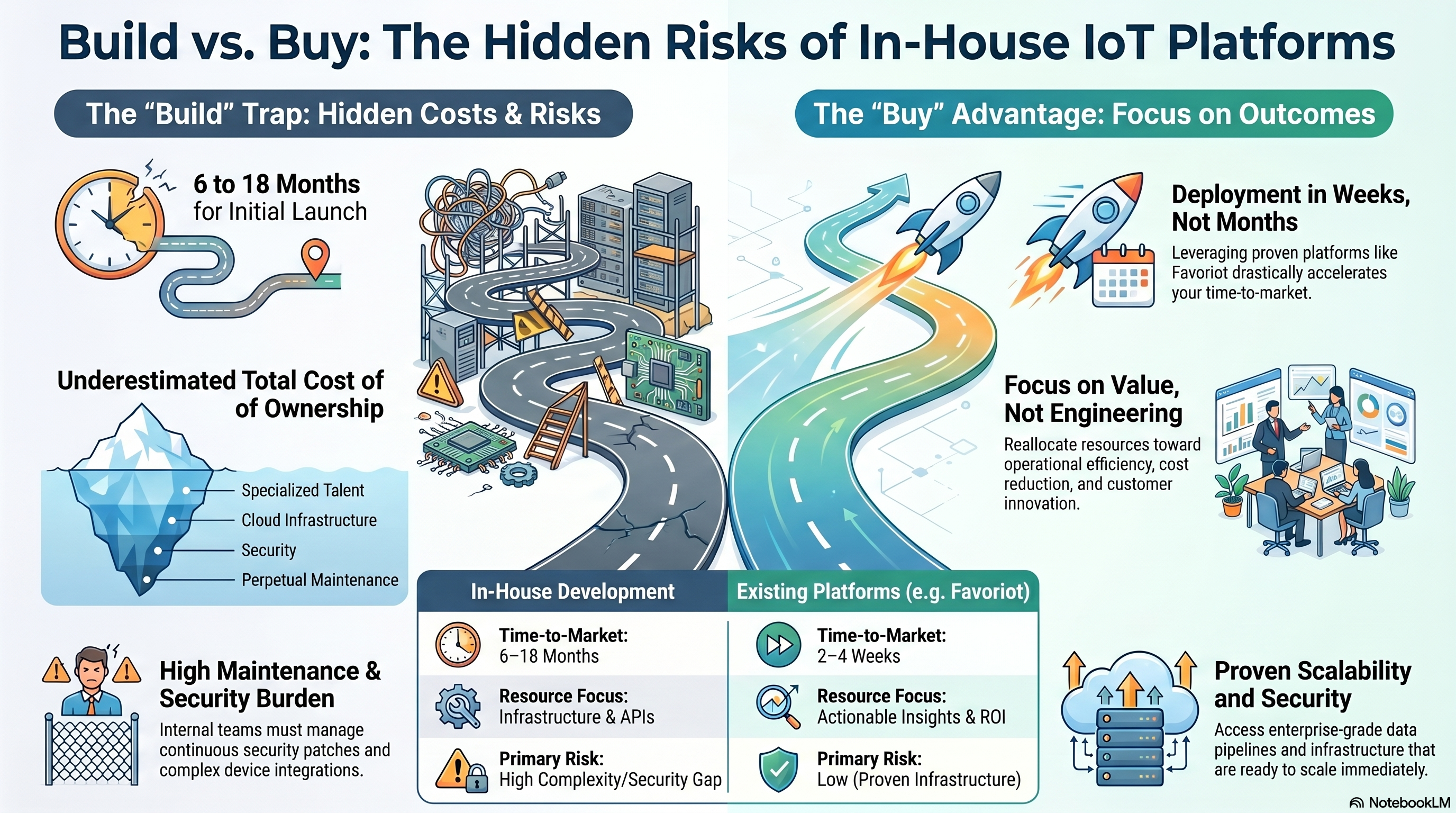
Organisations considering IoT initiatives often face a strategic decision: build an in-house IoT platform or adopt an existing one such as Favoriot. While building internally may appear to offer control and flexibility, the reality is that it introduces significant cost, complexity, and delay that can undermine the intended business outcomes.
The following analysis outlines the key reasons why developing an in-house IoT platform is often not the optimal path.

- Misalignment with Business Objectives
The primary goal of most IoT initiatives is not to build software infrastructure, but to achieve measurable outcomes such as:
- Operational efficiency
- Cost reduction
- Asset visibility
- Predictive maintenance
- Regulatory compliance
Developing a platform diverts focus away from these objectives and shifts attention toward engineering challenges that do not directly contribute to business value.
- Extended Time-to-Market
Building an IoT platform from scratch typically requires:
- 6 to 18 months for initial development
- Additional time for testing, stabilisation, and deployment
During this period:
- Business problems remain unresolved
- Competitive advantage is delayed
- Market opportunities may be lost
In fast-moving sectors, speed of deployment is often more critical than ownership of infrastructure.
- High Total Cost of Ownership (TCO)
The cost of building an IoT platform is frequently underestimated. It includes:
- Software development (backend, frontend, APIs)
- Infrastructure (cloud, storage, networking)
- Security implementation
- Ongoing maintenance and support
In addition, organisations must invest in specialised talent, including:
- IoT engineers
- Cloud architects
- DevOps engineers
- Cybersecurity specialists
This creates a long-term financial commitment that extends beyond initial development.
- Continuous Maintenance Burden
An IoT platform is not a one-time project. It requires continuous upkeep:
- Software updates and bug fixes
- Security patches
- Device compatibility updates
- Performance optimisation
This results in a permanent operational burden that consumes internal resources.
- Security and Compliance Risks
IoT systems involve multiple layers:
- Devices
- Connectivity
- Cloud infrastructure
- Data pipelines
Each layer introduces potential vulnerabilities. Building a secure, compliant system requires deep expertise and ongoing vigilance. Any weakness can lead to:
- Data breaches
- Operational disruption
- Regulatory penalties
- Integration Complexity
IoT environments are inherently heterogeneous, involving multiple protocols and standards such as:
- MQTT
- HTTP/REST
- LoRaWAN
- Modbus
- OPC-UA
Developing and maintaining compatibility across these technologies is complex and resource-intensive. Integration challenges are often underestimated during planning.
- Reinventing Existing Capabilities
Most in-house IoT platforms replicate features that are already available in mature platforms:
- Device management
- Data ingestion and storage
- Dashboards and visualisation
- Alerts and notifications
- API integration
This duplication of effort results in inefficient use of time and resources without creating differentiation.
- Opportunity Cost of Internal Resources
Engineering teams assigned to platform development are diverted from higher-value activities such as:
- Developing domain-specific solutions
- Enhancing customer experience
- Driving innovation in core business areas
This misallocation reduces overall organisational productivity.
- Scalability Challenges
While initial pilots may succeed, scaling introduces new complexities:
- Handling high data volumes
- Ensuring system reliability
- Managing distributed deployments
- Controlling cloud costs
Designing for scalability from the outset requires advanced expertise that many organisations do not possess internally.
- Delayed Return on Investment
During the development phase:
- No operational improvements are realised
- No new revenue streams are generated
- Costs continue to accumulate
This delays the financial benefits of IoT adoption and weakens the business case.
- Organisational Friction
Long development cycles often lead to internal challenges:
- Stakeholder frustration due to lack of visible progress
- Misalignment between technical and business teams
- Increased scrutiny on project viability
This can impact organisational confidence in IoT initiatives.
- Missed Market Opportunities
While internal development is ongoing:
- Competitors may deploy solutions faster
- Customer expectations evolve
- Market conditions change
The delay can result in lost opportunities that cannot be recovered.
The Alternative: Leveraging an Existing Platform such as Favoriot
Adopting an established IoT platform enables organisations to:
- Accelerate deployment timelines from months to weeks
- Reduce upfront and ongoing costs
- Access proven, secure, and scalable infrastructure
- Focus on use cases and business outcomes rather than platform engineering
More importantly, it allows teams to prioritise what matters most:
- Turning data into actionable insights
- Driving operational improvements
- Delivering measurable impact quickly
Strategic Perspective
The decision is not simply “build versus buy.” It is a choice between:
- Investing time and resources in infrastructure development, or
- Delivering business value rapidly through proven platforms
Organisations that prioritise speed, efficiency, and outcomes are more likely to succeed by leveraging existing IoT platforms rather than building their own.
Conclusion
Building an in-house IoT platform introduces significant risks in cost, time, and complexity, often without delivering proportional strategic advantage. In contrast, adopting a mature platform such as Favoriot enables faster execution, reduced risk, and earlier realisation of value.
The critical question for decision-makers is:
Is the organisation aiming to build a platform, or to solve a business problem?



Leave a Reply