
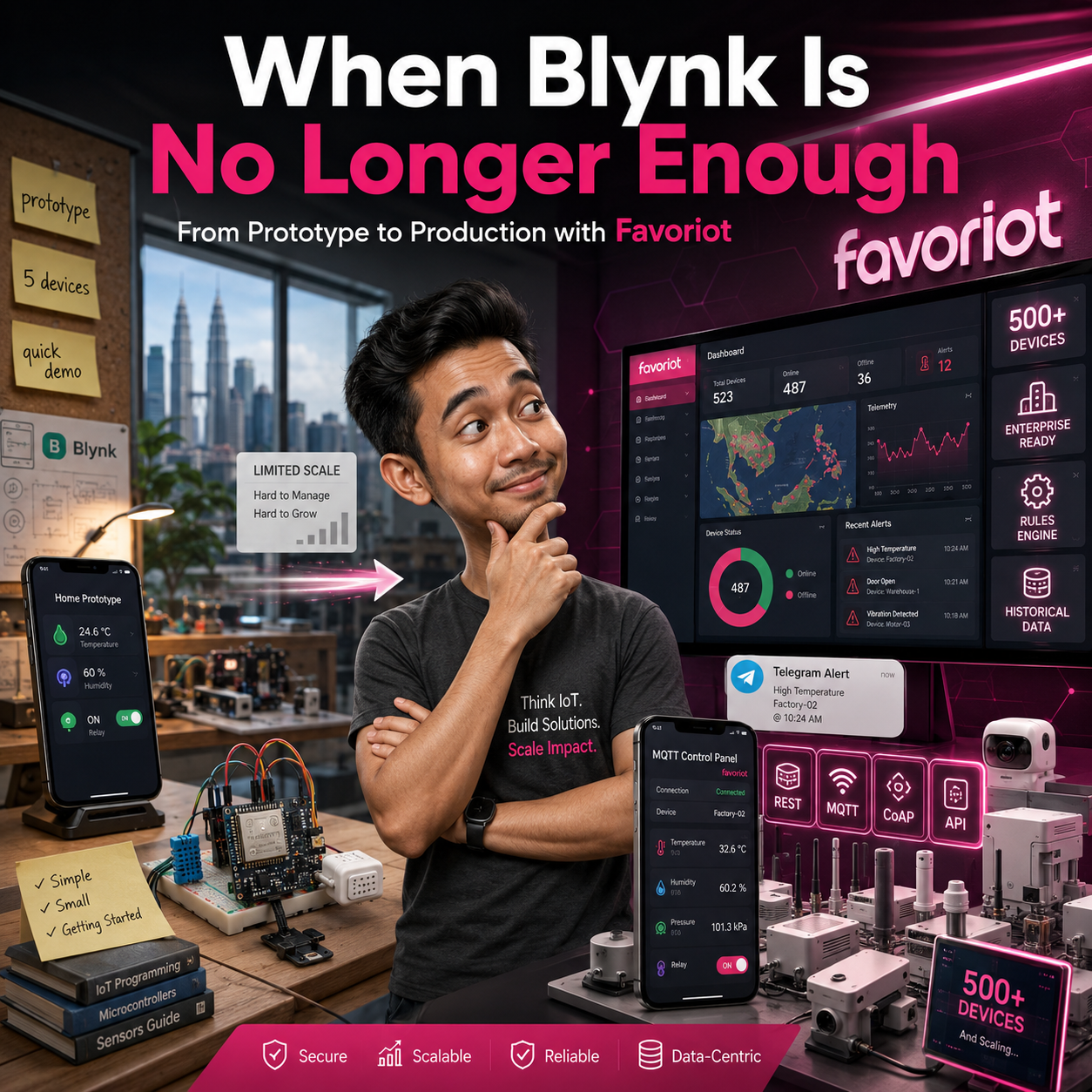
When Blynk Is No Longer Enough: Why Serious IoT Builders Are Turning to Favoriot
What happens when the tool that built the prototype becomes the ceiling that stops the product?
That question is being asked quietly in IoT developer communities, university labs, and startup offices across Southeast Asia. Blynk has served millions of makers, hobbyists, and early-stage developers well. It lowered the barrier to entry. It made IoT approachable. For a weekend project or a classroom exercise, it delivered exactly what was promised.
But somewhere between the prototype and the production deployment, the cracks appear. And the developers who are honest about it start looking for what comes next.
The Blynk Starting Point
Blynk built its reputation on simplicity. A drag-and-drop mobile app builder, a growing widget library, compatibility with hundreds of hardware modules, and a free tier that made experimentation risk-free. For anyone who needed to connect a sensor to a dashboard in under an hour, Blynk was the obvious answer.
That simplicity is genuinely valuable. It is not being dismissed here.
The challenge arrives when the project matures. When a university thesis becomes a commercial pilot. When a proof-of-concept is expected to scale from five devices to five hundred. When the client asks about API integration, multi-user access, rule-based automation, or data retention policies. Suddenly the platform that was designed for speed-to-prototype is being asked to carry weight it was never meant to hold.
This is not a flaw in Blynk. It is a category limitation.
Entering Favoriot: Built for What Comes After the Prototype
Favoriot is an IoT platform built in Malaysia and designed to serve the full lifecycle of an IoT project, from initial device connection through to large-scale enterprise deployment.
Where Blynk optimises for fast mobile UI creation, Favoriot prioritises data architecture, API flexibility, and scalability without punitive device caps.
The distinction matters more than most developers realise until they need it.
Device Management Without a Ceiling
One of the most cited frustrations among developers moving beyond Blynk is the device limit structure. Favoriot offers pricing tiers that include unlimited devices, making it a natural fit for fleet monitoring, smart city deployments, and industrial applications where connected endpoints grow continuously and unpredictably.
REST, MQTT, and CoAP in One Platform
Favoriot supports multiple communication protocols including REST API, MQTT, and CoAP. This multiprotocol architecture gives hardware teams the flexibility to connect a wide range of sensors and gateways without being forced into a single connectivity pathway. For teams working with low-power or bandwidth-limited deployments, this matters considerably.
Data Management as a First-Class Feature
Favoriot treats data as the core product, not a side feature. The platform provides real-time aggregated data streams, historical data access, and customisable dashboards that can be shared publicly or privately. For projects where the business value lives in the analytics layer rather than the mobile control interface, this architecture is a meaningful advantage.
Rule-Based Event Processing and Alerts
The platform includes rule-driven event-action mechanisms that trigger automated responses based on sensor readings. Notifications are supported across multiple channels including email, SMS, and Telegram. This moves Favoriot beyond basic monitoring into genuine operational intelligence, the kind of functionality that deployments in agriculture, utilities, and facility management actually require.
API-First for Enterprise Integration
Enterprise IoT projects rarely exist in isolation. They need to communicate with ERP systems, maintenance platforms, business intelligence tools, and third-party services. Favoriot’s API-first architecture is designed for this reality, expanding platform capability without requiring custom middleware development.
The Mobile Gap That Blynk Fills, and How Favoriot Closes It
One honest observation about Favoriot is that its web dashboard, while capable, does not offer the same mobile-first experience that Blynk’s native app delivers. For teams that want live sensor control and real-time feedback from a smartphone, this has historically felt like a gap.
That gap has a practical and immediate solution.
The IoT MQTT Panel, available on both Android and iOS, connects directly to Favoriot’s native MQTT broker with no additional middleware or third-party configuration required. The setup takes minutes. Users create a connection profile using Favoriot’s standard MQTT broker details, configure their panels, and begin publishing and subscribing to device topics almost immediately.
The app supports MQTT over TCP and WebSocket, SSL-secured communication, and JSON payloads, all of which align cleanly with how Favoriot structures its MQTT implementation. There is no payload transformation needed. The setup is predictable for anyone already familiar with the platform.
What the IoT MQTT Panel provides is a wide range of configurable interaction panels including buttons, switches, sliders, indicators, message logs, and real-time charts. Control panels can publish actuator commands to device topics. Indicators and graphs subscribe to sensor data streams. Text logs display raw MQTT messages for inspection and debugging.
This makes the combination of Favoriot and IoT MQTT Panel a genuinely capable alternative to what Blynk offers out of the box, with one important difference: the underlying platform behind Favoriot is built for enterprise scale, not maker prototyping.
For students and new builders, IoT MQTT Panel offers a visual and interactive way to understand MQTT concepts such as publish, subscribe, topics, and payloads. For experienced developers, it serves as a fast validation and monitoring tool during prototyping and system testing. For teams in production, it provides a lightweight mobile layer that sits above Favoriot’s data and rules engine without duplicating it.
The two tools occupy different roles and complement each other well. Favoriot excels at long-term data storage, visual dashboards, rules, alerts, and platform-level management. IoT MQTT Panel provides the fast, flexible mobile interaction layer for direct engagement with MQTT topics on the go.
The Honest Comparison
Blynk still holds real advantages. Its hardware compatibility, covering over 400 modules, is broader than what Favoriot currently supports. Its no-code mobile app builder remains one of the fastest paths from idea to working interface. For consumer IoT product companies that need to ship a branded mobile application to end users, Blynk’s purpose-built tooling for that specific workflow is hard to match.
The choice is not about which platform is better in the abstract. It is about which platform matches the actual trajectory of the project.
If the goal is a fast prototype or a consumer-facing mobile app, Blynk remains a strong option.
If the goal is data-centric architecture, unlimited device scalability, enterprise API integration, multi-protocol connectivity, and a platform designed to grow with the project rather than cap it, Favoriot combined with IoT MQTT Panel is the combination worth evaluating.
A Platform Designed for the Region
There is one more consideration that global comparisons consistently underweight: local context matters.
Favoriot is built and maintained by a Malaysian team that understands the technical environment, regulatory landscape, and deployment realities of Southeast Asia. Local support, documentation suited to regional context, and a partner network familiar with Malaysian and ASEAN infrastructure conditions are not small advantages when a project encounters real-world friction.
For organisations in the region building IoT solutions that need to go beyond the pilot stage, that context is worth something considerable.
What This Means for the Next Project
The Blynk-to-Favoriot conversation is ultimately a conversation about maturity. Not every IoT project needs to move away from Blynk. But every IoT project needs to be honest about where it is going.
If the roadmap includes scale, enterprise integration, serious data management, and long-term operational sustainability, the platform decision made at the prototype stage will either support or constrain that ambition. And if a mobile interaction layer is needed during development or in the field, IoT MQTT Panel provides exactly that, without reinventing the architecture.
Is the current IoT platform designed for where the project is going, or only for where it started?
That is the question worth sitting with before the next sprint begins.
Explore Favoriot’s platform capabilities at favoriot.com. The IoT MQTT Panel is available on Android and iOS.





Leave a Reply