
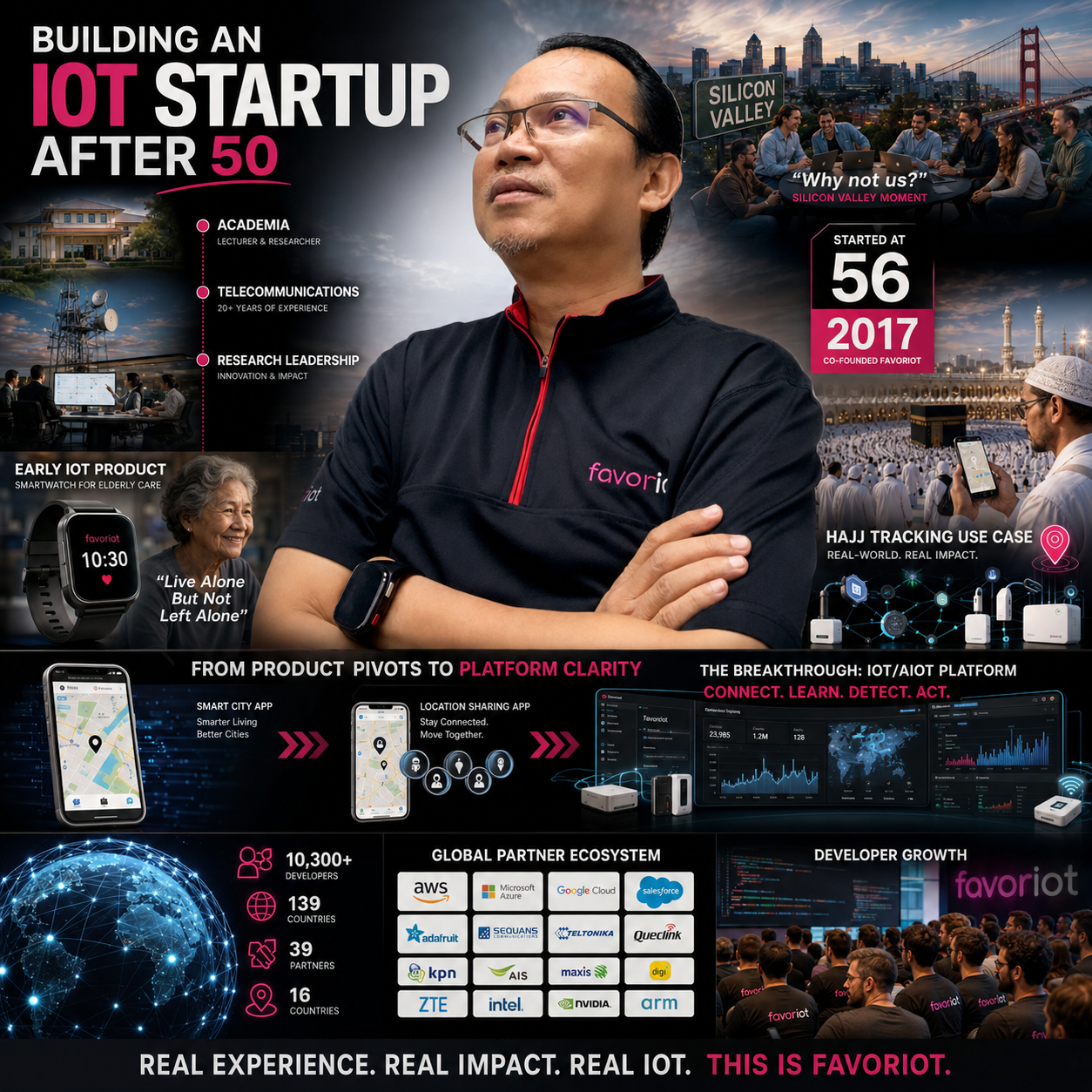
What happens when a man who spent decades inside some of Malaysia’s most established institutions decides to walk away from job security, a senior title, and a predictable salary to build something from scratch — at age 56?
Most people would call that a midlife crisis. Dr. Mazlan Abbas calls it the beginning.
The story of Favoriot is not a straightforward startup narrative. There are no venture capital fairy tales here, no overnight viral growth, no unicorn on the horizon. What there is instead is something far more instructive: a messy, iterative, honest account of what it actually takes to build a technology company when the odds, the timing, and sometimes the market itself seem to be working against you.
The Dots That Could Only Be Connected Looking Backwards
Steve Jobs once said that you cannot connect the dots looking forward. You can only connect them looking backwards. That quote opens Dr. Mazlan’s presentations for good reason. Because when you trace the arc of his career, the through-line becomes unmistakable — even if it was invisible at the time.
He was born in Johor Bahru in 1961, the son of a man who worked as a government clerk by day and repaired radios and television sets by night. Abbas Abdul Wahab was not an engineer by formal training. He was a practical man who understood how things worked and refused to let skill go to waste. That image — a father hunched over circuits under a dim lamp after hours — left an impression that no classroom could manufacture.
Dr. Mazlan went on to pursue electrical engineering at UTM, specializing in communications. He then earned an MSc in Telematics from the University of Essex, followed by a PhD back at UTM with a focus on broadband telecommunications. From there came a career that moved through academia as a lecturer and eventually Associate Professor, then into Malaysia’s telco industry at Celcom handling roles spanning R&D, billing, mobile data, and network management, and then into research leadership at MIMOS as Senior Director of the Wireless Communications Cluster.
Every role added a layer. Teaching built the discipline of explanation. Telco built the understanding of scale and infrastructure. Research built the habit of asking what comes next. None of it felt like preparation for entrepreneurship at the time. In retrospect, it was exactly that.
The Silicon Valley Shift
In 2016, Dr. Mazlan joined a delegation to Silicon Valley. Visits to Google, encounters with startup culture, conversations inside accelerator spaces — the trip did something that decades of professional competence had not fully managed to do. It shifted his mental frame.
The question he brought home was simple and quietly radical: “If they can do it, why not us?”
That question did not ask whether Malaysia had the talent. It did not ask whether the market was ready. It simply refused to accept geography or circumstance as a reason to hold back. A year later, in 2017, Dr. Mazlan co-founded Favoriot at the age of 56.
Starting With Empathy, Not a Product
The entrepreneurial story of Favoriot begins not with a technology brief but with an observation about human vulnerability. As parents age, children who once looked up to them for protection begin to realize the relationship has quietly inverted. The ones who were once heroes now need watching over. They live alone. They might fall. They might wander. Their families are busy, scattered, worried.
That observation became Raqib, originally launched as Favorwatch. The concept was an IoT-enabled smartwatch that could monitor an elderly person’s vital signs, track their location in real time, and alert family members through a mobile app. The tagline that emerged from the work was both product brief and human truth: “Live Alone But Not Left Alone.”
The early version of the device tracked blood pressure, ECG readings, steps, fitness data, and location. It sent SOS alerts. It gave families visibility without surveillance. It was thoughtful technology built around a genuine problem.
Then came the pivot that no startup plan anticipates. The team recognized that the same technology had a compelling application in a context far larger and more complex than elderly care. Hajj management.
Consider the operational scale of managing millions of pilgrims in Mecca. A single Hajj season involves tens of thousands of tents, thousands of security cameras, hundreds of ambulances, and thousands of officers from dozens of countries. Pilgrims are elderly, they are often unwell, they are navigating one of the most physically demanding religious obligations in the world in extreme heat. Losing someone in that environment is not a logistical inconvenience. It is a human tragedy.
Favoriot took Raqib into that environment. Dr. Mazlan did not just build the solution from the outside. He performed the Hajj himself, wearing the device, gathering ground-truth data about what worked and what did not, from network and roaming issues to SIM card compatibility challenges across different countries. The product was trialed in Saudi Arabia, India, the Maldives, Egypt, Bangladesh, and Thailand. It was real-world testing at a scale and intensity that no laboratory could replicate.
Yet the lesson that the team took away from Raqib was not about the technology. It was about timing, user behavior, and the brutal honesty of the market. Building for both elderly people and Hajj pilgrims meant dealing with deeply cautious buyer behavior, hardware dependency on third-party device partners, and a go-to-market decision that loomed over every sales conversation: B2C or B2B? Each had implications for pricing, support, and distribution that the team had to learn through doing, not reading.
Then COVID-19 arrived and shut down Hajj for two years. The window closed.
The question that surfaced was one that every hardware-dependent startup eventually faces: do we carry the product or end its life?
Building the Platform That Would Outlast the Products
What emerged from the cycle of pivots was clarity. Favoriot’s real value was not in any single application. It was in the platform underneath all of them.
The Favoriot IoT Platform was built to connect devices, ingest real-time data, and surface it through dashboards and alerts so that operators could see exactly what was happening as it happened. It was designed to be developer-friendly, with RESTful APIs, support for multiple protocols including MQTT, COAP, and WebSocket, and a hierarchy structure that allowed enterprises to manage thousands of devices and data streams at scale.
The platform philosophy was summarized in a phrase that the team adopted as a design principle: “Get started in days, not months.” For system integrators, that sentence carries significant weight. Time-to-deployment is not a nice-to-have. It is often the deciding factor in whether a solution gets built at all.
By January 2026, the Favoriot platform had registered over 10,300 developers across 139 countries, with nearly 14,000 applications built on top of it. The platform had also trained 402 professionals, with 86 having obtained formal IoT certifications. The largest segment of trained users, almost half, came from the education sector, reflecting a deliberate strategy to build the next generation of IoT practitioners around the Favoriot ecosystem.
The platform had also evolved. Recognizing that data collection alone was no longer sufficient competitive differentiation, Favoriot began its transition to an AIoT platform, one that does not simply collect and display data but learns from it, detects early signals, and supports faster, better-informed decision-making. Connect. Learn. Detect. Act. Those four words describe the platform’s operating logic and the direction the company has chosen as it moves beyond 2026.
What the Pivot History Really Teaches
Raqib was not a failure. Favorsense, the smart city incident reporting application that ran from 2017 to 2021, was not a failure either. Neither was Dscover, the location-sharing and group coordination app that ran until 2025. Each product was a deliberate experiment that taught the company something it could not have learned any other way.
Favorsense taught them that smart city buyers are slow, bureaucratic decision-makers. Local councils had existing complaint systems they had no organizational appetite to replace. Standardizing features across different councils meant either compromising the product or multiplying support overhead. The lesson was uncomfortable but instructive: the size of a market is not the same as the speed of that market.
Dscover taught them about competitive substitution. When WhatsApp already does group messaging and Google Maps already does location sharing, the bar for convincing users to adopt a new app is extraordinarily high. The pricing model and the question of differentiation were never fully resolved before the product was wound down.
But each of these experiments fed the platform. Features built for Raqib informed the data hierarchy. Learnings from Favorsense shaped the alerting and rules engine. Understanding from Dscover reinforced the importance of ecosystem thinking over standalone application bets.
The Favoriot Partner Network, which now spans 39 partners across 16 countries, is the structural expression of that ecosystem thinking. The network encompasses software partners building on Favoriot APIs, hardware partners supplying sensors and gateways, service partners implementing solutions for end clients, training partners developing IoT talent, and distribution partners building regional adoption. The ambition is clear: Favoriot does not need to win every deployment directly. It needs to be the platform that its partners build on.
The Underrated Advantage of Starting Late
There is a conventional narrative in startup culture that founders need to be young. That the raw energy, the risk tolerance, and the openness to disruption belong to people who have not yet accumulated the caution that comes with experience and responsibility.
Dr. Mazlan’s trajectory challenges that narrative directly. At 56, he brought something that no accelerator program can simulate: decades of pattern recognition across academia, the telco sector, and government-linked research. He knew how large organizations make decisions. He knew how infrastructure gets built and how it fails. He knew the difference between a technology trend and a market reality, and how wide that gap can sometimes be.
That knowledge did not make the journey easier. It made it more honest. The meetings were real because he understood what buyers actually needed. The pivots were faster because he had seen what organizational inertia looks like from the inside. The platform bet was sharper because he understood that sustainable B2B businesses are built on infrastructure, not applications.
Content creation became another lever. The IoT World blog, the Mazlan Abbas personal blog, multiple eBooks, LinkedIn presence, YouTube content, and the Favoriot TikTok channel all form part of a deliberate thought leadership strategy. In a market where buyers trust expertise before they trust products, being the most visible credible voice in the room is a business asset. Dr. Mazlan understood this intuitively. Personal brand and platform brand reinforce each other.
The Question Worth Sitting With
The Favoriot story is still being written. The AIoT platform is still early. The Partner Network is still scaling. The move from IoT data collection to genuine intelligence-driven decision support is still a work in progress.
But the story that has already been lived raises a question worth sitting with, especially for anyone in the technology industry who has spent years inside large organizations building expertise they have never taken the risk of applying independently.
What does it actually cost to wait? Not the financial cost. The opportunity cost. The cost of knowledge accumulated but never tested. The cost of problems identified but never addressed. The cost of asking “why not us” and not having a good answer.
Dr. Mazlan asked that question in Silicon Valley in 2016 and chose to take it seriously. Eight years later, Favoriot has trained practitioners across 139 countries, built a partner ecosystem spanning 16 nations, and is evolving into an AIoT platform at the moment when the industry’s need for intelligent, real-time operational systems has never been greater.
The dots connected.
If you have been sitting on an idea that combines deep domain knowledge with a genuine problem worth solving, what is the question you have not yet allowed yourself to ask?
Dr. Mazlan Abbas is the CEO and Co-Founder of Favoriot, an AIoT platform company focused on helping organizations connect, learn from, and act on real-world data. He writes regularly on IoT and entrepreneurship at mazlanabbas.com and iotworld.co.





Leave a Reply