
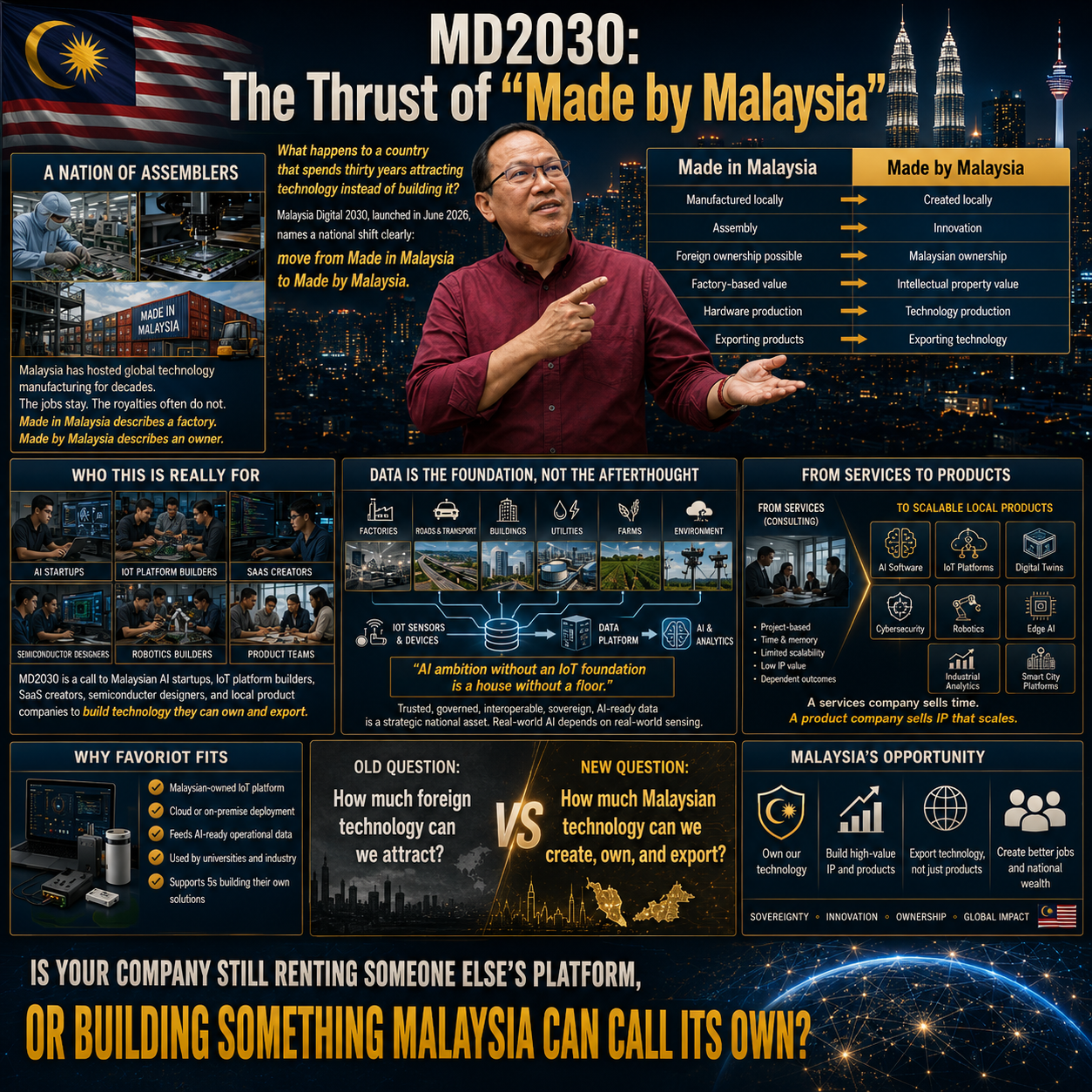
What happens to a country that spends many years attracting technology instead of building it?
That is the uncomfortable question sitting underneath Malaysia’s newest digital policy shift. For decades, the nation has been good at bringing technology in. Data centres. Chip factories. Global manufacturing lines. Malaysia has built an economy around hosting other people’s innovation. It works, but it has a ceiling. Jobs and exports flow in, yet the intellectual property, the patents, the software ownership, and the long-term value quietly flow back out.
Malaysia Digital 2030 (MD2030), launched in June 2026, names this problem directly. And its answer comes wrapped in a slogan that is easy to miss the significance of: Made by Malaysia, not Made in Malaysia.
A Nation of Assemblers
Intel manufactures chips in Malaysia. AMD operates here. Infineon runs production lines here. These are genuine achievements, but none of that technology is Malaysian owned. The engineering jobs stay. The royalties do not.
Made in Malaysia describes a factory. Made by Malaysia describes an owner.
| Made in Malaysia | Made by Malaysia |
|---|---|
| Manufactured locally | Created locally |
| Assembly | Innovation |
| Foreign ownership possible | Malaysian ownership |
| Factory based value | Intellectual property value |
| Hardware production | Technology production |
| Exporting products | Exporting technology |
The distinction points to a growth model that has generated plenty of activity without generating much ownership.
Who This Is Really For
MD2030 is not written for policymakers alone. It is written for the Malaysian AI startup, the IoT platform builder, the robotics engineer, the semiconductor designer, the people who have spent years delivering projects on other people’s platforms and are now being invited to build their own.
The plan wants more companies that look like Malaysian AI firms, Malaysian SaaS providers, and Malaysian IoT platforms, businesses where the core technology, not just the labour, is owned locally. It sets out to promote Made by Malaysia digital products, accelerate adoption in high growth sectors, unlock the value of Malaysian data, and help local companies commercialise their intellectual property into exportable digital solutions.
Data Is the Foundation, Not the Afterthought
Here is where the policy gets more interesting than most people realise. Public conversation about AI tends to focus on chatbots and large language models. MD2030 goes further. It insists that data is a strategic national asset, and that trusted, governed, interoperable, sovereign, AI-ready data is the precondition for competitive Malaysian AI.
That single point quietly elevates the importance of IoT.
Chatbots respond to text. Real-world AI, the kind that manages a factory floor, predicts equipment failure, or optimises a city’s traffic flow, depends on real-world sensing. Factories, buildings, roads, utilities, farms, ports, and hospitals only become intelligent when they are continuously generating operational data. Strip away the sensors and the AI has nothing to reason about.
This is the connection many strategy conversations miss. AI ambition without an IoT foundation is a house without a floor.
From Services to Products
MD2030 is nudging Malaysian technology companies toward a specific behavioural shift: stop selling only engineering hours, start building reusable, ownable, exportable products.
The plan calls out categories where this shift is expected to happen, including AI software, IoT platforms, digital twins, cybersecurity products, robotics, edge AI, industrial analytics, and smart city platforms. The distinction matters. A services company sells time. A product company sells IP that scales.
Favoriot sits comfortably inside this description already. It is a Malaysian owned IoT platform, built with local engineering talent, deployable on cloud or on premises, feeding AI ready operational data, adopted by universities and industry, and used by customers in more than one hundred countries. It also supports system integrators who want to build their own branded solutions on top of it, extending Malaysian ownership further down the value chain rather than keeping it locked inside a single company.
That is not a coincidental fit. It is what happens when a platform is built with ownership and exportability in mind from the start, rather than retrofitted onto someone else’s stack.

The Real Shift Is a Question, Not a Slogan
Strip away the branding and MD2030 is really asking Malaysia to change the question it has been asking itself for thirty years.
The old question was: how much foreign technology can we attract?
The new question is: how much Malaysian technology can we create, own, and export?
That single change in framing, from adoption to creation, is the entire thrust of Made by Malaysia. It sits at the centre of the country’s broader ambition to become an AI Nation by 2030, one where locally built AI, trusted local data, and home-grown digital products are not imported dependencies but exportable strengths.
For any technology leader in Malaysia reading this, the honest question is a personal one. Is your company still renting someone else’s platform to deliver projects, or are you building something Malaysia can eventually call its own?


Leave a Reply