
The IoT Partnership Advantage: Why No Single Company Needs to Own the Entire Technology Stack
The Internet of Things industry presents an unusual business challenge. Delivering a complete solution often requires expertise across several technologies, industries, and commercial channels.
A successful deployment may involve sensor manufacturers, gateway suppliers, telecommunications providers, IoT platforms, application developers, analytics specialists, AI companies, cybersecurity experts, and system integrators.
Each contributes a different capability to the final solution.
For established technology companies, developing some of these capabilities internally may be commercially practical. For startups and smaller businesses, attempting to control the entire value chain can become expensive and difficult to sustain.
This is why partnerships are becoming a central part of how IoT solutions are developed, delivered, and supported.
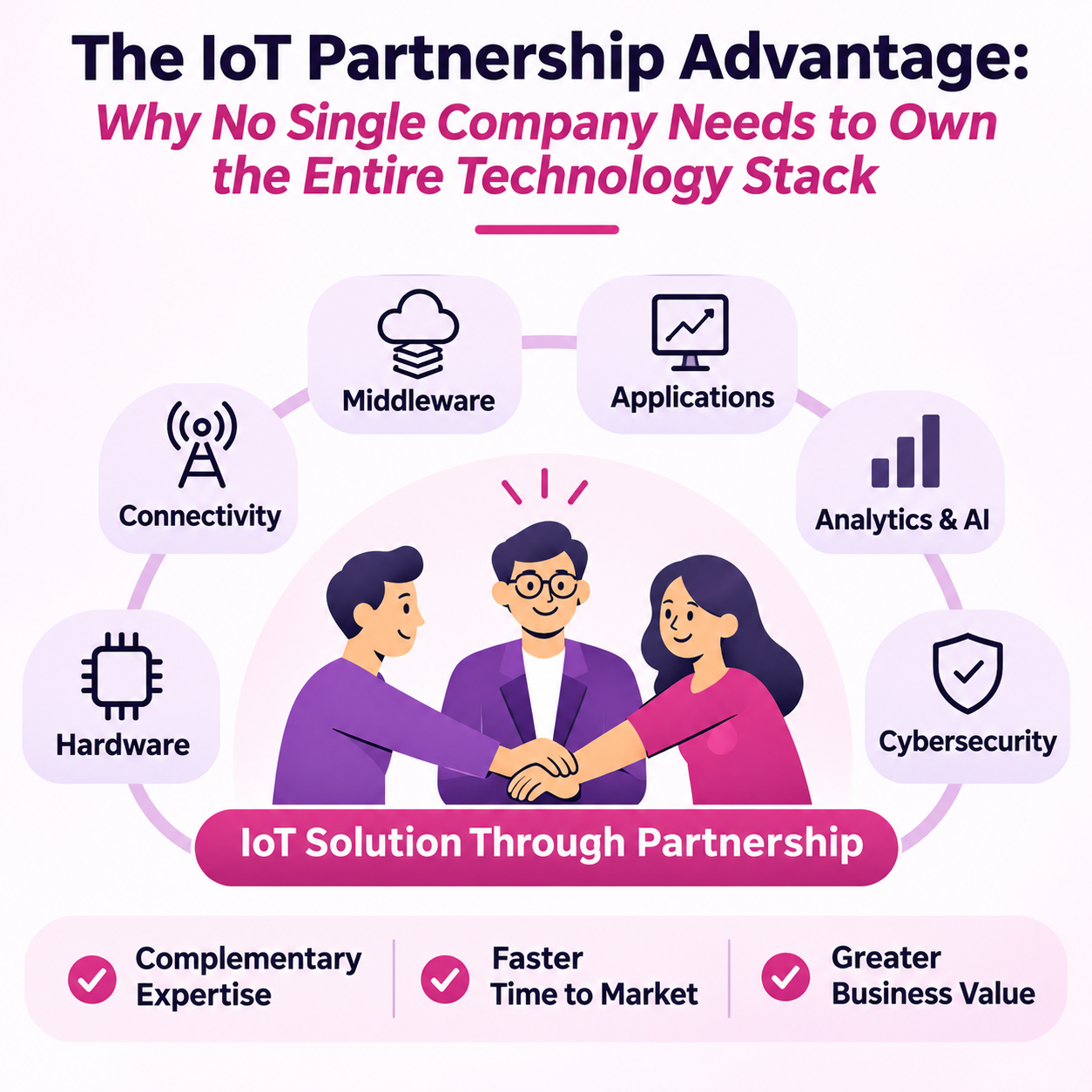
Understanding the IoT Value Chain
How different partners contribute to one IoT solution:
Each layer requires its own technical knowledge, commercial relationships, and support capabilities.
A company specialising in industrial sensors may have limited experience developing cloud applications. A software company may lack the resources to design certified wireless hardware.
Partnerships allow these businesses to contribute their strengths without becoming experts in every discipline.
Seven Business Benefits of IoT Partnerships
| Benefit | Business impact |
|---|---|
| Faster deployment | Existing products reduce development time |
| Lower capital requirements | Less investment in non-core technologies |
| Specialist expertise | Access to skills without building large internal teams |
| Broader market coverage | Channel partners provide industry and geographic access |
| Better solution quality | Components are selected based on proven capabilities |
| Shared commercial opportunities | Partners can introduce projects and cross-sell services |
| Greater scalability | Companies can support larger projects through complementary resources |
The commercial benefits extend beyond product development.
A small IoT company may have a strong technical product but limited access to enterprise customers. A system integrator may have those customer relationships but need a suitable IoT platform.
By working together, both companies can pursue opportunities that neither could easily deliver alone.
The Build-versus-Partner Decision
Startups frequently face a difficult question: which capabilities should they develop internally, and which should they obtain through partnerships?
The answer depends on whether a capability creates meaningful competitive advantage.
If a company’s strength lies in predictive maintenance software, developing a proprietary wireless gateway may not improve its commercial position.
Likewise, a hardware manufacturer may gain more from partnering with an established IoT platform than from building and maintaining its own middleware.
The decision should consider development cost, technical ownership, customer requirements, maintenance responsibilities, and long-term commercial control.
Partnerships Must Extend Beyond Technology
Technology compatibility is only one part of a successful partnership.
Companies must also agree on commercial responsibilities.
Who owns the customer relationship? Who prepares the proposal? Who provides installation services? Who handles technical support? How are revenue and recurring subscription fees shared?
Without clear answers, partnerships can become sources of conflict rather than growth.
Strong IoT partnerships normally require three foundations: complementary capabilities, clear commercial boundaries, and mutual commitment to customer success.
Channel partners are especially important. Distributors provide product reach, resellers bring local market access, and system integrators combine technologies into solutions that meet operational requirements.
From Startup Dependency to Business Maturity
For young IoT companies, partnerships are often necessary for survival and early growth.
As they mature, they can invest selectively in technologies that strengthen their competitive position.
The objective should not be complete independence from suppliers or partners. It should be freedom to make business decisions without being trapped by a single technology provider or commercial relationship.
Open interfaces, documented APIs, clear agreements, and alternative suppliers can help preserve that freedom.
The IoT industry will continue to create opportunities for companies that specialise in different parts of the value chain.
The winners will not necessarily be those with the largest internal development teams. They may be those that understand their strengths, choose partners carefully, and consistently deliver measurable customer value.
“In IoT, connecting devices creates data. Connecting companies creates opportunities.”


Leave a Reply