
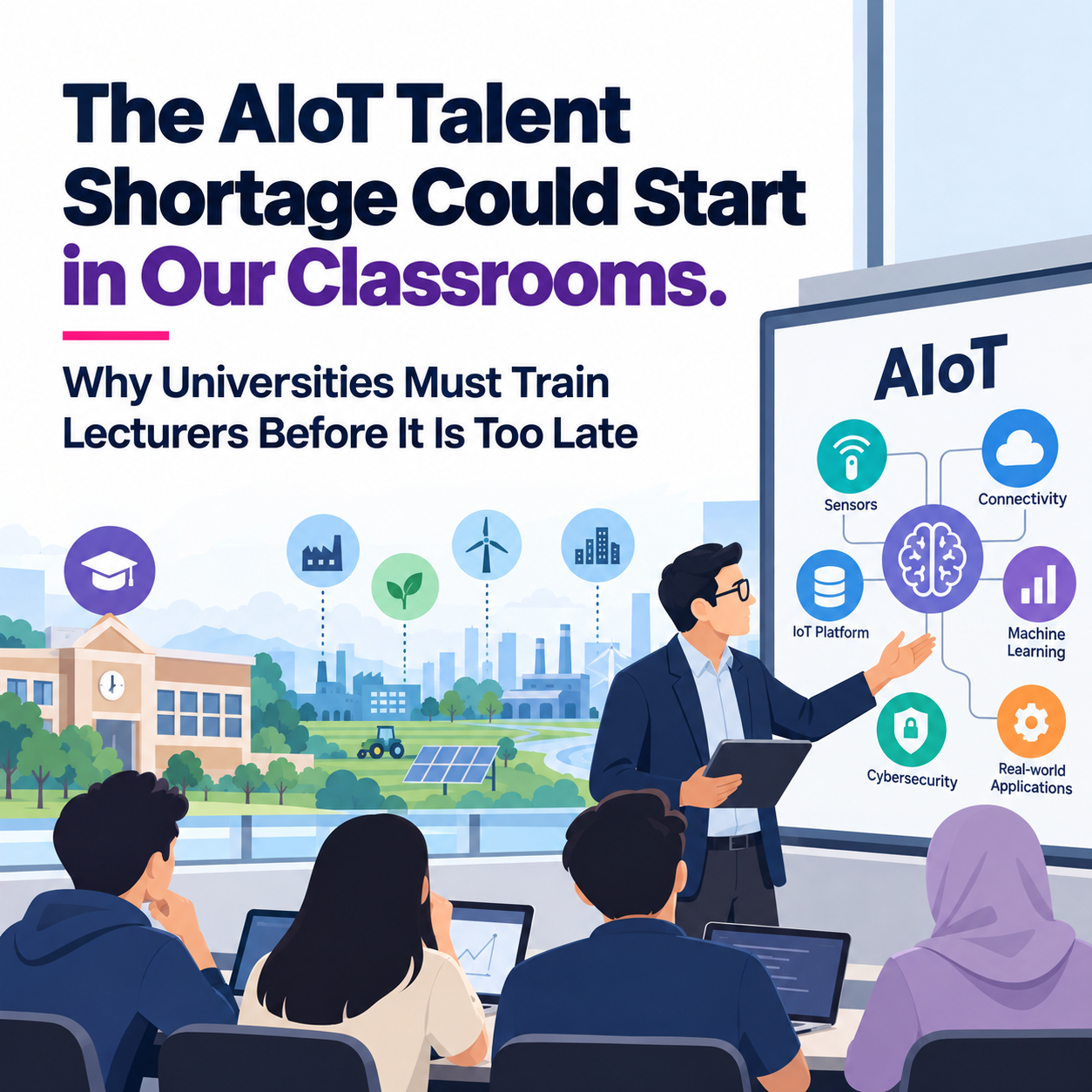
Artificial Intelligence is becoming a common subject in higher education. But developing professionals who understand how AI works with sensors, connected equipment and real-time operational data presents a different challenge.
Artificial Intelligence of Things (AIoT) combines IoT connectivity, data platforms, machine learning and intelligent decision support. Its applications extend across manufacturing, energy, agriculture, environmental monitoring and smart cities.
As industries explore intelligent connected systems, universities and polytechnics have an opportunity to develop specialist AIoT talent before demand becomes more widespread.
The challenge is not simply introducing another course. It is preparing educators who can teach the combination of technologies required to build real AIoT solutions.
Why AIoT Expertise Is Still Uncommon
AIoT requires knowledge across several disciplines that are traditionally taught separately.
An electronics engineer may understand sensors and microcontrollers but have limited machine learning experience. A data scientist may understand predictive algorithms but lack knowledge of industrial connectivity. A software developer may build applications without understanding how physical equipment generates data.
An AIoT specialist connects these capabilities into a functioning system.
Six areas are particularly relevant:
- Sensors and embedded systems: Understanding physical measurements and device programming.
- IoT connectivity: Working with MQTT, HTTP, LoRaWAN, Wi-Fi and cellular communication.
- IoT platforms: Managing devices, data collection, storage and dashboards.
- Machine learning: Applying forecasting, anomaly detection and classification.
- Edge computing and cybersecurity: Processing data securely and protecting connected infrastructure.
- Operational knowledge: Understanding how information supports real business decisions.
Developing these skills requires practical learning, multidisciplinary collaboration and exposure to industry problems.
Why Lecturer Training Must Come First
Universities frequently focus on revising curricula, purchasing laboratory equipment or introducing new degree programmes when preparing for emerging technologies.
These activities are useful, but they cannot replace lecturer readiness.
A university may have modern laboratories and computing facilities, yet struggle to deliver practical AIoT education if lecturers have limited experience building complete connected systems.
Training lecturers early creates several benefits:
1. Faster Curriculum Development
Lecturers with AIoT knowledge can introduce relevant topics into existing electronics, telecommunications, computer science and engineering programmes without waiting for an entirely new degree structure.
2. Better Practical Teaching
Trained lecturers can guide students through sensor connectivity, data collection, machine learning experiments and operational dashboards.
3. Stronger Final-Year Projects
Students can develop complete AIoT applications rather than isolated sensor demonstrations or software models.
4. More Industry-Relevant Research
Lecturers can identify opportunities involving predictive maintenance, environmental intelligence, energy management and connected infrastructure.
5. Greater Knowledge Sharing
A small group of trained lecturers can conduct internal workshops, mentor colleagues and help establish multidisciplinary teaching teams.
6. Stronger Industry Collaboration
Educators who understand AIoT systems are better positioned to engage companies, discuss technical requirements and develop joint projects.
The benefits extend beyond individual lecturers. Each trained educator can influence successive groups of students over many years.
A Practical AIoT Training Roadmap for Universities
Educational institutions do not need to introduce a comprehensive AIoT programme immediately.
A phased approach can reduce costs while building internal expertise.
Phase 1: Train the Trainers
Select lecturers from electronics, computer science, telecommunications, mechatronics and related disciplines for foundational AIoT training.
The training should include hands-on exercises involving sensors, connectivity, IoT platforms, dashboards and basic machine learning.
Phase 2: Develop Internal Teaching Modules
Trained lecturers can introduce AIoT topics into existing subjects, laboratory exercises and technical workshops.
Phase 3: Launch Multidisciplinary Student Projects
Students from different departments can collaborate on intelligent energy monitoring, predictive equipment monitoring, smart agriculture and environmental applications.
Phase 4: Establish Industry Partnerships
Universities can work with technology companies and system integrators to obtain real operational problems, technical guidance and project opportunities.
Phase 5: Develop Specialised AIoT Programmes
Once sufficient expertise exists, institutions can introduce micro-credentials, professional certifications, specialised electives or dedicated AIoT programmes.
This approach allows institutions to develop teaching capabilities progressively while managing resources.
The Early-Adopter Advantage for Students
Students who develop AIoT expertise early can build technical portfolios that distinguish them from graduates with only introductory AI knowledge.
They may also gain access to multidisciplinary research opportunities, industry projects and specialist career paths.
AIoT skills are transferable across sectors because many applications share common foundations involving sensing, connectivity, data management and intelligent analytics.
For graduates interested in entrepreneurship, AIoT also provides opportunities to develop commercial monitoring and decision-support applications.
These benefits are not automatic. They depend on practical competence, market demand and the ability to solve meaningful problems.
The Cost of Waiting
Developing academic expertise takes time. Lecturers need training, laboratory exercises must be tested, curricula require revision and students need opportunities to gain experience.
If institutions wait until AIoT becomes a common recruitment requirement, they may find themselves several years behind institutions that began preparing earlier.
The opportunity is to act before that happens.
Universities and polytechnics should begin developing AIoT educators today so that their students can become the specialists industries may need tomorrow.
The strongest AIoT education programmes will not necessarily be those with the most expensive laboratories. They will be those that combine knowledgeable lecturers, practical learning and meaningful industry collaboration.
Note: Favoriot offers an AIoT Training – check HERE


Leave a Reply