AIoT x Johor Innovation Challenge
Future Ready Johor 2026
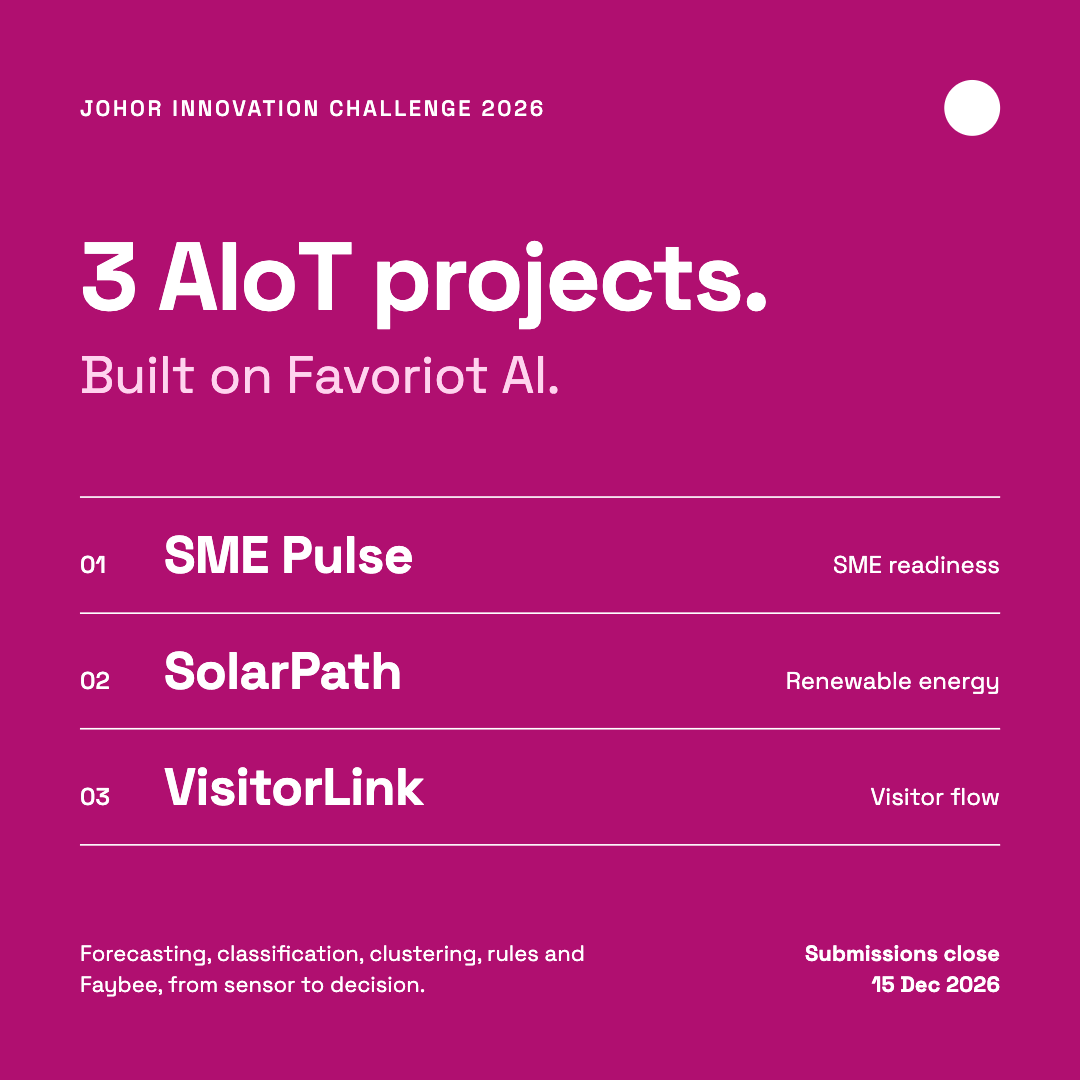
Three AIoT projects, built step by step on Favoriot AI
Each project answers one problem statement from the Johor Innovation Challenge. Every step uses a real Favoriot feature: the hierarchy, rule engine, analytics, machine learning models and the Faybee AI assistant. Plans and limits follow the September 2026 Favoriot pricing and feature matrix.
Submissions
11 Nov to 15 Dec 2026
Team size
3 to 5 members, 18+
Grand finale
17 Jan 2027, Johor Bahru
RM10,000 seed funding goes to each of the 4 champions, one per problem statement. The 20 finalist teams also share up to RM10,000 in tools and tokens during the bootcamp. Workshop 3 on 28 Nov covers using AI to research and build a mockup, which suits this plan well.
Which Favoriot plan each step needs
The step lists carry a plan tag where a feature is gated. Prices are per year in MYR, and monthly billing is also offered.
{{p.name}}
{{p.price}}
{{p.items}}
Best fit: Professional. Every ML step in this plan needs it. One project uses two or three of the 10 models, so a single team stays well inside the limit.
Tight budget path. Startup still gives dashboards, analytics, rules and the Control node. Replace the ML classifier with a Conditional filter rule and keep forecasting as a stretch goal.
Watch the data points. Free allows 500 daily data points and Maker 10,000. One reading a minute is 1,440 a day, so post every 5 to 10 minutes while testing, if each post counts as one point.
Project 1 · Problem statement 1: SME Readiness for JS-SEZ Industries
SME Pulse
An energy and ESG readiness monitor that lets a Johor SME show measured data to the larger firms it wants to supply.
The problem
Small firms are asked for digital and ESG evidence to join JS-SEZ supply chains. Most have no measured energy data, so they cannot show where they stand or what to fix first.
The solution
Clip-on energy meters stream power use to Favoriot. A trained model labels each day Efficient, Watch or Wasteful, a forecast predicts the next week, and the owner gets an alert before the bill grows.
Suggested hardware
ESP32 board, an AC energy meter module with current clamp, a temperature sensor and an optional water flow sensor. Swap in whatever the team already owns.
Build steps
{{s.n}}
{{s.title}}
{{s.feature}}
{{s.body}}
What to show the judges: a before and after kWh trend from your pilot SME, the daily efficiency label, and one alert that reached the owner on Telegram.
Project 2 · Problem statement 2: Renewable Energy Adoption Pathway
SolarPath
A rooftop solar readiness advisor that tests real sunlight and real load on pilot sites, then recommends the next step for each building type.
The problem
Homes, shops and factories hesitate on solar because they cannot tell how much power a roof would give or how much of it they would use. Guesswork stalls adoption.
The solution
A small pilot kit measures irradiance, panel output and site load. Models forecast generation and demand, group sites by usage pattern, and a rule can switch a load on when the sun is strong.
Suggested hardware
ESP32, a light or irradiance sensor, a voltage and current sensor on one small panel, an AC energy meter for site load, a relay for the controllable load.
Build steps
{{s.n}}
{{s.title}}
{{s.feature}}
{{s.body}}
What to show the judges: predicted versus measured generation on the same chart, the site clusters with a recommended pathway each, and the relay switching a load during peak sun.
Project 3 · Problem statement 4: Connecting visitors in Johor
VisitorLink
A visitor flow assistant that predicts crowding at attractions, transit stops and event venues, then points visitors to quieter options.
The problem
Visitors move between attractions, hotels and venues with no live view of queues or crowds. Operators cannot spread demand, so good places feel crowded and others stay empty.
The solution
Door and stop counters send live headcounts to Favoriot. Models forecast the next hours and label each place Quiet, Busy or Crowded. Staff get alerts and a visitor app receives the status.
Suggested hardware
ESP32 with a people counting sensor such as a time of flight or PIR pair at entrances, plus a temperature sensor. Add a GPS tracker on a shuttle if one is available.
Build steps
{{s.n}}
{{s.title}}
{{s.feature}}
{{s.body}}
What to show the judges: a live crowd map for one venue, the 12 hour forecast against what actually happened, and a Telegram alert that triggers a redirect to a quieter stop.
How the plan meets the four judging criteria
Problem statement 3, Talent for JS-SEZ Industries, is left out on purpose. It is mainly a people and skills problem, so sensors add little. A team that picks it would pair Favoriot AIoT training with a skills matching tool instead.




Leave a Reply