
A Structured Guide for Designing and Deploying AIoT Solutions Using the Favoriot Insight Framework (FIF)
1. Introduction
The adoption of Artificial Intelligence of Things (AIoT) has accelerated across industries, driven by the need for real-time visibility, predictive capabilities, and data-driven decision-making. However, many organisations struggle to translate IoT data into meaningful operational outcomes.
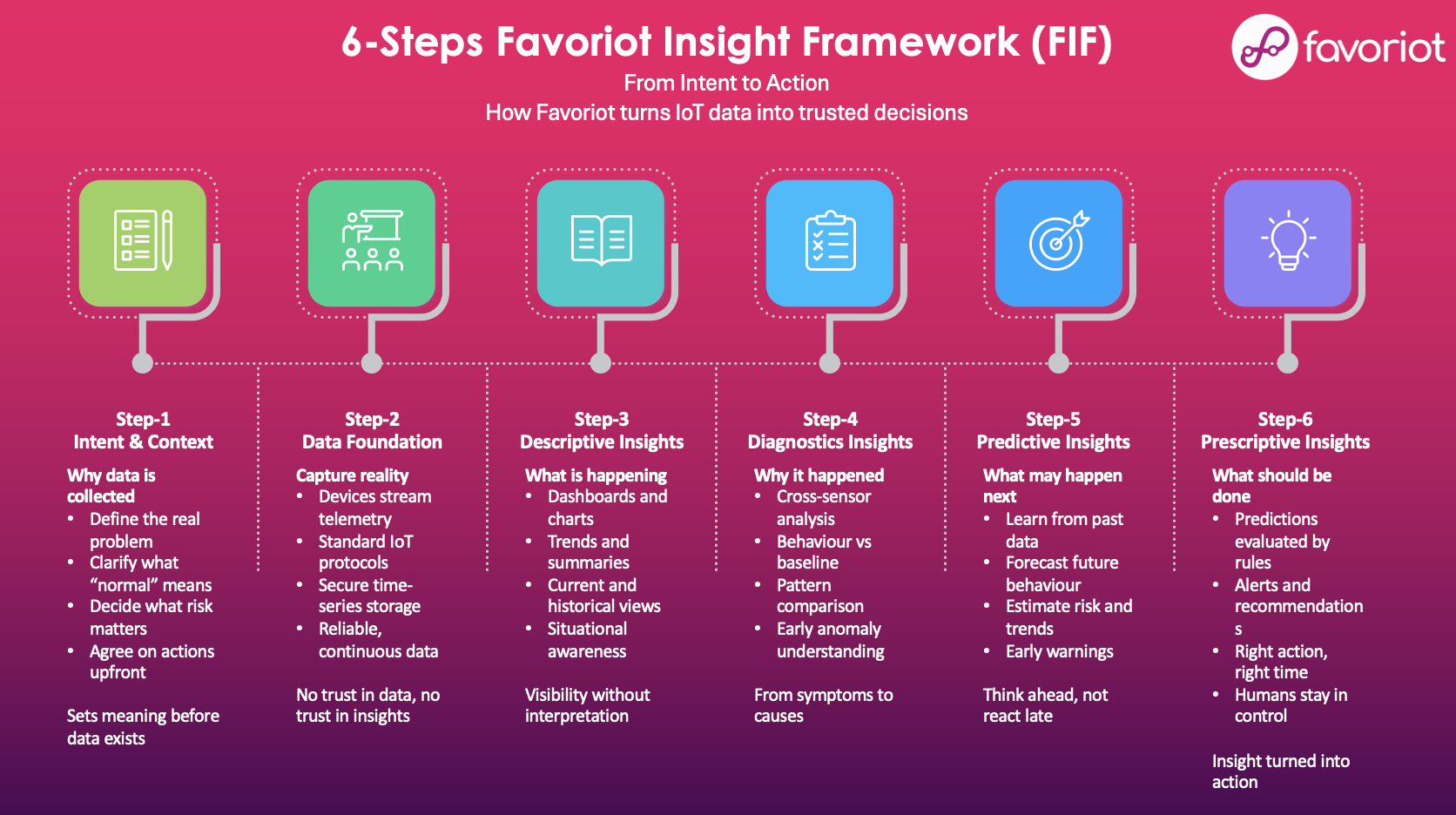
The Favoriot Insight Framework (FIF) provides a structured methodology to guide organisations from problem definition to actionable insights. This playbook serves as a practical reference for:
- AIoT solution design
- System implementation
- Training and capability development
- Consultancy and advisory engagements
It is intended for developers, system integrators, enterprises, academic institutions, and public-sector organisations seeking to build scalable, outcome-driven AIoT solutions.
2. How to Use the Playbook
This playbook can be applied in two primary ways:
2.1 Sequential Implementation
For new AIoT initiatives, follow the FIF’s six steps in sequence, from defining intent to executing actions.
2.2 System Assessment and Enhancement
For existing deployments, use the framework to assess maturity:
- Systems limited to monitoring are typically at Step 3 (Descriptive Insights)
- Systems lacking root cause analysis are below Step 4 (Diagnostic Insights)
- Systems without forecasting capabilities have not reached Step 5 (Predictive Insights)
- Systems without automated or guided actions are incomplete at Step 6 (Prescriptive Insights)
3. The FAVORIOT Insight Framework (FIF)
The FIF consists of six progressive stages. Each stage builds on the previous one, ensuring a complete transition from data collection to decision execution.

STEP 1: Intent and Context
Define the Operational Objective
Purpose
To establish a clear understanding of why data is being collected and how it will support decision-making.
Key Activities
- Define the core problem or operational challenge
- Identify business objectives and key performance indicators (KPIs)
- Establish baseline conditions and acceptable thresholds
- Determine risks and required responses
Deliverables
- Problem Definition Document
- KPI Framework
- Risk and Action Matrix
Outcome
A well-defined context that ensures all subsequent data and analytics efforts are aligned with business objectives.
STEP 2: Data Foundation
Establish a Reliable Data Infrastructure
Purpose
To ensure consistent, secure, and accurate data collection from physical assets.
Key Activities
- Select and deploy appropriate sensors and devices
- Design connectivity architecture (e.g., WiFi, Cellular, LoRaWAN)
- Implement data ingestion via APIs or Edge Gateway
- Structure and store data in a time-series format
- Ensure data integrity, continuity, and security
Deliverables
- System Architecture Diagram
- Data Model and Schema
- Connectivity and Deployment Plan
Outcome
A trusted data pipeline that supports reliable analytics and decision-making.
STEP 3: Descriptive Insights
Enable Real-Time Visibility
Purpose
To provide operational awareness through data visualisation and monitoring.
Key Activities
- Develop dashboards for real-time and historical data
- Visualise key performance indicators
- Configure threshold-based alerts
- Monitor trends and anomalies
Deliverables
- Operational Dashboards
- KPI Monitoring Views
- Alert Configuration
Outcome
Clear visibility into current system performance and conditions.
STEP 4: Diagnostic Insights
Identify Root Causes
Purpose
To analyse data relationships and determine the underlying causes of observed events.
Key Activities
- Perform cross-sensor and cross-variable analysis
- Compare actual performance against baseline conditions
- Identify patterns and correlations
- Detect anomalies and deviations
Deliverables
- Root Cause Analysis Reports
- Correlation and Pattern Models
- Anomaly Detection Rules
Outcome
A deeper understanding of system behaviour, enabling informed decision-making.
STEP 5: Predictive Insights
Forecast Future Conditions
Purpose
To anticipate potential issues and trends using historical and real-time data.
Key Activities
- Develop and train predictive models
- Forecast operational trends and risks
- Generate early warning signals
- Estimate probabilities of failure or deviation
Deliverables
- Predictive Models (Machine Learning / Statistical)
- Forecast Reports
- Risk Indicators and Alerts
Outcome
Improved ability to anticipate and mitigate risks before they occur.
STEP 6: Prescriptive Insights
Drive Action and Decision Execution
Purpose
To translate insights into actionable recommendations and operational responses.
Key Activities
- Define decision rules and workflows
- Configure alerts with recommended actions
- Automate responses where appropriate
- Integrate with external systems and processes
Deliverables
- Decision and Response Playbooks
- Alert and Notification Systems
- Workflow Automation Configurations
Outcome
Timely and informed actions that improve operational performance and outcomes.
4. Integrated Value of FIF
The strength of the FIF lies in its structured progression:
- Steps 1–2: Establish meaning and data reliability
- Steps 3–4: Build understanding and analytical depth
- Steps 5–6: Enable proactive and actionable decision-making
Organisations that do not progress beyond descriptive analytics often fail to realise the full value of AIoT investments.
5. Common Implementation Challenges
5.1 Lack of Clear Problem Definition
Projects initiated without a well-defined objective often result in underutilised systems.
5.2 Data Quality Issues
Inconsistent or incomplete data undermines analytics and decision-making.
5.3 Over-Reliance on Dashboards
Visualisation alone does not provide sufficient insight for operational improvement.
5.4 Absence of Predictive Capabilities
Without forecasting, organisations remain reactive rather than proactive.
5.5 Missing Action Layer
Insights without corresponding actions fail to deliver business value.
6. Sample Application: Smart Agriculture
Objective
Improve crop yield and reduce water wastage.
Implementation Using FIF
- Step 1: Define irrigation optimisation goals
- Step 2: Deploy soil moisture and environmental sensors
- Step 3: Monitor farm conditions via dashboards
- Step 4: Analyse correlations between irrigation and crop health
- Step 5: Predict irrigation requirements based on weather and soil data
- Step 6: Trigger irrigation recommendations or automated control
Result
Improved resource utilisation and more consistent agricultural output.
7. Target Users
This playbook is designed for:
- Developers building AIoT applications
- System integrators delivering end-to-end solutions
- Enterprises deploying IoT systems at scale
- Academic institutions conducting AIoT training and research
- Government agencies implementing smart infrastructure
8. Conclusion
The success of AIoT initiatives depends not only on technology deployment but also on the ability to convert data into meaningful, timely actions.
The Favoriot Insight Framework (FIF) provides a structured pathway to achieve this by guiding organisations through six essential stages, from defining intent to executing decisions.
By following this playbook, organisations can move beyond data collection and visualisation toward achieving measurable operational outcomes through AIoT.



Leave a Reply