
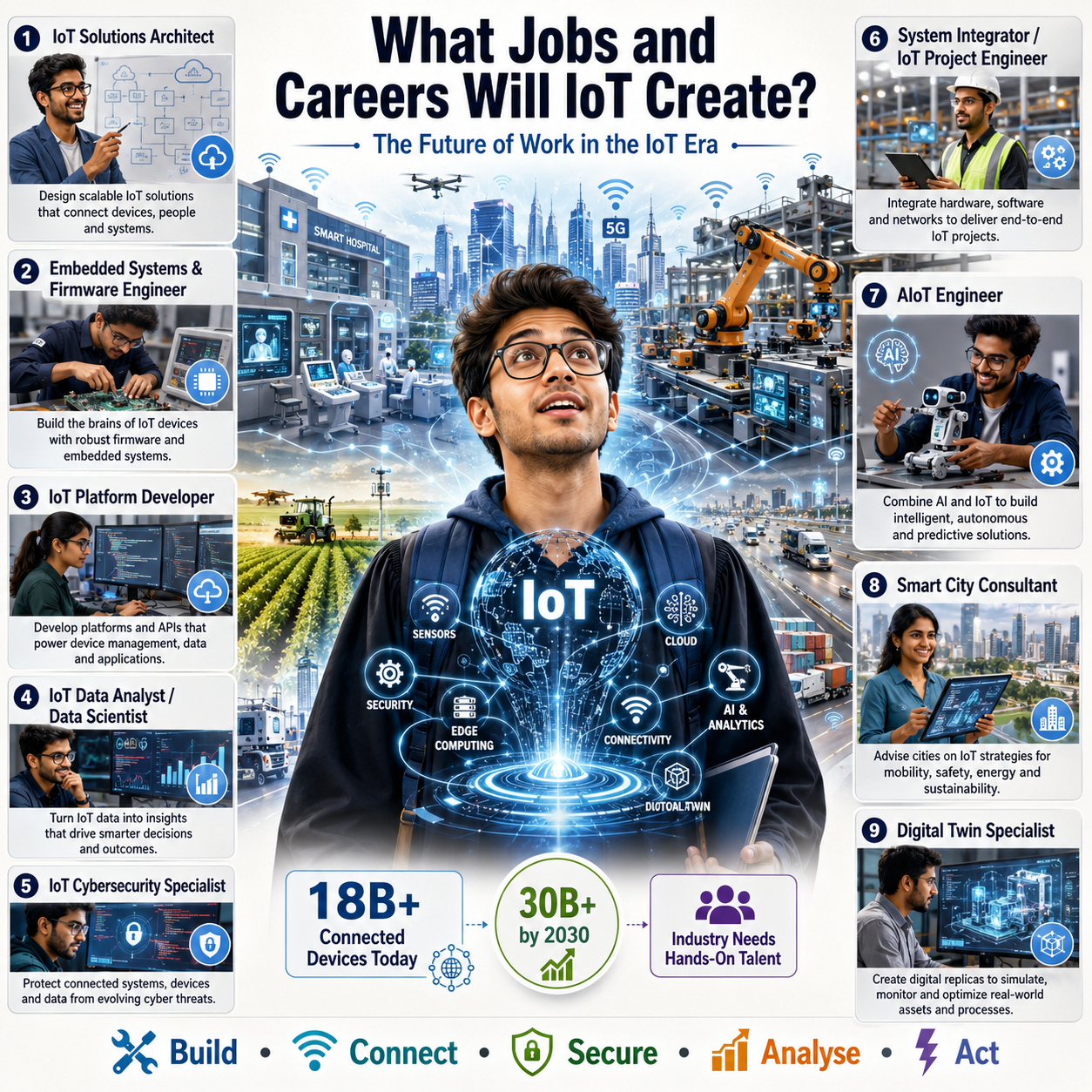
What if the job your child will spend their career in does not have a name yet?
That is not a hypothetical. That is the reality of the Internet of Things industry right now. IoT is not simply a technology trend. It is an economic restructuring that is quietly and systematically building an entirely new category of work. And most students, parents, and career advisors have not caught up with what that actually means.
The question is not whether IoT will create jobs. It already is. The more important question is whether the next generation of graduates will be positioned to fill them, or whether industry will spend the next decade searching for talent that never showed up.
The Scale of the Opportunity Is Difficult to Overstate
There are already over 18 billion connected devices in the world. By 2030, that number is projected to exceed 30 billion. Each of those devices needs to be designed, manufactured, deployed, connected, secured, maintained, and eventually replaced. Each one generates data that needs to be collected, processed, analysed, and acted upon. Each deployment sits inside a business that needs someone to explain what the data means and what should be done next.
None of that happens automatically. It all requires people.
The IoT skills gap is already being discussed in boardrooms, at industry conferences, and in government workforce planning circles across Southeast Asia, Europe, and North America. The gap is not in funding. It is not in ambition. It is in qualified people. The market wants IoT professionals and cannot find enough of them.
The Roles That Are Already in Demand
IoT careers span a wider range than most people realise. The field is not exclusively for hardware engineers or software developers. It reaches into data science, business strategy, security, urban planning, agriculture, healthcare, and manufacturing. The following roles represent where talent is most urgently needed today.
IoT Solutions Architect
The architect sits at the intersection of hardware, software, connectivity, and business requirements. This person designs the full system: which sensors to use, how data flows from device to cloud, which protocols are appropriate for the environment, and how the platform integrates with enterprise systems. Architects are among the most sought-after and highest-paid professionals in the field.
Embedded Systems and Firmware Engineer
Every IoT device runs software at its core. Embedded engineers write the firmware that tells a sensor how to read data, when to transmit, how to conserve power, and how to recover from failure. This role requires proficiency in C or C++, deep understanding of microcontrollers such as ESP32 and STM32, and experience with real-time operating systems.
IoT Platform Developer
Platforms are the central nervous system of any IoT deployment. Developers who can build on top of, integrate with, and extend IoT platforms are in high demand. This includes API integration work, dashboard development, rule engine configuration, and the construction of data pipelines that move information from device to application layer.
IoT Data Analyst and Data Scientist
Sensor data is only valuable if someone can extract insight from it. IoT data roles involve working with time-series data, identifying anomalies, building predictive models, and translating raw sensor readings into operational recommendations. As artificial intelligence becomes embedded in IoT systems, these roles increasingly require familiarity with machine learning and model deployment at the edge.
IoT Cybersecurity Specialist
Security is arguably the most underfunded and understaffed area in the entire IoT ecosystem. A connected water treatment plant, a smart hospital ward, or a logistics fleet represents an attack surface that did not exist a decade ago. IoT security specialists are responsible for threat modelling, secure firmware design, network segmentation, and incident response. Demand for this profile is growing faster than supply.
System Integrator and IoT Project Engineer
System integrators are the companies that take IoT components and turn them into functioning solutions for clients. The engineers and project managers inside these organisations are responsible for scoping, building, deploying, and supporting real installations. These roles require both technical depth and the ability to communicate clearly with non-technical stakeholders.
The Careers That Are Still Being Named
Beyond the roles that already exist, IoT is generating entirely new career categories that did not have clear definitions five years ago and will be mainstream within the next decade.
AIoT Engineer is one of them. As artificial intelligence moves from centralised cloud servers to the devices themselves, a new discipline has emerged that sits at the intersection of embedded engineering and machine learning. AIoT engineers design and deploy AI models that run on resource-constrained hardware: a camera that detects intruders without sending video to the cloud, a motor controller that predicts failure before it happens, an environmental sensor that classifies air quality in real time.
Smart City Consultant is another. Governments and municipal authorities are deploying IoT systems for traffic management, flood monitoring, energy optimisation, and public safety. They need professionals who understand both the technical architecture and the public policy dimensions of those deployments. This is not a pure engineering role. It requires strategic thinking, stakeholder management, and an ability to translate complex system capabilities into outcomes that matter to communities.
Digital Twin Specialist is a third. A digital twin is a virtual model of a physical system, updated continuously with real sensor data. Managing and interpreting digital twins for buildings, factories, and infrastructure is becoming a standalone discipline with its own tooling, methodologies, and certification pathways.
What Industry Actually Wants to See
Speaking to companies across Southeast Asia that are actively hiring IoT talent, a consistent picture emerges. Employers do not just want graduates who know the theory. They want graduates who have already built something.
A graduate who can demonstrate a working prototype, explain the design decisions they made, describe what broke and how they fixed it, and show a live dashboard pulling real sensor data walks into an interview with a significant advantage over a candidate who can describe the same concepts from a textbook.
This is why the choice of training environment matters as much as the curriculum. Students who learn IoT on a structured platform like Favoriot gain exposure to device management, data streaming, API integration, dashboard configuration, and rule-based alerting in a single coherent environment. They leave their training programme with a portfolio of working systems rather than a collection of disconnected lab exercises.
That kind of practical readiness is what shortens the gap between graduation and genuine productivity. Employers have noticed the difference.
A Word to Parents Making Career Decisions with Their Children
The advice that was sound twenty years ago, choose a stable profession in a known field, was rational for a world that changed slowly. That world no longer exists.
IoT is not a niche for technology enthusiasts. It is the infrastructure layer of the next industrial economy. Smart factories, connected hospitals, precision agriculture, intelligent transportation systems, and data-driven cities are not aspirational projects. They are active deployments generating real revenue and real employment today.
A young person who builds genuine competence in IoT, whether through a university programme, a structured online course, or a hands-on training environment, is positioning themselves for a career that is unlikely to be automated away and highly likely to grow in scope and compensation over the next two decades.
The earlier that journey begins, the more ground can be covered before the first job interview.
Where to Begin
The path into IoT does not require a specific undergraduate degree. Engineers, computer scientists, data scientists, and business graduates have all found meaningful roles in this industry. What matters more than the degree title is the practical experience accumulated along the way.
Programmes like FAVORIOT Academy are designed specifically for this gap. They are structured to take a participant from foundational concepts through to working deployments using the same platform tools that industry actually uses. The curriculum covers device connectivity, data management, dashboard creation, and AIoT integration in a progressive sequence that mirrors real project work.
For students who want to understand what an IoT career actually looks like from the inside, hands-on training with a structured platform and real hardware is the most direct path to that understanding.
The IoT industry is not waiting. Companies are deploying systems now. Cities are connecting infrastructure now. Factories are automating now. The question is not whether this wave is coming. The question is whether the next generation of talent will be on it or watching it pass.
What field would you encourage a student today to build deep expertise in, and how much of that decision is based on what the industry needs rather than what is most familiar?
Dr. Mazlan Abbas is the CEO of Favoriot, an IoT platform company focused on enabling connected solutions across Southeast Asia espeically Malaysia. He writes regularly on IoT strategy, AIoT education, and the future of connected industries at iotworld.co.


Leave a Reply