

The question organisations almost never ask after a successful pilot is the most important one: if this worked so well in one location, why has no one replicated it?
The Pilot That Never Grows Up
Across factories, campuses, logistics hubs, and municipal infrastructure projects throughout Southeast Asia and beyond, a familiar story keeps repeating. An organisation invests in an IoT pilot. Sensors are deployed. A dashboard comes alive with real-time data. Executives visit the site, nod approvingly, and declare the project a success. Then nothing happens.
Six months later, the pilot is still a pilot. The dashboard is still showing data from the same twelve sensors. The vendor is still waiting for a purchase order that never arrives. And somewhere inside the organisation, someone quietly moves on to the next initiative.
This is not a technology failure. It is a systems failure. And the blame, when distributed honestly, lands in places that are rarely examined.
The Comfortable Illusion of “Proof of Concept”
The first problem is definitional. Most organisations treat a pilot as proof that the technology works. It is not. A pilot only proves that a technology can be made to work under controlled conditions, with dedicated attention, vendor support on speed dial, and a team that has been specifically assembled to make the project succeed.
Proof of concept and proof of scalability are entirely different things. An organisation that confuses one for the other is not making a bad decision. It is making no decision at all. It is postponing the harder question: what would it actually take to make this work everywhere?
That question demands a different kind of thinking. It requires asking about data architecture, not just sensor placement. It requires thinking about who owns the data after the vendor leaves. It requires confronting the fact that the IT department, the operations team, and the procurement committee may all have fundamentally different definitions of what “success” looks like.
Where the Blame Actually Lives
There is a tendency to locate the problem in the technology. The platform was not enterprise-ready. The connectivity was unreliable. The hardware was not ruggedised for the environment. These are real problems, but they are rarely the primary reason pilots fail to scale.
The more uncomfortable reality is that most pilots fail to scale because the organisation was never structured to absorb them.
Vendors often carry a share of this blame. A pilot designed primarily to win a deal is engineered for impressiveness, not for integration. It is built to demonstrate what is possible, not to surface what will be difficult. The sensors are placed where the data looks cleanest. The dashboard is configured to highlight the most compelling metrics. The entire experience is curated in a way that masks the genuine complexity that would emerge at scale.
But organisations are not passive victims here. Procurement cycles that favour lowest upfront cost consistently produce pilots that cannot be extended without re-tendering. Internal champions who drive a pilot forward rarely have the institutional authority to mandate adoption across departments. And executives who celebrate a pilot result without asking the scaling question are, in effect, giving permission for the project to stall.
The Architecture Question That Gets Skipped
Every IoT pilot that fails to scale was built for one thing: demonstrating value at a single point in time. Very few are built on an architecture that was designed from the outset to support multiple sites, multiple device types, multiple user roles, and multiple data pipelines running simultaneously.
This is the conversation that happens too late, if it happens at all. The question of whether the platform is multi-tenant, whether it supports white-labelling for different business units, whether its APIs can connect to the organisation’s existing enterprise systems and these questions rarely make it into the pilot brief.
They should be the first questions asked.
An IoT platform that can manage one site can be impressive. A platform that can manage a hundred sites, with isolated data environments for each business unit, standardised device onboarding, and centralised analytics, is a fundamentally different proposition. Building the pilot on the wrong foundation does not just delay scale. It makes scale impossible without starting over.
Platforms built with this in mind such as Favoriot, which has supported multi-site deployments across smart cities, agriculture, and industrial operations since 2017 are designed around these questions from the ground up. The architecture is not retrofitted for scale. It is built for it.
The System Integrator’s Untold Role
System integrators sit at the centre of most IoT deployments, yet their role in the scaling failure is almost never examined. A system integrator whose business model is built around project delivery has little structural incentive to design for managed services at scale. Every new site deployment is a new project. Every new project is new revenue. The incentive to standardise and replicate is weak when differentiation and customisation are what get billed.
This is changing. The system integrators who are building genuinely scalable IoT practices are the ones who have recognised that the platform layer is not the customer’s problem to solve. They arrive with a pre-configured, pre-tested environment. They offer the organisation a reproducible template, not a bespoke build. They treat the first deployment not as a finished product but as a reusable blueprint.
That shift in thinking is what separates a pilot from a programme.
For system integrators looking for a platform that enables this model to become a standardised onboarding, replicable templates, and a data layer that scales across sites without rebuilding, see Favoriot‘s partner programme which is designed specifically around this approach. The platform handles the infrastructure layer so integrators can focus on delivering the deployment.
What Scaling Actually Requires
Scaling an IoT deployment is not about replicating the technology. It is about replicating the conditions under which the technology works. That means standardising device onboarding so that adding a new site does not require a new engineering engagement. It means building dashboards on role-based access so that different stakeholders see what is relevant to them without compromising data governance. It means connecting the IoT data layer to the decision-making layer so that the output of a sensor array does not end its journey on a screen that no one checks.
It also means being honest about what a pilot is. A pilot is a hypothesis. It tests whether a problem can be solved with a particular approach. It is not a commitment, and it is not a product. Treating it as either one is where the trouble begins.
The Question Worth Asking Now
The organisations that are successfully scaling IoT deployments today are not the ones with the most advanced technology. They are the ones that asked a different question at the beginning. Not “can we make this work?” but “if this works, how do we make it work everywhere?”
That question changes everything. It changes the platform selection criteria. It changes the vendor brief. It changes the role of the system integrator. And it changes what success looks like at the end of a pilot.
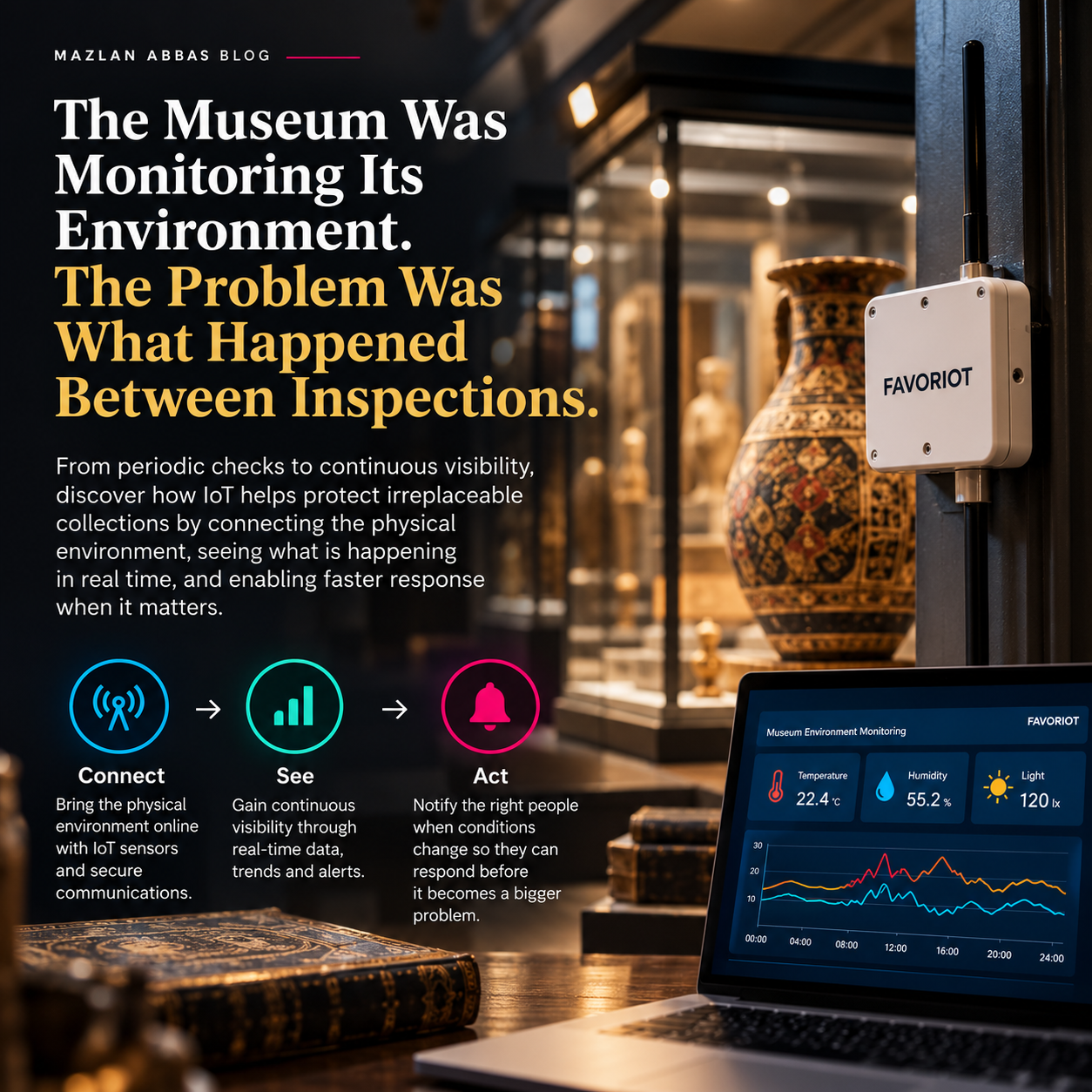
One practical way to stress-test a pilot brief against this question is to apply a simple scaling lens: does the platform you are choosing allow you to Connect data from multiple device types, See operations across multiple sites in real time, and Act on insights without rebuilding the data layer each time? If the answer to any of those three is unclear at pilot stage, the architecture conversation has been skipped.
The technology has never been the limiting factor. The thinking has.
What would your organisation need to change, right now, to make your next pilot the first deployment of a programme rather than the last deployment of a proof of concept?
If you are working through the pilot-to-programme transition and want to see how other organisations have approached the architecture and platform questions, the IoT project case studies on this site are a practical starting point and Favoriot’s platform is where much of that work has been deployed.
Dr. Mazlan Abbas is the CEO and Co-Founder of Favoriot, an AIoT platform company focused on helping organizations connect, learn from, and act on real-world data. He writes regularly on IoT and entrepreneurship at mazlanabbas.com and iotworld.co.




Leave a Reply