
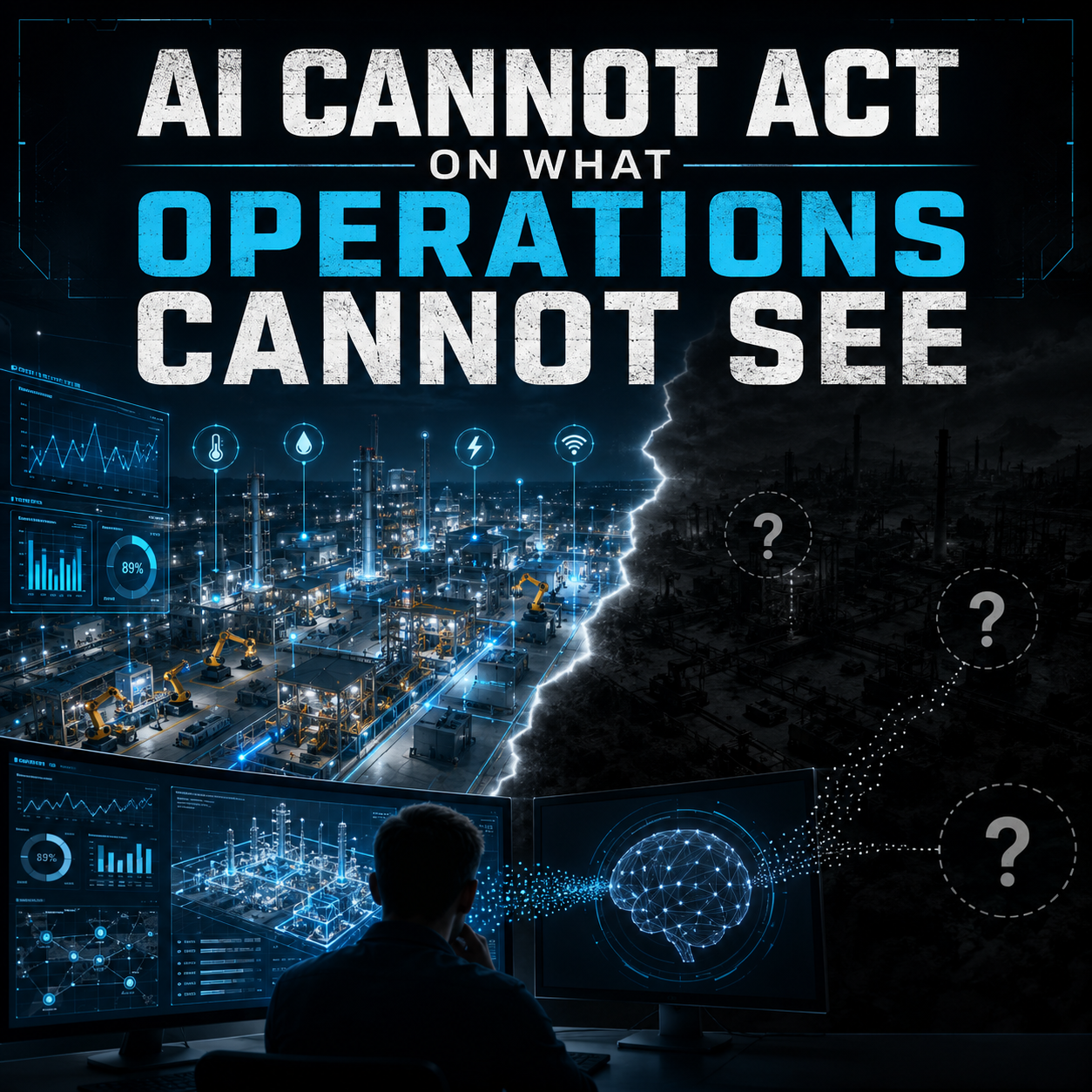
What happens when a company hands its most advanced technology a job it was never equipped to do?
That is effectively what is happening across manufacturing floors, cold chains, smart buildings, and utility networks right now. Enterprises are racing to deploy AI agents that promise to reroute shipments, adjust production schedules, and flag equipment failures before they happen. Yet in most operations, that promise runs into a wall the algorithms cannot climb over: the operation itself cannot see what is happening in real time.
AI does not fail because the models are weak. It fails because it is being asked to act on operations that are still, in a very literal sense, blind.
The Gap Nobody Budgeted For
Gartner projects that by 2027, 60 percent of AI projects will be abandoned simply because organizations lack AI-ready data. That is not a modeling problem. It is a visibility problem, and it predates every AI initiative built on top of it.
The pattern shows up early and often. According to recent industry research, 42 percent of companies abandoned most of their AI initiatives in 2025, up sharply from just 17 percent the year before. Ask why, and the answer rarely points to the algorithm. It points upstream, to sensor data that never reached the right system, to operational technology and IT that were never properly connected, to machines and assets that report status only when someone walks over and checks manually.
Agentic AI makes the gap harder to ignore. Nearly 60 percent of companies are investing tens or hundreds of millions of dollars into agent-based AI, yet only 15 percent report being fully prepared to deploy it in production. The investment has outpaced the infrastructure. Everyone wants the copilot. Almost nobody has finished wiring the building it is supposed to operate in.
Operational Blindness, Now With Higher Stakes
This is not a new condition. Operational blindness, the gap between what is happening on the ground and what decision makers can actually see, has quietly limited industrial performance for decades. What has changed is the cost of ignoring it.
When operational blindness meant a delayed report or a missed maintenance window, the damage was contained and usually recoverable. When it means an AI agent making decisions on incomplete or stale data, the damage compounds. A model that reroutes a cold chain shipment based on a temperature reading that is six hours old is not being cautious. It is being wrong with confidence, and it will keep being wrong at the speed and scale AI was supposed to fix.
Wireless and distributed assets make this worse. Industrial organizations increasingly depend on wireless sensors for logistics, autonomous transport, and remote monitoring, yet these remain among the largest blind spots even inside otherwise mature operations. An AI system tasked with optimizing a network it cannot fully perceive is not optimizing. It is guessing, and calling the guess an insight.
Seeing Before Acting
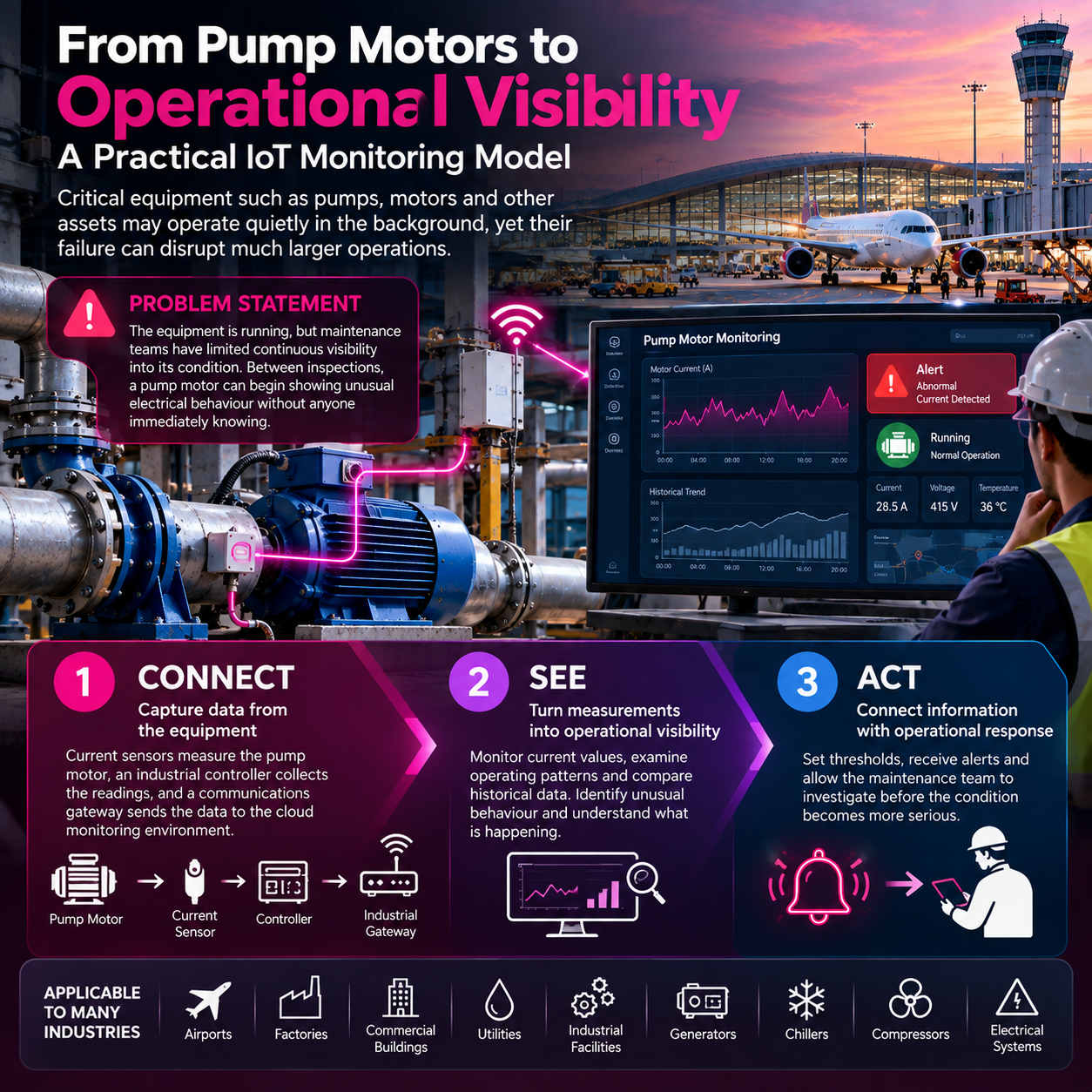
The fix is not a better algorithm. It is a foundation the algorithm can trust: continuous, real-time data flowing from physical assets into a system capable of turning raw signals into context an AI agent can act on responsibly.
This is the layer that sits beneath every successful agentic AI deployment, and it is the layer most organizations skip because it is less exciting than the AI headline sitting on top of it. Sensors have to be connected. Data has to move in real time, not in daily batch uploads. Provenance and governance have to be built in from the start, not patched on after the first bad decision.
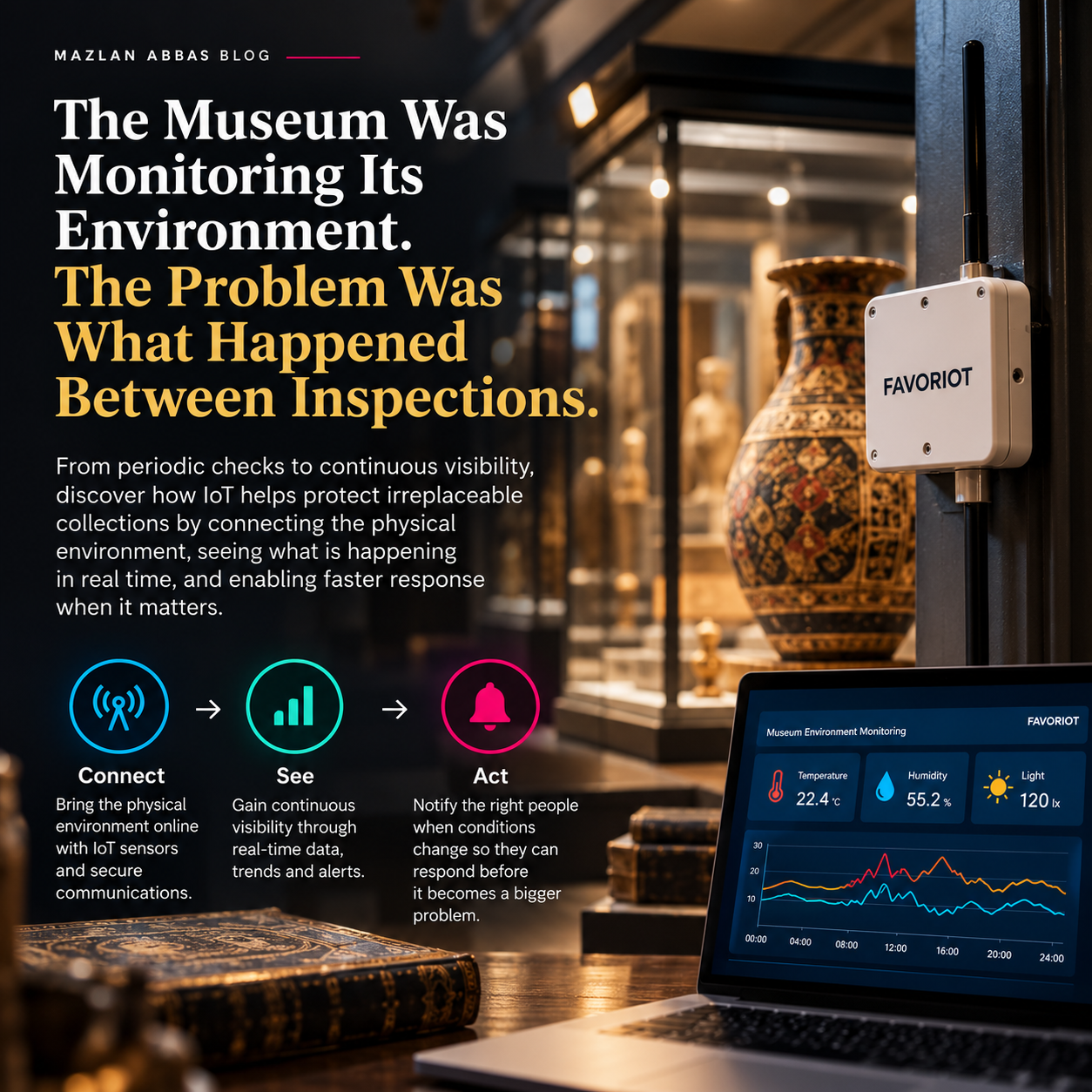
This is the quiet work AIoT platforms like FAVORIOT were built around: turning scattered sensor readings from machines, cold chains, and buildings into a continuous, structured stream that an AI agent can actually reason over. Not another dashboard to check, but the connective tissue between the physical asset and the decision layer sitting above it. Without that layer, an AI agent is a brain with no eyes, reasoning confidently over a world it cannot actually observe.
Organizations that get this right are not chasing a flashier model. They are closing the distance between the physical operation and the digital decision, one sensor, one data pipeline, one connected asset at a time. By the time an AI agent is asked to reroute a shipment or shut down a failing machine, the visibility work has already been done quietly, months earlier, by people who understood that intelligence without sight is just a well-dressed guess.
The Question Worth Sitting With
Every organization currently piloting AI agents should ask itself a simpler question first: does the operation actually see itself, in real time, before it hands that view to a machine and asks it to act?
Most will find the honest answer is no. The interesting part is not the answer itself. It is what each organization decides to do about it, and how long it is willing to let its AI agents operate on a version of reality that no longer exists by the time the data arrives.
Sources:
- The Data Problems Undermining Midmarket AI Projects In 2026
- AI Project Failure Rate 2026: 80% Fail | Pertama Partners
- Agentic AI Readiness Index 2026: The Gap Between Investment and Data Maturity | E3 Magazine
- Data and agentic AI: the seven trends that will shape 2026 – Izertis



Leave a Reply