
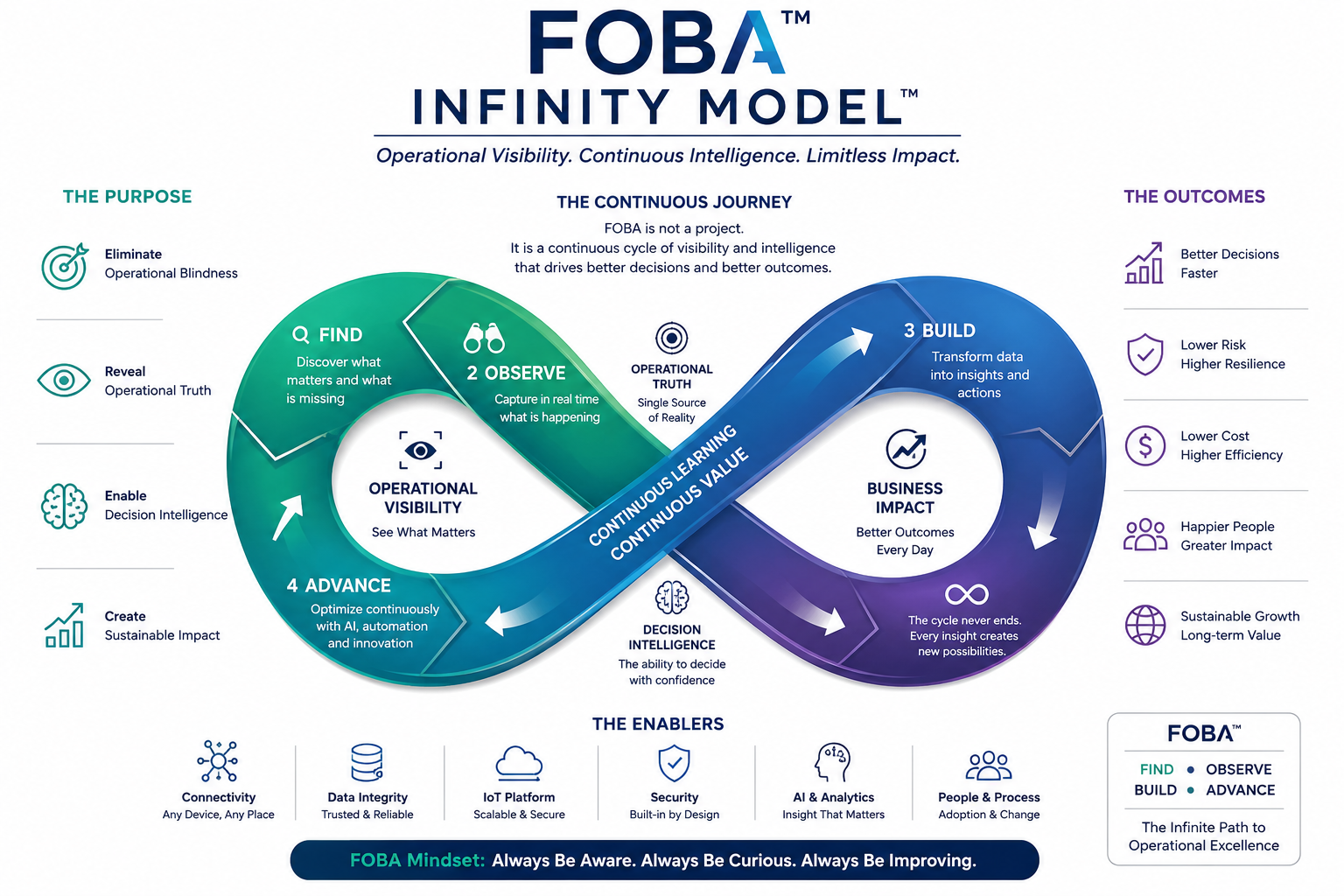
What if the biggest threat to your organization isn’t the crisis you’re firefighting today, but the one you can’t see at all? Every operations leader has lived this moment. A machine fails without warning. A process quietly bleeds cost for months before anyone notices. A decision gets made on gut feel because the data arrived too late to matter. This is operational blindness, and it is far more common than most executives want to admit. Mazlan Abbas has spent years studying why organizations struggle to turn data into decisions, and decisions into outcomes. Out of that work comes the FOBA Infinity Model, a framework built on a simple but uncomfortable truth: you cannot manage what you cannot see, and you cannot improve what you do not understand.
The Problem With Standing Still
Most organizations treat operational improvement as a project. They deploy sensors, install a dashboard, run a pilot, declare victory, and move on. Six months later, the same blind spots resurface in a new disguise. FOBA rejects that mindset entirely. It is not a project with a start and end date. It is a continuous loop, shaped deliberately like the infinity symbol, because operational excellence is not a destination. It is a discipline of always being aware, always being curious, and always being in motion toward improvement. The name itself is the roadmap: Find, Observe, Build, Advance.

Find: Discover What Matters and What Is Missing
The cycle begins with Find. Before any organization can improve, it has to know what it does not know. This stage is about discovery, surfacing the gaps, blind spots, and unmonitored processes that quietly drain performance. It is the uncomfortable but necessary first step of admitting that visibility has limits.
Observe: Capture Reality in Real Time
Once the gaps are known, Observe takes over. This is where connectivity, sensors, and IoT platforms capture what is actually happening on the ground, in real time, without filters or delay. Observe is the mechanism that produces what the model calls Operational Truth, a single source of reality that everyone in the organization can trust. Without this shared truth, teams argue over whose data is right instead of solving the actual problem. Together, Find and Observe form the left side of the infinity loop: Operational Visibility. This is the foundation. You cannot skip ahead to intelligence or impact without first seeing clearly.
Build: Turn Data Into Decisions
Crossing to the right side of the loop, Build transforms raw observation into insight and action. This is where AI and analytics earn their keep, converting streams of data into Decision Intelligence, the ability to decide with confidence rather than guesswork. A dashboard full of numbers is not intelligence. Intelligence is knowing what to do next because the data has been shaped into a clear signal.
Advance: Never Stop Optimizing
The final stage, Advance, is where automation and innovation take the wheel to optimize continuously. This is the stage most organizations get wrong, because they treat it as the finish line. In the FOBA model, Advance loops back into Find. Every insight creates new possibilities, and every improvement reveals the next blind spot worth investigating. The cycle never ends, and that is precisely the point. Build and Advance together form the right side of the loop: Business Impact, delivering better outcomes every single day rather than a one-time bump.
The Enablers Behind the Loop
None of this happens by accident. The FOBA model rests on six enablers working in concert: connectivity that reaches any device in any place, data integrity that ensures the information can be trusted, an IoT platform that scales securely, security built in by design rather than bolted on afterward, AI and analytics that surface insight that actually matters, and people and process, because no technology adopts itself. Organizations that lean too heavily on one enabler while neglecting the others tend to stall out. A brilliant AI model fed by unreliable data is worse than no model at all.
What Organizations Actually Gain
The payoff for running this loop consistently shows up in five places. Decisions get made faster and with more confidence. Risk drops while resilience rises. Costs shrink as efficiency climbs. People become happier because they are no longer fighting fires blind, and their impact grows as a result. And perhaps most importantly, growth becomes sustainable rather than a temporary spike followed by another plateau. These are not abstract promises. They are the natural output of an organization that has replaced guesswork with Operational Truth and hesitation with Decision Intelligence.
Why the Shape Matters
The infinity symbol was not chosen for aesthetics. It is a deliberate rejection of the linear project mindset that has failed so many digital transformation efforts. Linear projects have endpoints, budgets that run out, and momentum that fades. A loop has none of these limitations. It only asks one thing of the organization: keep moving through it. The FOBA mindset can be summed up in one line: always be aware, always be curious, always be improving.
Where Does Your Organization Sit on the Loop
Most leaders reading this will recognize their organization somewhere on this infinity symbol, likely stuck rather than circling. Some are stuck at Find, still arguing about what data even matters. Others reached Observe years ago and never moved past dashboards nobody trusts. Few make it all the way to Advance and fewer still loop back to Find with the discipline to start again. So here is the question worth sitting with. If operational blindness is the risk nobody talks about, where exactly does your organization stand right now, and what would it take to keep the loop moving instead of standing still?
You may check how Favoriot solves the problem of Operational Blindness.

Leave a Reply