
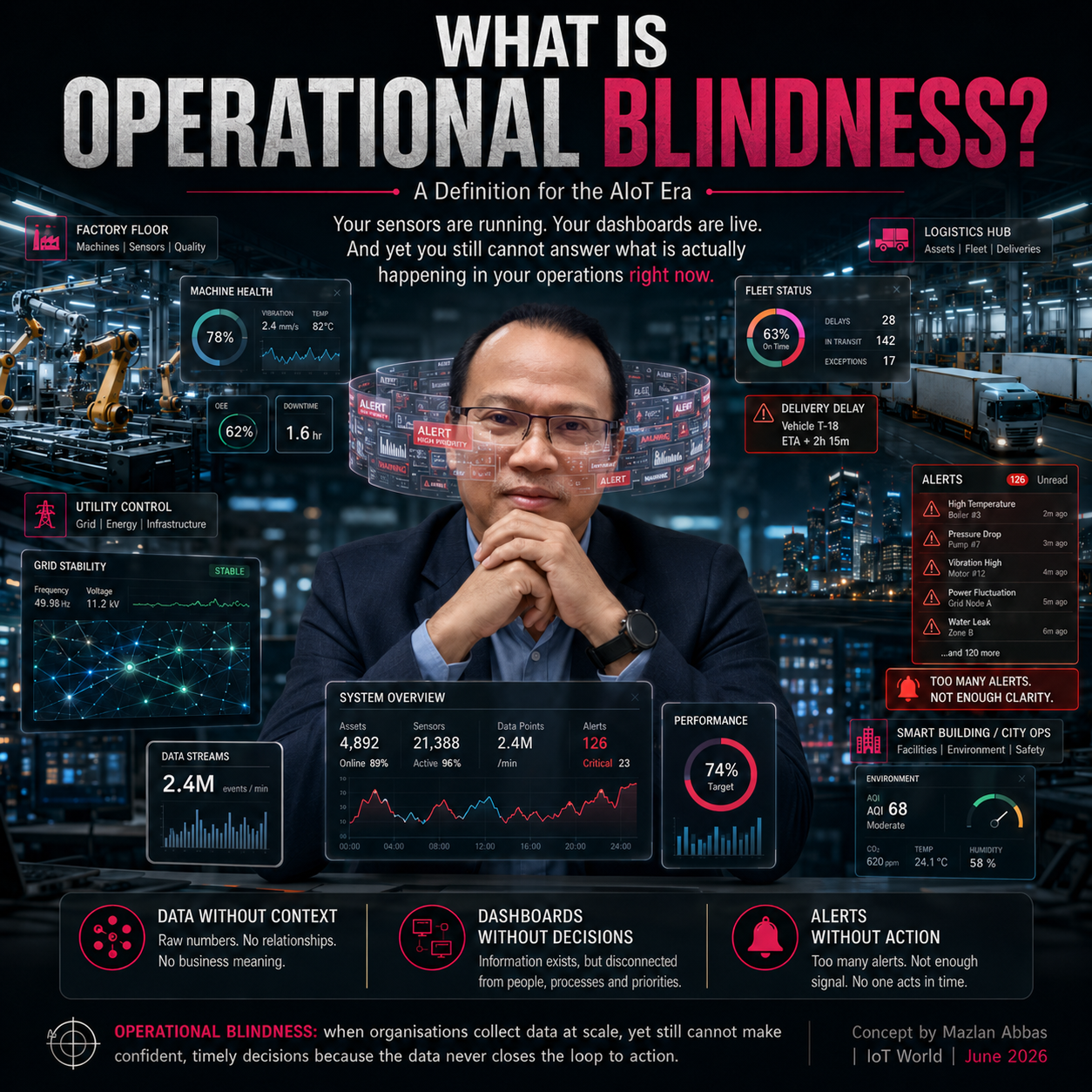
What Is Operational Blindness? A Definition for the AIoT Era
Your sensors are running. Your dashboards are live. Your reports land every morning. And yet you still cannot answer the one question that matters: what is actually happening in your operations right now?
Twenty years inside the Internet of Things teaches you a great deal about what technology can do. It also teaches you, uncomfortably, about what technology consistently fails to do, despite every promise made at every conference.
The failure I keep encountering is not a failure of sensors, or connectivity, or cloud infrastructure. Those problems are largely solved. The failure is something quieter and more damaging. It is the condition where an organisation has spent real money on IoT, deployed sensors, built a data pipeline, commissioned dashboards, hired analysts, and still cannot act confidently on what the data is telling them.
I have seen enough IoT deployments across several countries, from factory floors to utility substations, from municipal control rooms to logistics depots, to know that this condition is widespread, undernamed, and underestimated. So I am naming it.
I call it Operational Blindness.
Operational Blindness (AIoT context) is the condition where an organisation invests in IoT infrastructure (sensors, connectivity, platforms, dashboards), collects operational data at scale, yet still cannot make confident, timely decisions because the data never closes the loop to action. The organisation sees numbers. It does not see clearly.
This is not a fringe problem. It is the dominant failure mode of IoT deployments today. And understanding it precisely is the first step toward curing it.
What Operational Blindness Is Not
Before defining what the condition is, it helps to be clear about what it is not, because the misdiagnosis is part of why it persists.
It is not a lack of data. Most organisations suffering from Operational Blindness are producing more data than they know what to do with. The sensors are working. The readings are coming in. The problem is not volume. It is translation.
It is not a technology failure. The platforms are running. The dashboards load. The alerts fire. By every technical metric, the system is functioning. And yet the operations leader still cannot answer the question that counts.
It is not a people problem. The engineers built what they were asked to build. The analysts are producing reports. The executives attended the IoT strategy sessions. Everyone is competent. Nobody is deliberately obscuring anything. The blindness is systemic, not personal.
It is not the same as inattentional blindness. Cognitive science has long described inattentional blindness: the failure to notice unexpected stimuli when attention is directed elsewhere. That is a perceptual phenomenon. What I am describing is organisational and architectural: a structural failure to convert operational signals into decisions, regardless of how much attention is paid.
The organisation is not failing to look. It is failing to see. There is a difference, and that difference is worth several million ringgit a year in avoidable losses.
How Operational Blindness Develops: Three Layers
Operational Blindness does not arrive suddenly. It accumulates in layers, often while the organisation believes it is making progress on its digital transformation journey. Here is how it builds:
The sensors produce readings. The readings arrive in a platform. Numbers appear on a screen. A temperature. A vibration frequency. A throughput count. A utilisation percentage. Individually, these are measurements. Collectively, without the operational context that gives them meaning, they are noise dressed as insight. The engineer knows what 72°C means for that specific motor in that specific facility. The operations director, looking at a dashboard of 400 data points, does not.
Analytics exist in one system. Operations run in another. Maintenance schedules live in a spreadsheet on someone’s desktop. The workflow for what to do when a threshold is crossed is described in a procedure manual that was last updated in 2019. The data is never integrated with the decision-making process it was meant to serve. Decisions get made on gut feel, on the morning meeting, on whoever shouted loudest, on yesterday’s report, not on today’s data.
The system is configured to send notifications when thresholds are crossed. It does. Dozens of them, every day. The operations team has learned, through months of irrelevant alerts, to treat each notification as noise until proven otherwise. Alert fatigue sets in. When the critical signal finally arrives, it drowns in the accumulated noise of a hundred trivial ones. The organisation does not fail to respond because it does not care. It fails to respond because it can no longer tell which signals demand a response.
By the time all three layers are in place, the organisation is fully operationally blind. It has the infrastructure of visibility without the reality of it.
The Diagnostic Question
Over the years, I have developed a single question that I ask when I visit an organisation that believes its IoT deployment is working. It takes less than a minute to ask. The answer reveals everything.
If the answer takes more than 60 seconds to produce (if someone needs to open a laptop, log into a system, call a colleague, or pull up a report), Operational Blindness is present. The data exists. The clarity does not.
I have asked this question in manufacturing plants, utility operations centres, smart building management rooms, logistics hubs, and municipal infrastructure teams. The most common answer is a pause. Followed by the sound of a keyboard. Followed by: “Let me just check the dashboard.”
That pause is Operational Blindness.
The Three Stages of Severity
Not all Operational Blindness is the same. I observe it across a spectrum, and knowing where an organisation sits determines the appropriate intervention:
| Stage | Condition | Typical symptom |
|---|---|---|
| Early | Data collected, rarely reviewed | IoT deployed, dashboards built, nobody opens them daily |
| Moderate | Data reviewed, not acted upon | Reports generated, meetings held, decisions made the old way regardless |
| Severe | Data ignored, system distrusted | Alerts dismissed, platform abandoned, teams revert entirely to manual processes |
Most organisations I encounter are at the moderate stage. They have invested, they have built something, and it is producing data. But the data is not producing decisions. They are in the most dangerous position: convinced they have solved the problem because the technology is running, unaware that the actual problem, the gap between signal and action, remains open.
Which Industries Are Most Affected
Operational Blindness is sector-agnostic. Anywhere that physical operations generate data and that data should inform decisions, the condition can develop. In my experience across Malaysia and Southeast Asia, these sectors carry the highest burden:
Why Operational Blindness Persists
If the condition is this widespread and this costly, why does it persist? In my experience, four forces sustain it:
The technology bias. IoT deployments are typically led by technology teams whose success metrics are technical: uptime, data throughput, platform stability. Nobody is measured on whether a decision was made faster because of the data. The loop between technology and operational outcome is never closed in the organisation’s success criteria.
The dashboard illusion. A working dashboard creates the perception of visibility. Leaders see a screen full of numbers and feel informed. The feeling of being informed and the reality of being informed are not the same thing, but they are easy to confuse, especially when the dashboard was expensive to build and looks impressive in a presentation.
The integration gap. IoT platforms are rarely designed around how operational decisions are actually made. They display data. They do not embed into workflows, escalation chains, or the daily rhythms of the people who need to act. The data lives in the platform. The decision lives in the head of a person who never opens the platform.
The ROI pressure. Organisations that have spent significantly on IoT infrastructure face a psychological barrier to acknowledging that it is not delivering operational value. Admitting Operational Blindness feels like admitting the investment was wasted. It was not. The infrastructure is real and recoverable. But the reluctance to name the problem delays the solution.
The investment was not wasted. The gap between data collected and decision made is bridgeable. But you cannot bridge a gap you refuse to acknowledge exists.
What Curing Operational Blindness Actually Requires
More data is not the cure. More dashboards are not the cure. A new platform is not automatically the cure. Curing Operational Blindness requires closing a specific gap: the gap between what the sensors detect, what the systems analyse, and what the operators actually decide.
That requires three things, in sequence:
-
Contextualisation Raw sensor data must be translated into operational language. Not “72°C” but “Motor 4B is running 8 degrees above its safe operating threshold and has been for 40 minutes. Probability of failure within 6 hours: high.” Context converts measurement into meaning.
-
Integration into workflow The translated insight must reach the right person, through the channel they already use, at the moment they can act on it. Not a dashboard they check once a day. Not an email that arrives at 9am about something that happened at 2am. A signal that arrives where decisions are made, when they need to be made.
-
Closed-loop accountability The system must know whether action was taken, what action was taken, and what the outcome was. Without this loop, the organisation cannot learn from its operational data. It cannot improve its response protocols. It cannot measure whether the IoT investment is delivering operational value. The loop must close: from sensor to decision to outcome and back.
This is not a technology problem alone. It is an architecture problem: the architecture of how data, people, and decisions connect inside an organisation. Solving it requires both the right platform and the right implementation philosophy.
A Word on What This Is Not Claiming
I am aware that the phrase “operational blindness” has appeared in other contexts: software architecture, media theory, logistics resilience. I am not claiming to have invented the words. Language is shared.
What I am claiming is a specific, precise definition for a specific, observable condition in the AIoT space, one I have diagnosed in organisation after organisation across a twenty-year career. And I am claiming that this condition, defined this way, does not yet have a sufficient body of work dedicated to naming it, measuring it, and solving it in the Southeast Asian context.
That is the work I intend to do, and it starts with establishing a shared, precise vocabulary for the condition. This article is the beginning of that vocabulary.
If you lead operations in any data-generating environment and you read this article and recognised something familiar, that recognition matters. It means the condition is present. It means the conversation is worth having.
The Closing Thought
We are entering a decade in which IoT investment across Malaysia and Southeast Asia will grow significantly. The pressures of Industry 4.0, smart city agendas, ESG reporting, and supply chain resilience are all pushing organisations toward more sensors, more data, more platforms.
None of that investment will deliver its promised return if Operational Blindness is allowed to persist quietly beneath the surface of every deployment.
The organisations that cure it will operate faster, fail less, and extract the ROI that their technology investment was always supposed to deliver. The organisations that do not will keep buying more sensors and remain just as blind.
The first step is naming the condition. We have done that here.
The next step is yours.
Download the Malaysia Operational Blindness Report 2026 when it launches in Q3, or request an Operational Blindness audit with the Favoriot team to find out where your deployment stands.
Originally published on iotworld.co · June 2026 · If you reference or cite the AIoT-specific definition of Operational Blindness in your own work, please attribute: Mazlan Abbas, “What Is Operational Blindness? A Definition for the AIoT Era,” IoT World, June 2026, iotworld.co
Operational Blindness Index Self-Assessment (Calculator)
You can conduct your own Self-Assessment Operational Index and understand where is your current blindness in the operations. Take that assessment HERE.




Leave a Reply