
The Next Evolution Beyond IoT
For more than a decade, digital transformation has been driven by connectivity. Organisations invested heavily in sensors, gateways, smart meters, cameras, industrial controllers, cloud platforms, and Internet of Things (IoT) technologies with a common belief: if everything could be connected, operations would naturally become smarter.
Connectivity has delivered enormous amounts of operational data. Yet many organisations continue to experience unplanned downtime, delayed responses, service disruptions, energy waste, regulatory challenges, and poor coordination across teams.
The question is no longer whether assets are connected.
The real question is:
Can the organisation truly understand what is happening across its operations, at this very moment?
This is the challenge that defines the next phase of digital transformation.
It is no longer about connecting assets. It is about achieving continuous operational visibility.
This is where the Operational Visibility Platform (OVP) emerges as a new category, especially for organisations responsible for critical infrastructure.
Beyond Connectivity
Traditional IoT platforms excel at connecting devices and collecting telemetry. They provide the digital foundation for modern operations, but connectivity alone does not guarantee operational awareness.
Many organisations now face a new problem.
Operational data exists in multiple systems including SCADA, BMS, GIS, ERP, CMMS, maintenance databases, weather services, CCTV systems, and thousands of distributed sensors. Each system provides a partial view, leaving operators to manually piece together the full picture during an incident.
The result is what I describe as Operational Blindness: the inability to detect, understand, coordinate, and respond effectively despite having abundant operational data.
The missing layer is visibility.
What Is an Operational Visibility Platform?
An Operational Visibility Platform (OVP) continuously collects, correlates, analyses, and visualises operational data from physical assets, Operational Technology (OT), enterprise applications, and external information sources. Its purpose is to provide a single, trusted operational picture that enables faster decisions and coordinated action.
Unlike conventional monitoring platforms that focus on displaying measurements, an OVP transforms fragmented information into operational understanding.
It helps organisations move from simply knowing that an event has occurred to understanding its significance, impact, and the actions required.
An Operational Visibility Platform enables operators to answer critical questions such as:
- What is happening right now?
- Where is the issue occurring?
- How serious is it?
- What caused it?
- Which assets, services, or customers are affected?
- Who needs to respond?
- What should happen next?
- Has the situation been resolved?
Answering these questions quickly is often impossible when operational information remains isolated across different systems and departments.
Why Critical Infrastructure Requires Operational Visibility
Critical infrastructure supports services that society depends upon every day. Disruptions can affect public safety, economic activity, national security, and environmental sustainability.
Examples include:
- Water treatment and distribution
- Electricity generation and transmission
- Oil and gas pipelines
- Telecommunications
- Railways and metro systems
- Airports and seaports
- Hospitals
- Data centres
- Smart cities
- Flood mitigation systems
- Manufacturing plants supporting national supply chains
These environments consist of thousands of interconnected assets operating continuously across multiple locations.
A single equipment failure can trigger cascading consequences throughout an entire operation.
Maintaining operational resilience requires more than monitoring individual assets. It requires understanding how every component interacts within the broader operational ecosystem.
Turning Data into Operational Understanding
Most organisations already possess vast amounts of operational data.
Sensors stream telemetry every second.
SCADA supervises industrial processes.
ERP manages business transactions.
CMMS records maintenance activities.
GIS maps asset locations.
Weather services provide environmental intelligence.
The challenge is not data availability.
The challenge is bringing these sources together to create a complete operational picture.
An Operational Visibility Platform connects these information streams into one environment, allowing operators to understand relationships that isolated systems cannot reveal.
Typical capabilities include:
| Capability | Purpose |
|---|---|
| Multi-source data integration | Connect sensors, PLCs, SCADA, BMS, ERP, GIS, weather services, and APIs |
| Real-time operational monitoring | Continuously observe assets and services |
| Enterprise dashboards | Provide regional, enterprise-wide, or national visibility |
| Intelligent alerting | Detect abnormal conditions and notify the right personnel |
| Asset health monitoring | Track equipment condition and performance |
| Workflow orchestration | Coordinate maintenance and incident response |
| Historical analytics | Identify recurring operational patterns |
| Decision support | Prioritise actions based on operational impact |
| Mobile operations | Deliver alerts and updates to field teams |
| Compliance reporting | Produce operational, ESG, SLA, and regulatory reports |
The objective is not to generate more dashboards.
It is to create operational clarity.
Operational Visibility Across Industries
Water Utilities
An Operational Visibility Platform combines information from reservoirs, pump stations, pressure sensors, flow meters, water quality monitoring, energy consumption, generators, rainfall data, maintenance schedules, and customer complaints.
With this integrated view, utilities can detect leaks sooner, predict equipment failures, reduce non-revenue water, and coordinate field responses more effectively.
Electricity Networks
Power utilities manage substations, transformers, renewable generation, battery storage, smart meters, weather conditions, and maintenance activities simultaneously.
Operational visibility helps operators anticipate failures, balance network loads, respond faster to outages, and improve grid resilience.
Smart Airports
Modern airports depend on hundreds of interconnected operational systems, including baggage handling, passenger flow, HVAC, escalators, lighting, fuel infrastructure, parking, and security.
Rather than monitoring each system independently, an OVP provides a unified operational view of airport readiness.
Smart Hospitals
Hospitals rely on uninterrupted operation of medical equipment, cold-chain storage, oxygen systems, backup power, laboratories, pharmacy refrigeration, building services, and indoor air quality systems.
Operational visibility focuses on ensuring facility continuity rather than managing clinical records.
Smart Manufacturing
Manufacturing facilities operate thousands of assets including production lines, robots, CNC machines, compressors, boilers, utilities, warehouses, and quality inspection systems.
An Operational Visibility Platform gives plant managers visibility across the entire factory, improving maintenance planning, energy management, production efficiency, and operational resilience.
Flood Management
Flood response depends on information from river level sensors, rainfall stations, weather forecasts, drainage systems, flood gates, pumping stations, CCTV networks, emergency responders, and public reports.
By integrating these sources into one operational view, agencies can detect risks earlier and coordinate faster responses before conditions become critical.
How an Operational Visibility Platform Differs
Many organisations already use specialised operational systems, each designed for a specific purpose.
| Platform | Primary Role |
|---|---|
| SCADA | Process monitoring and control |
| Building Management System (BMS) | Building operations |
| Energy Management System (EMS) | Energy monitoring |
| CMMS | Maintenance management |
| GIS | Asset mapping |
| IoT Platform | Device connectivity and data collection |
| Operational Visibility Platform | Enterprise-wide operational understanding and decision support |
An OVP does not replace these platforms.
Instead, it connects them, correlates their information, and provides operators with a unified operational picture that improves decision-making across the organisation.
The Global Shift Towards Operational Visibility
Although the term Operational Visibility Platform is still emerging, several global technology companies have developed solutions that reflect the same direction.
Examples include:
- AVEVA Unified Operations Center
- Siemens Insights Hub
- GE Vernova GridOS and Asset Performance Management
- Honeywell Forge
- Schneider Electric EcoStruxure
- Bentley Infrastructure Digital Twin
- Hitachi Lumada
- IBM Maximo Application Suite
Most of these platforms originated from industrial automation, digital twins, asset performance management, or enterprise asset management. Their common objective is to improve operational awareness across increasingly complex infrastructure.
Favoriot’s Opportunity
Favoriot is well positioned to lead this emerging category.
Rather than being viewed solely as an IoT platform, Favoriot can define itself as an Operational Visibility Platform for Critical Infrastructure.
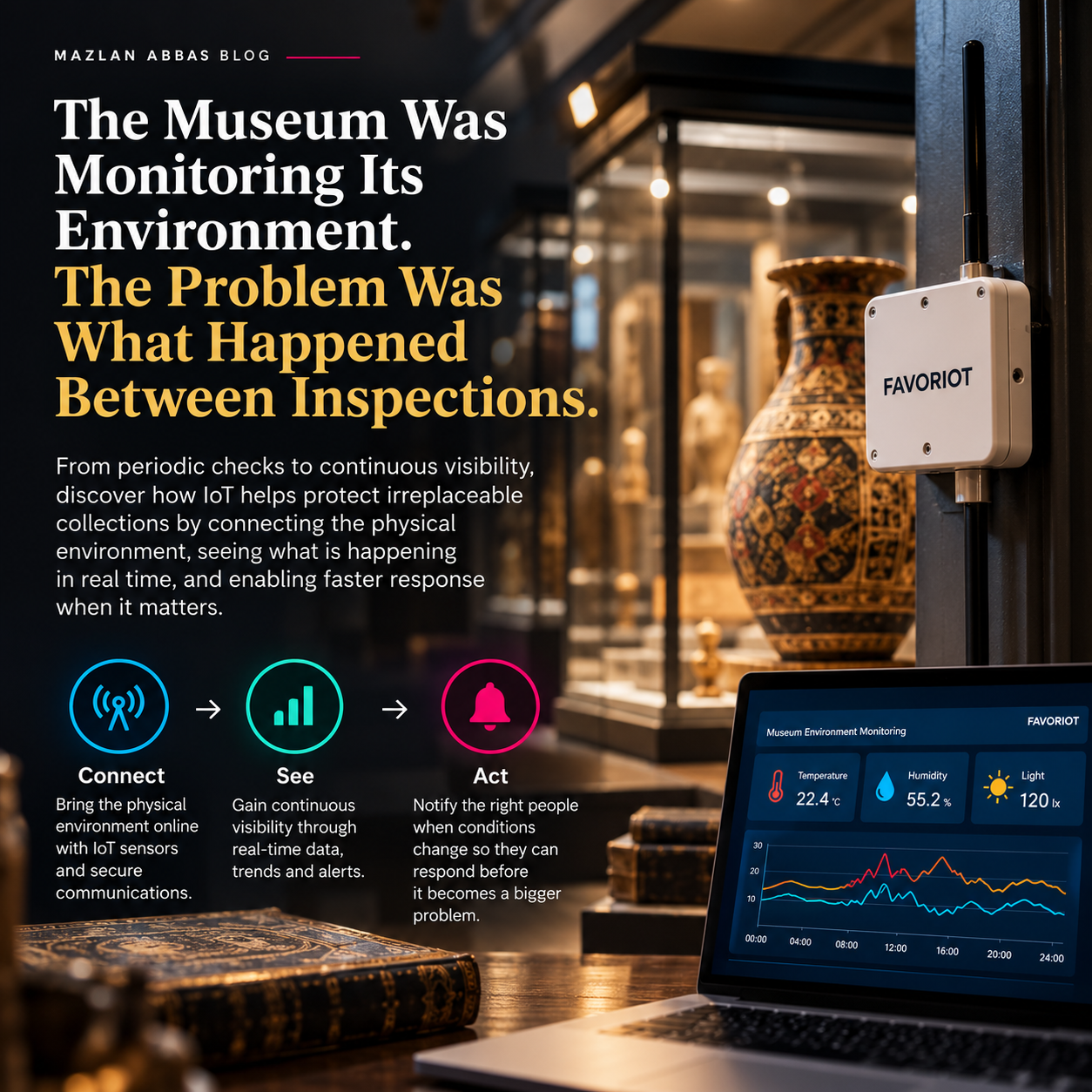
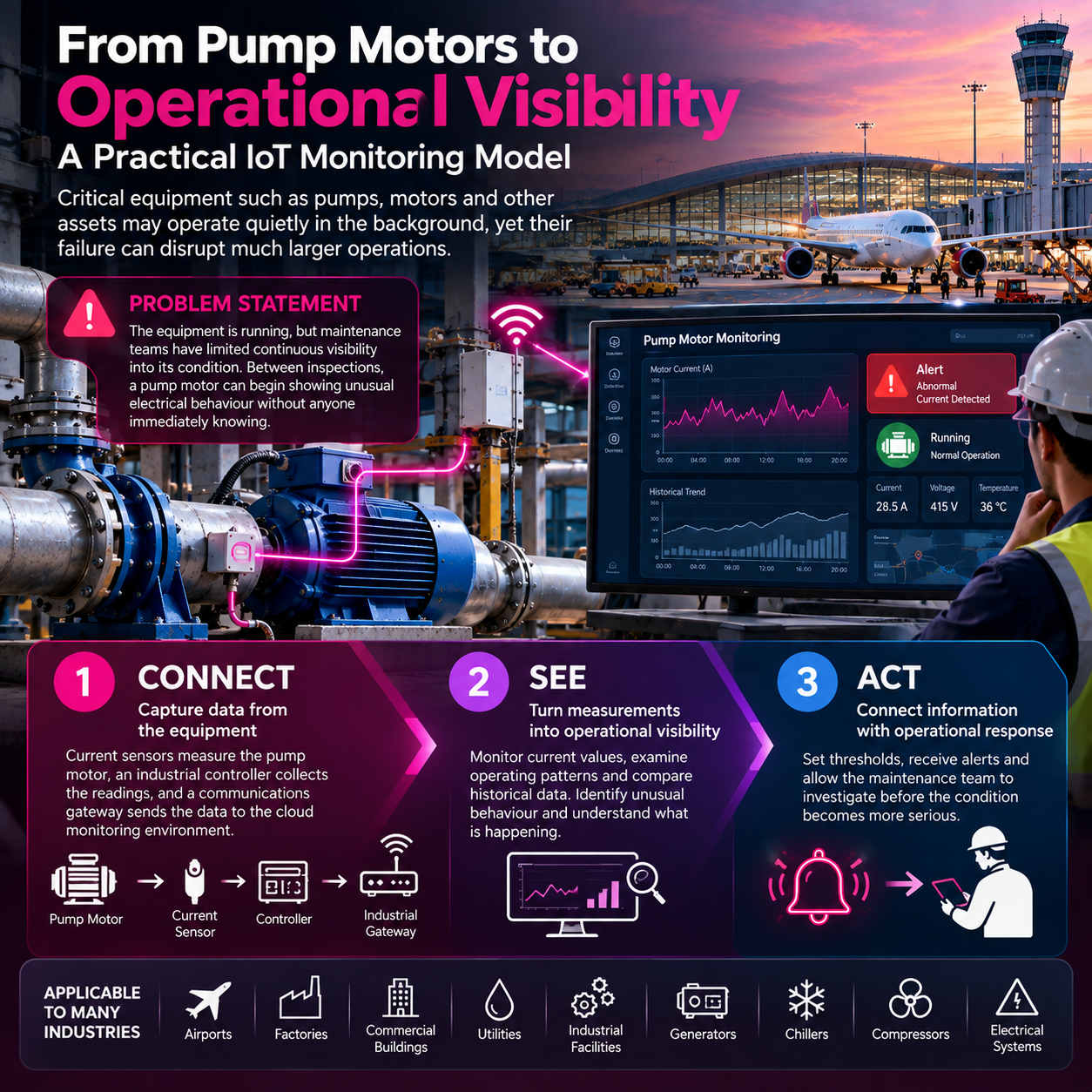
This positioning shifts the conversation away from device connectivity and toward operational outcomes. It highlights Favoriot’s ability to help organisations continuously understand, manage, and improve their operations through its Connect • See • Act™ approach.
The architecture is straightforward:

This represents the next stage of digital transformation.
Competitive advantage will no longer come from deploying more sensors or building more dashboards. It will come from providing continuous operational visibility that enables faster decisions, coordinated responses, and measurable operational improvements.
Artificial Intelligence, automation, and autonomous operations all depend on one essential foundation: trusted operational visibility.
Without visibility, organisations remain operationally blind.
With visibility, they become resilient, responsive, and ready for the future.
About the Author
Dr. Mazlan Abbas is the originator of the Operational Blindness concept and the co-founder and Chief Executive Officer of FAVORIOT Sdn Bhd.
Drawing on more than three decades of experience in telecommunications, research, academia, IoT, and technology leadership, he developed Operational Blindness to describe a recurring organisational condition: critical operational reality remains unseen, misunderstood, delayed, or disconnected from action, even when digital systems and data are already present.
His work proposes that the value of IoT and AI should not be measured by the number of devices connected, dashboards created, or data points collected. It should be measured by whether an organisation can see what is happening, understand its significance, make a timely decision, and act before the decision window closes.
Dr. Mazlan continues to develop the theory, measurement methods, sector applications, and research agenda for Operational Blindness, Operational Visibility, and the emerging category of Operational Visibility Platforms.



Leave a Reply