
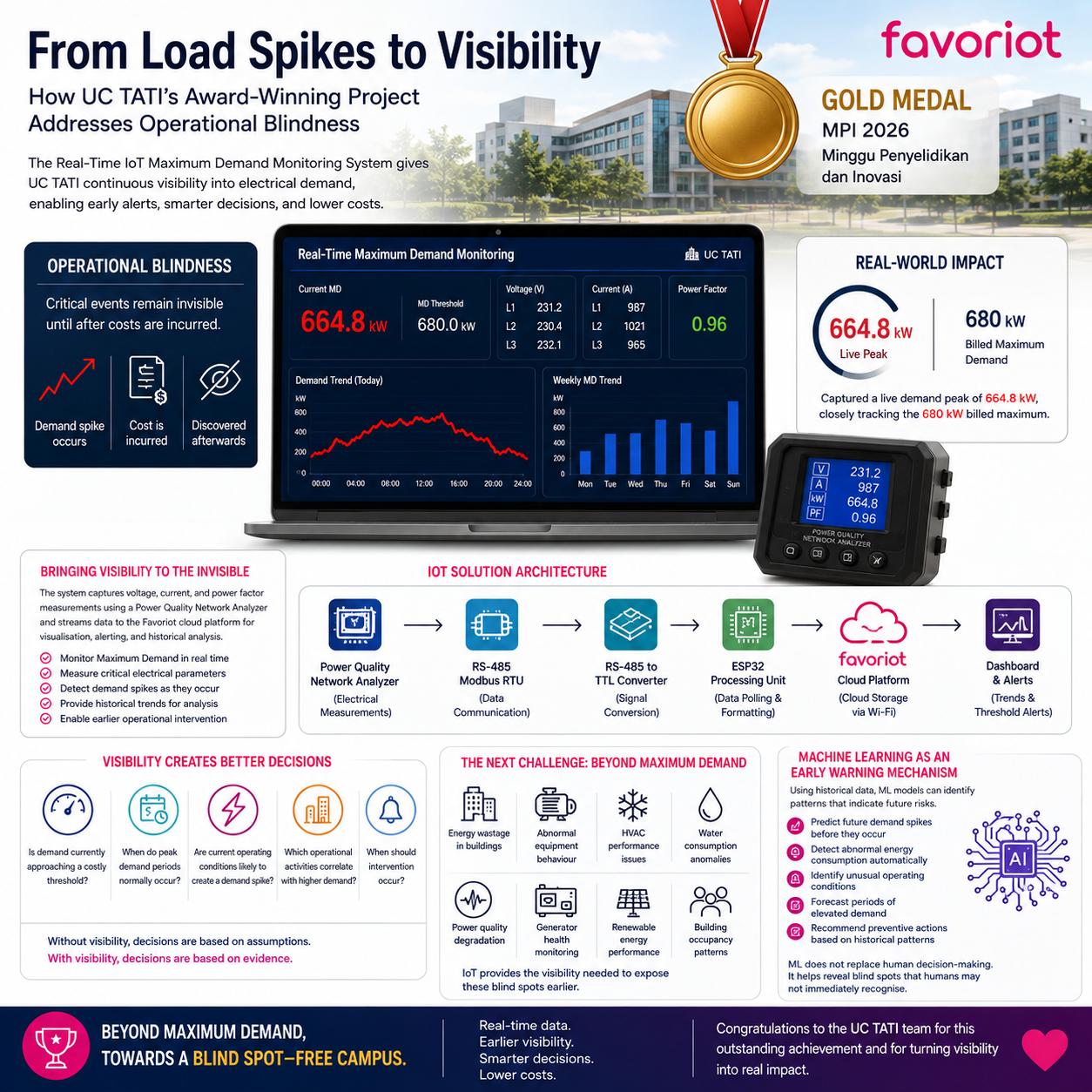
The team at Favoriot would like to extend its sincere congratulations to the researchers from University College TATI (UC TATI) for winning the Gold Medal at Minggu Penyelidikan dan Inovasi (MPI) 2026 for their project, “Real-Time IoT Maximum Demand Monitoring for UC TATI.”
The award recognises an innovation that addresses a challenge faced by many organisations but rarely discussed openly:
Many organisations today have access to reports, utility bills, spreadsheets, and historical records. Yet they continue making decisions without real-time visibility into what is actually happening within their operations.
The issue is not a lack of data.
The issue is that critical operational events often remain invisible until their consequences have already occurred.
The UC TATI project is an excellent example of how IoT can help close this visibility gap.
The Cost of Operating Blind
Maximum Demand (MD) is one of the most important factors affecting electricity charges for commercial and institutional facilities.
At UC TATI, electrical loads generated by air-conditioning systems, laboratory equipment, machines, and computers can create sudden demand spikes. Like many organisations, the campus traditionally relied on utility bills and periodic meter readings to understand its demand profile. This meant that excessive demand was often discovered only after charges had already been incurred.
This situation represents a classic case of operational blindness.
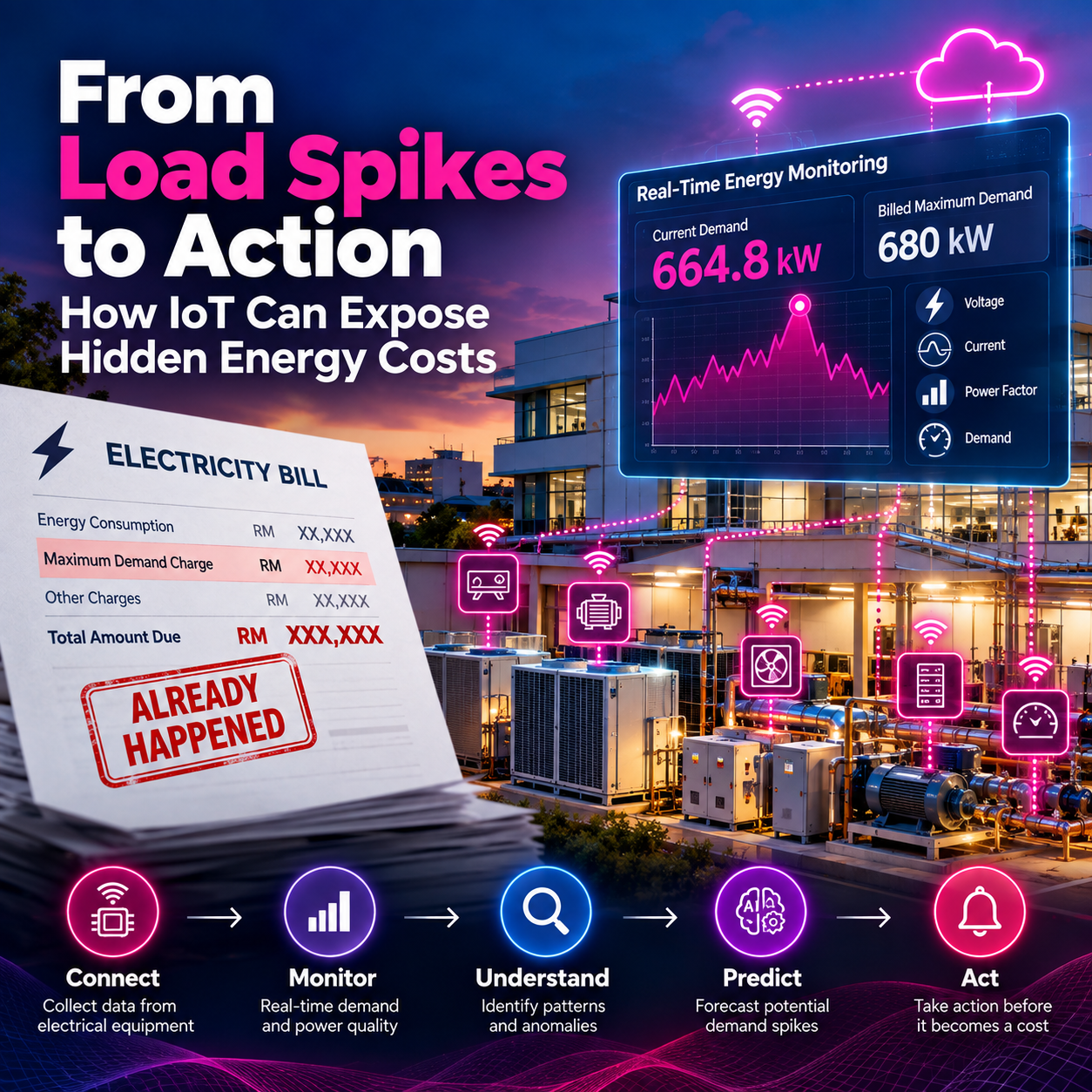
The demand spike occurs.
The cost is incurred.
Only afterwards does the organisation discover what happened.
Without visibility, there is no opportunity to intervene.
Without intervention, there is no opportunity to optimise.
Without optimisation, costs continue to accumulate.

Bringing Visibility to a Previously Invisible Problem
The UC TATI team developed an IoT-based monitoring solution that provides continuous visibility into electrical demand in real time.
The system captures voltage, current, and power factor measurements using a Power Quality Network Analyzer. Data is transmitted through an RS-485 Modbus RTU network, processed by an ESP32 microcontroller, and streamed to the Favoriot cloud platform for visualisation, alerting, and historical analysis.
The objective was straightforward:
- Monitor Maximum Demand in real time
- Measure critical electrical parameters
- Detect demand spikes as they occur
- Provide historical trends for analysis
- Enable earlier operational intervention
What was previously invisible becomes visible.
What was previously discovered after the event can now be observed while it is happening.
That is how operational blindness begins to disappear.
Visibility Creates Better Decisions
The significance of the project extends beyond the dashboard itself.
The dashboard is not the outcome.
Visibility is the outcome.
The system allows campus operators to answer questions that were previously difficult or impossible to answer in real time:
- Is demand currently approaching a costly threshold?
- When do peak demand periods normally occur?
- Are current operating conditions likely to create a demand spike?
- Which operational activities correlate with higher demand?
- When should intervention occur?
These questions are fundamental to operational management.
Without visibility, decisions are based on assumptions.
With visibility, decisions are based on evidence.
Demonstrating Real-World Impact
According to the project results, the monitoring system successfully captured a live demand peak of 664.8 kW, closely tracking the 680 kW maximum demand recorded for billing purposes.
This demonstrates that real-time monitoring can provide an accurate operational picture while creating opportunities to respond before financial penalties are incurred.
The project also demonstrates that IoT does not need to be complex to create value.
Sometimes the greatest benefit comes from making an invisible problem visible.
Thank You for Choosing Favoriot
Favoriot is honoured that the UC TATI team selected the Favoriot platform as part of their solution architecture.
The project demonstrates how universities can apply IoT technologies to solve genuine operational challenges rather than simply building proof-of-concept demonstrations.
More importantly, it showcases how local researchers and educators can create practical solutions that deliver measurable outcomes using locally developed technology platforms.
The Next Challenge: Identifying Blind Spots Before They Appear
The current system addresses one specific area of operational blindness: Maximum Demand visibility.
The opportunity ahead is much larger.
The same approach can be extended to uncover other operational blind spots across the campus.
Examples include:
- Energy wastage in buildings
- Abnormal equipment behaviour
- HVAC performance issues
- Water consumption anomalies
- Power quality degradation
- Generator health monitoring
- Renewable energy performance
- Building occupancy patterns
Each of these areas contains information that often remains hidden until problems become visible through complaints, failures, downtime, or rising costs.
IoT provides the visibility needed to expose those blind spots earlier.
Machine Learning as an Early Warning Mechanism
The next evolution of the project could involve applying Machine Learning to the growing collection of historical demand data.
Rather than simply showing what is happening now, the system could identify patterns that indicate future risks.
For example, Machine Learning models could:
- Predict future demand spikes before they occur
- Detect abnormal energy consumption automatically
- Identify unusual operating conditions
- Forecast periods of elevated demand
- Recommend preventive actions based on historical patterns
In this context, Machine Learning does not replace human decision-making.
It helps reveal blind spots that humans may not immediately recognise.
Beyond Maximum Demand
The true achievement of the UC TATI project is not merely the development of a monitoring system.
It is the creation of visibility where previously there was none.
Many organisations invest in sensors, dashboards, and digital technologies but continue to operate blindly because the information never reaches the point of decision-making.
The UC TATI project demonstrates a different approach.
It transforms electrical demand from a monthly surprise into a continuously visible operational parameter.
That is the first step toward eliminating operational blindness.
Congratulations once again to:
- Tc. Mohd Firdaus Bin Che Yusoff
- Ts. Mohd Anuar Bin Mohamed Ayub
- Ts. Mohd Tarmizi Bin Ibrahim
- AP. Ts. Dr. Ruzlaini Binti Ghoni
- Muhammad Fadzillah Bin Che Yusoff
for this well-deserved Gold Medal achievement.


Their work serves as an excellent example of how IoT can move beyond data collection and become a practical tool for helping organisations see what they could not previously see, understand what they did not previously understand, and act before problems become consequences.


Leave a Reply