
What does it mean to know your factory and still not understand it?
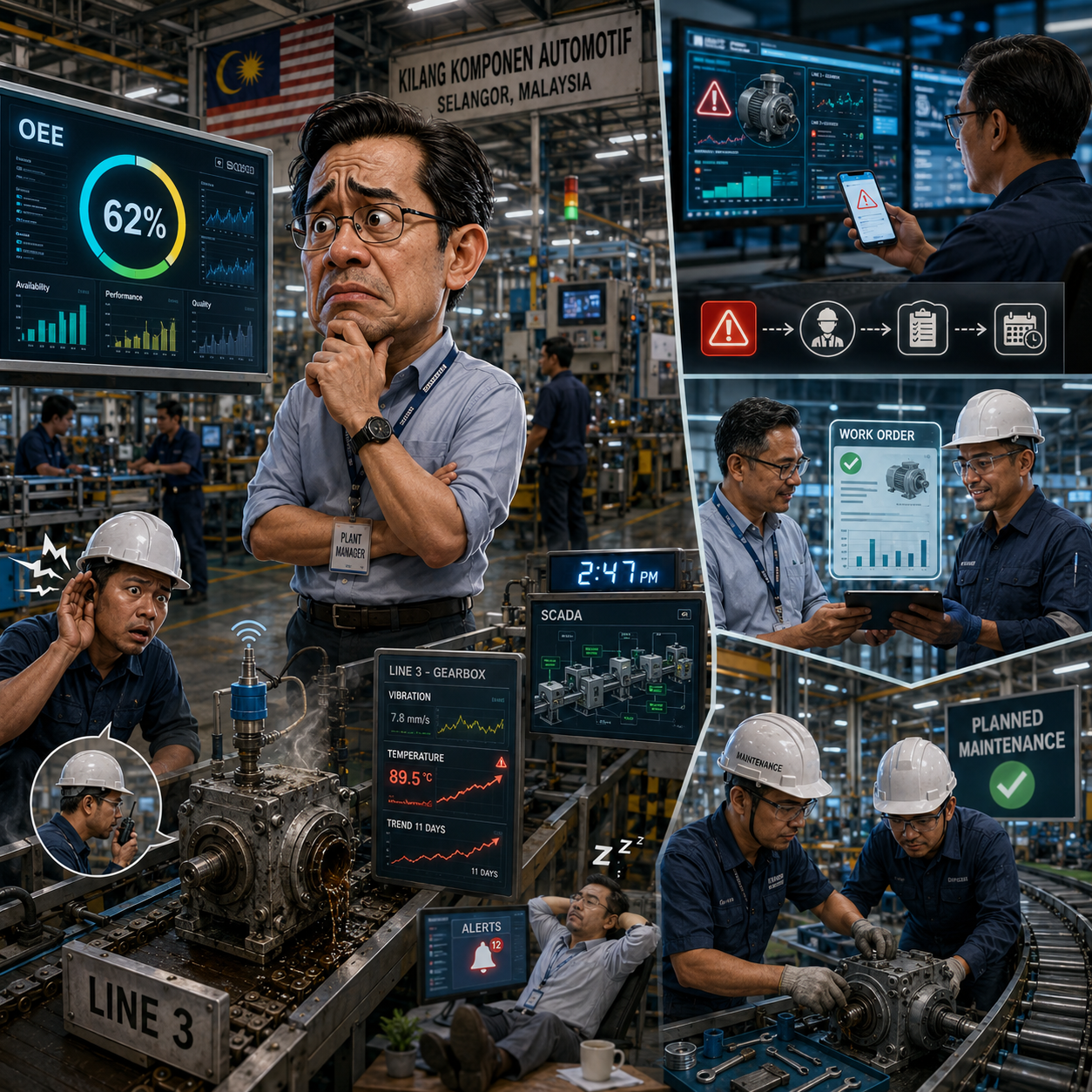
A plant manager in a mid-sized automotive components facility in Selangor runs a reasonably modern operation. The production floor is wired. Vibration sensors sit on critical motors. Temperature probes monitor the cooling system. A SCADA system feeds live data into an OEE dashboard that refreshes every sixty seconds. On paper, the facility is digitised. On the dashboard, Overall Equipment Effectiveness holds steady at 62 percent.
That number troubles him. Not because it is catastrophic, but because it has not moved in eighteen months. The sensors have not moved it. The dashboard has not moved it. And when a conveyor gearbox seized last Tuesday at 2:47 in the afternoon, shutting down Line 3 for four hours, the maintenance team found out the same way they always do: a technician heard an unusual sound, flagged the supervisor, and the supervisor made a phone call.
The sensors had been reporting elevated temperature on that motor for eleven days.
Nobody had acted on the data. Not because anyone ignored it. Because no one had been assigned to act on it, no threshold had been set to trigger an escalation, and the alert, when it finally appeared, landed in a monitoring interface that the maintenance team does not use during shift hours.
This is operational blindness on the factory floor. It is not a sensor problem. It is not a connectivity problem. It is a decision-routing problem. And it is the gap that Industry 4.0 consistently fails to close.
The OEE Illusion
Overall Equipment Effectiveness is one of the most widely used metrics in manufacturing. It measures availability, performance, and quality simultaneously, collapsing the complexity of production health into a single percentage. A world-class OEE is typically cited at 85 percent. Most facilities operate between 40 and 65 percent. The gap between those numbers represents enormous recoverable value.
The problem is that OEE, as most facilities use it, is a reporting metric rather than a decision tool. It tells a plant manager what happened. It does not tell a maintenance supervisor what to do next, when to do it, or how urgently.
When a facility reports 62 percent OEE, the number contains three separate stories: equipment that was unavailable because of breakdowns, equipment that ran slower than rated speed, and production that was rejected or reworked. Each of those stories demands a different response from a different person on a different timeline. The OEE dashboard shows all three collapsed into a single number, refreshed in real time, and displayed on a screen in the plant manager’s office.
The maintenance technician does not have a screen in the plant manager’s office. And the plant manager does not walk the floor with the OEE dashboard in hand at 6 AM when the shift begins.
The data exists. The decision never arrives.
Why Predictive Maintenance Fails in Practice
The manufacturing industry has spent a decade investing in predictive maintenance. Sensor costs have dropped dramatically. Connectivity infrastructure is widespread. Cloud storage makes it practical to retain years of machine telemetry. Machine learning models can now detect the early signature of bearing failure, motor degradation, and thermal runaway with reasonable accuracy.
And yet reactive maintenance persists. Survey after survey of industrial operators finds that the majority of unplanned downtime events occur in facilities that already have condition-monitoring data available for the affected equipment. The failure was predictable. The prediction was not acted upon.
The reason is rarely a sensor gap or a model accuracy problem. The reason is an alert architecture problem.
Predictive maintenance generates signals. Those signals need to be connected to a specific human being, at a specific moment in their workday, with enough context to make a decision and enough authority to act on it. In most manufacturing facilities, that connection does not exist. The signal goes to a monitoring dashboard. The dashboard is checked periodically. Periodically is not the same as immediately. And even when the signal is seen, the maintenance team faces a judgment call: how serious is this, how long can it wait, which asset takes priority, and who needs to know?
Without a defined escalation framework built into the IoT architecture itself, those judgment calls are made from experience, intuition, and organisational habit. Sometimes that works. When it does not work, a conveyor gearbox seizes at 2:47 in the afternoon.
The predictive maintenance model is technically sound. The operational model that surrounds it is broken.
The Three Layers of Manufacturing Blindness
Operational blindness in a manufacturing context compounds across three distinct layers, each one building on the failure of the previous.
The first layer is data without context. Sensors generate readings. Those readings are stored and displayed. But a temperature reading of 78 degrees Celsius means nothing without knowing whether that motor typically runs at 65 degrees, whether 78 degrees has been observed before without incident, and whether other parameters on the same asset are also trending abnormally. Context transforms a reading into a signal. Most facility data architectures collect readings. Very few transform them into contextualised signals automatically.
The second layer is signals without routing. Even when a contextualised signal is generated, it must reach the right person. Maintenance is not a monolithic function. A predictive alert for a hydraulic press requires a different skill set than a thermal alert on a conveyor motor. The alert needs to reach the right technician, not just appear in a shared monitoring queue. And it needs to reach them through a channel they use during their working hours, with enough information to act without additional investigation.
The third layer is actions without feedback. When a maintenance technician responds to an alert, what happens to that information? In most facilities, the response is undocumented, the outcome is not linked back to the original alert, and the pattern of which alerts led to successful interventions and which were false positives is never analysed systematically. The feedback loop that would make the system smarter over time does not exist. The same judgment calls are made shift after shift, drawing on the same individual experience, with no accumulating institutional intelligence.
A plant manager looking at a 62 percent OEE is looking at the aggregate output of all three of these failures, with no way of knowing from the number alone which layer is driving the loss.
Before and After: What Changes When the Blindness Is Cured
Consider the same automotive components facility, the same conveyor gearbox, the same eleven days of elevated temperature readings. The difference is a facility that has addressed all three layers.
Before. The maintenance team starts their shift at 6 AM with a handover from the night supervisor. The handover covers production output and any equipment issues that caused visible problems. The elevated temperature on the conveyor motor was noted in the SCADA log nine days ago. It was not included in any handover because no alarm threshold was breached and no production impact had occurred. The technician responsible for Line 3 equipment has not checked the SCADA log this week. He checks it on Fridays when the maintenance manager asks for a weekly summary.
At 2:47 PM on Tuesday, the gearbox seizes. Line 3 stops. The supervisor calls maintenance. The technician arrives, diagnoses the failure, and confirms that a bearing has collapsed due to thermal fatigue. A replacement bearing is not in stock. A procurement request is raised. Line 3 remains offline for four hours. The OEE for that shift drops to 41 percent.
After. The IoT platform is configured with contextual thresholds for every critical asset on the floor. The threshold for the conveyor motor is not a fixed temperature value. It is a deviation from the asset’s own rolling baseline, adjusted for ambient temperature and production load. On Day 2 of the elevated reading, the system generates a predictive alert. The alert is automatically routed to the Line 3 maintenance technician through the facility’s operations application, along with a summary showing the trending data for the past 48 hours and a suggested priority classification.
The technician reviews the alert that morning, physically inspects the motor, and confirms early-stage bearing wear. He raises a maintenance work order, checks parts inventory, and orders the replacement bearing on a three-day lead time. The bearing arrives on Day 5. The technician schedules the replacement during a planned production break on Day 6. Total downtime: 45 minutes, planned, at zero impact to output targets.
The facility’s OEE for that week is unchanged by the maintenance event. The CMMS record links the original alert to the work order, the replacement, and the outcome. The system learns that a 12 percent deviation from rolling baseline on that motor class correlates with bearing failure within 14 days, refining the detection model for similar assets across the floor.
The plant manager starts his shift on Day 6 with a summary that shows one planned maintenance event, zero unplanned stoppages, and a parts procurement that was completed on schedule. He does not learn about the near-failure. He learns about a problem that was solved before it became a failure. That is the shift from operational blindness to operational clarity.
The OEE dashboard still shows 62 percent. But the trend line is now moving. And the maintenance team is no longer reacting to what the floor sounds like.
The Technology Is Not the Problem
It is worth being precise about where the failure lies, because the manufacturing industry continues to invest heavily in the wrong layer.
The sensor technology for condition monitoring is mature, affordable, and widely available. Vibration, temperature, current draw, acoustic emission, and oil analysis sensors can detect the early signatures of most common failure modes across most industrial equipment categories. The connectivity infrastructure to transmit that data to a processing platform is similarly mature. The cloud storage and compute capacity to retain and analyse that data at scale has been a commodity for several years.
The gap is in the intelligence layer between the data and the decision. That layer has three components: contextual analysis that transforms raw readings into meaningful signals, routing logic that connects those signals to the right person at the right time, and feedback architecture that captures outcomes and improves the system over time.
Most IoT deployments in manufacturing stop at the first layer. Sensors are installed. Data is transmitted. Dashboards are built. The deployment is called complete. The intelligence layer is never built because it requires a different skill set, a different conversation with the operations team, and a longer implementation timeline than a sensor rollout.
The result is a facility with excellent visibility and zero actionability. The data knows what is happening. The organisation does not.
A Diagnostic for Plant Managers
The following questions are designed to identify where operational blindness is costing a manufacturing facility most severely. They do not require a technology audit. They require an honest conversation with the people who run the floor.
On alert architecture: When a sensor threshold is breached on a critical asset, who receives the notification? Through what channel? At what time of day does that channel get checked? What happens if the recipient is on leave?
On maintenance decision-making: When the maintenance team decides which pending jobs to prioritise on a given shift, what information do they use? Is that information drawn from the IoT system or from supervisor experience?
On feedback loops: When a maintenance intervention prevents a failure, is that outcome recorded and linked to the predictive alert that triggered it? Is that data reviewed to improve future detection thresholds?
On shift handover: Does the shift handover between supervisors include a summary of active predictive alerts and their status? Or does it cover only events that have already caused production impact?
On the baseline question: For each piece of critical equipment on the floor, does the facility know what normal looks like? Not the manufacturer’s rated specification, but the actual operating baseline for that specific asset in its current installation, under typical production load conditions?
If the honest answer to most of those questions is “we don’t know” or “it depends on the supervisor,” the facility has an operational blindness problem. The sensors are running. The data is being collected. The floor is not yet seeing.
What Industry 4.0 Promised and What It Delivered
Industry 4.0 was sold to the manufacturing sector as a transformation of how factories think. Connected machines would anticipate their own failures. Predictive systems would replace reactive ones. Data would flow from sensor to decision to action without friction. The smart factory would manage itself.
What the industry delivered was connected infrastructure with disconnected intelligence. Sensor networks without alert architectures. Dashboards without decision routing. Data lakes without learning loops. The investment in collection was enormous. The investment in action was an afterthought.
The plant manager with the 62 percent OEE dashboard is not a victim of bad technology. He is a victim of an implementation approach that stopped three steps short of usefulness. His sensors are collecting. His dashboard is displaying. His organisation is still running on experience and instinct, with a data infrastructure that was never designed to change that.
The fix is not more sensors. It is an operational intelligence layer that connects what the sensors know to what the people on the floor do. That layer requires deliberate architecture, not additional hardware. It requires understanding how the maintenance team makes decisions before designing the system that improves those decisions.
That is the step Industry 4.0 consistently skips. And it is the step where the 62 percent becomes something else.
Request a Manufacturing Operational Blindness Audit
Is your facility collecting data that is not yet changing how your floor operates? The FAVORIOT team works with manufacturing operators to diagnose exactly where the intelligence gap sits: whether it is in the alert architecture, the decision routing, or the feedback loop that should be making the system smarter over time.
A manufacturing Operational Blindness audit maps the distance between what your sensors know and what your maintenance team acts on. It identifies the specific layer where the data is being lost before it becomes a decision.
Request a manufacturing Operational Blindness audit with the FAVORIOT team at favoriot.com.
What is your floor supervisor actually working from when they start the shift? The answer to that question may be the most revealing diagnostic your facility has.
Dr. Mazlan Abbas is the CEO and Co-Founder of Favoriot, an AIoT platform company focused on helping organizations connect, learn from, and act on real-world data. He writes regularly on IoT and entrepreneurship at mazlanabbas.com and iotworld.co.



Leave a Reply