
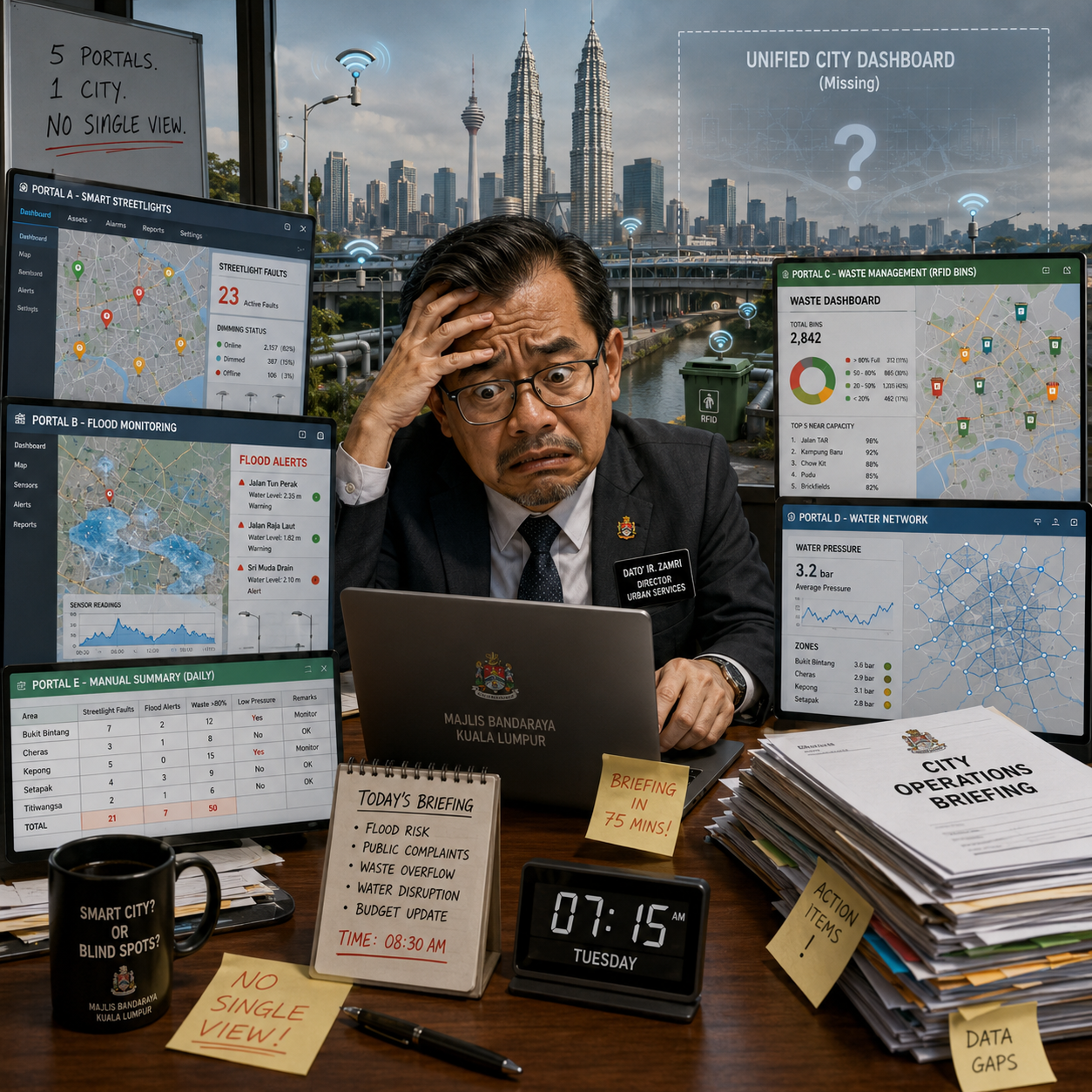
What is the point of a sensor network that nobody in charge can read?
That question is not rhetorical. Across Malaysian cities today, local authorities have deployed more physical infrastructure than at any point in the country’s history: smart streetlights that dim automatically, flood sensors placed along urban drains, RFID-tagged waste bins that report their fill levels, water meters transmitting consumption data around the clock. The hardware is in the ground. The network is live. The data is flowing.
And yet the director sitting in the office accountable for all of it is logging into five separate vendor portals just to understand whether his city is functioning today.
This is the defining paradox of Malaysian smart city infrastructure in 2026. The investment has been made. The sensors are working. The problem is governance, not technology. This is where Operational Blindness kicks on.
The Five-Portal Problem
Picture a typical morning at a mid-sized Malaysian local authority. The director of urban services opens his laptop and begins his daily review. He logs into the streetlight management portal provided by the vendor who won that particular tender. He opens a second browser tab for the flood early warning system, which was procured separately under a different ministry grant. He switches to a third portal for the waste management IoT dashboard, checks the water utility’s reporting interface, and consults a spreadsheet that someone on his team compiled manually to summarise what could not be aggregated automatically.
By the time he has a rough picture of the city’s operational state, forty-five minutes have passed. He has not yet read his email. The morning briefing with the Yang Dipertua starts in fifteen minutes.
This is not a failure of ambition. The local authority procured intelligently within the constraints of how public-sector IoT projects are typically funded: project by project, vendor by vendor, tender cycle by tender cycle. Each system was evaluated on its own merits. Each vendor delivered what was specified. The problem is that nobody specified interoperability as a requirement, because the accountability structure at the time of procurement did not yet demand it.
The accountability structure now demands it. And the infrastructure is not ready.
The Accountability Gap Nobody Talks About
Smart city discourse in Malaysia has focused almost entirely on the deployment layer: how many sensors are connected, what protocols are used, which platforms have been certified. This is understandable. Deployment is visible. It shows up in press releases and YB site visits and MDEC annual reports.
What does not show up in those documents is the question of who, precisely, is responsible for what the sensors are saying, and whether that person can actually see the data in a form that allows them to act.
There is a structural gap between the operational layer of a smart city and the governance layer. At the operational layer, sensors report values. At the governance layer, elected officials and senior administrators need answers: Is the flood risk in Taman Jaya elevated this morning? Are the three waste compactors in the commercial district due for collection before the Saturday market? Is there an anomaly in water pressure along Jalan Besar that needs a maintenance response before it becomes a burst pipe?
These are not data questions. They are decision questions. And the five-portal problem means that the people responsible for those decisions are not receiving answers. They are receiving raw feeds from disconnected systems and being asked to synthesise them under time pressure, without the tools to do so.
The political dimension of this gap is rarely acknowledged in technical procurement documents. But it is real. When a flash flood damages property and residents ask why they were not warned earlier, the answer “our flood sensor data was available in Portal B but our operations team was monitoring Portal A” is not acceptable to any municipal council. The accountability sits with the director. The data sat in a system he could not conveniently access.
What Malaysian Local Authorities Are Actually Facing
The fragmentation problem is particularly acute in Malaysia for reasons that are structural rather than accidental.
Malaysian local authority IoT deployments have historically been funded through multiple, parallel channels: federal grants administered through KPKT, state-level digital economy initiatives, utility company infrastructure programmes, and occasionally through bilateral development cooperation. Each funding channel has its own procurement rules, its own preferred vendor panels, and its own reporting requirements. The result is not a unified smart city platform. It is a collection of platforms that happen to coexist within the same municipal boundary.
The GLC digital mandate has accelerated deployment without resolving integration. GLCs with responsibilities for utilities, transport, and urban services have invested significantly in IoT infrastructure. But GLC boundaries and local authority boundaries do not always align. A single district may have sensors owned by three different entities reporting to three different parent organisations, none of which share a common data layer with the local authority that is politically accountable for service delivery to residents.
The multi-agency integration challenge is not merely technical. It is jurisdictional. Getting TNB, SYABAS, and Alam Flora data into the same operational view as the local authority’s own flood and lighting systems requires not just middleware but interagency data-sharing agreements, defined data governance frameworks, and a platform architecture that can accommodate multiple ownership structures without compromising security or attributability.
Most local authorities have neither the internal technical capacity to design such architecture nor the procurement framework to specify it correctly when engaging vendors. The gap between what is needed and what is being built is widening.
The Single-Pane Dashboard Changes the Accountability Structure
The language of “single-pane-of-glass” dashboards has existed in enterprise IT for years. In the smart city context, it means something more consequential than convenience.
When a municipal director can see flood sensor readings, streetlight fault alerts, waste bin fill levels, and water pressure anomalies from a single operational interface, something changes in how decisions are made and how accountability is assigned. The data is no longer siloed inside vendor portals. It belongs, functionally, to the institution. The institution can now be asked questions that have answers.
This matters for elected officials in a way that raw sensor data never can. A city councillor does not need access to MQTT broker logs or a Grafana dashboard. They need a weekly KPI report showing whether flood response times met the agreed service level, whether waste collection coverage hit its targets, whether energy savings from smart lighting are on track against the annual projection. A unified command dashboard is what makes that report possible without a team of analysts manually assembling it from five separate exports.
The accountability structure shifts in two important ways. First, accountability becomes attributable: when the data lives in one place, it is possible to define who is responsible for acting on each category of alert and to track whether that action was taken. Second, accountability becomes anticipatory: with aggregated data and basic analytics, a local authority can shift from reactive operations to predictive ones. A cluster of abnormal readings from three adjacent flood sensors is not yet a flood emergency. With the right unified view, it becomes a pre-positioned response opportunity.
Neither of these shifts is possible when the data is distributed across vendor portals that were never designed to share information with each other.
The Integration Architecture Question
Building a unified operational view for a Malaysian local authority is not a matter of choosing a better dashboard vendor. It requires addressing the integration problem at the data layer.
The practical architecture for this involves a platform that can ingest data from heterogeneous sources: different protocols, different vendor APIs, different data schemas, different update frequencies. Smart streetlight systems may report via NB-IoT. Flood sensors may use LoRaWAN. Water meters may transmit over cellular. Waste bin sensors may use Sigfox or a proprietary protocol specific to the vendor. A platform that can only accommodate one of these does not solve the problem.
Beyond ingestion, the platform must be capable of normalising data into a common schema that makes cross-domain queries possible. Asking “are there correlations between drain sensor anomalies and rainfall gauge readings in the past 72 hours” requires that both data sets live in a compatible format inside the same system. No amount of sophisticated analytics can compensate for data that cannot be joined.
The governance layer above the integration layer is where Malaysian institutions typically underinvest. Data governance for a multi-agency smart city platform must define ownership, access controls, retention policies, audit trails, and escalation protocols. Without this layer, a unified dashboard is a liability as much as an asset: it centralises sensitive infrastructure data without the governance framework to manage access appropriately.
The final layer is the interface layer, where the unified data view is translated into role-appropriate outputs. An operations engineer needs a different view from a municipal director. A director needs a different view from a councillor. A councillor needs a different view from a resident portal. A mature platform architecture supports all of these without requiring each layer to extract and reformat data manually.
The Political Moment for Malaysian Local Authorities
There is a window of opportunity that Malaysian local authorities should recognise.
The national digital economy strategy has created conditions that favour integration investments. Federal support programmes for smart city infrastructure increasingly emphasise interoperability and data governance rather than raw deployment volume. The Malaysia Digital Economy Corporation and KPKT have both signalled, at various points, that future grant programmes will be evaluated on outcomes rather than outputs. Outcomes require measurement. Measurement requires unified data.
For local authority directors who have spent years managing the five-portal problem, this is the moment to reframe the conversation with their state and federal counterparts. The argument is not “we need a better dashboard.” The argument is “our current architecture makes accountability impossible, and accountability is what elected governance requires.” That argument lands differently in a minister’s office than a technology procurement request.
The cities that move first on integration will also be the ones best positioned for the next cycle of federal smart city investment, because they will be able to demonstrate, with actual data, what their sensor networks are delivering. Cities still logging into five separate portals will struggle to make that case.
What the Path Forward Looks Like
For a Malaysian local authority beginning this journey, the starting point is not a platform selection exercise. It is a data inventory.
Which sensors are deployed? Who owns them? What protocols do they use? What data do they generate, and at what frequency? Who currently has access to that data, and what decisions are they making with it? The answers to these questions define the integration architecture requirement. Without them, any platform evaluation is premature.
From the data inventory, the local authority can define the integration scope: which systems must be unified in the first phase, which can be added later, and which require interagency agreements before their data can be included. This scoping exercise also clarifies the governance requirements: who will own the unified data, who will have access to which layers of the dashboard, and how incidents will be escalated across agencies.
Only then does platform selection make sense. The right platform for a Malaysian local authority is one that can accommodate the heterogeneous infrastructure already deployed, supports the governance framework the institution needs, and scales as additional systems and agencies are added over time. It is not necessarily the platform that was already deployed for streetlights or flood sensors. It is the platform that can sit above all of them.
The City That Can See Itself
A smart city is not a city with sensors. Every city of any scale now has sensors. A smart city is a city whose decision-makers can see what those sensors are saying, in a form that supports the decisions they are accountable for making.
Malaysian local authorities have done the hard work of deploying the infrastructure. The sensors are in the ground. The networks are live. The data exists. What remains is the governance architecture that turns that data into institutional visibility.
The director who logs into five portals every morning is not failing at his job. He is working within a system that was not designed for the accountability expectations now placed on it. That system can be redesigned. The technology to do it exists. The political case for it has never been stronger.
The question worth asking is not whether Malaysian local authorities can afford to build a unified operational view of their cities. It is whether they can afford to keep governing without one.
Malaysian local authorities ready to address the integration and governance gap in their smart city infrastructure are invited to explore how FAVORIOT’s AIoT platform approach supports multi-system integration, role-based dashboards, and outcome-level reporting. Schedule a consultation at favoriot.com/contactus.
Dr. Mazlan Abbas is the CEO of Favoriot, an AIoT platform company focused on helping organisations in ASEAN turn operational data into decisions. He writes on IoT strategy, AIoT deployment, and the future of intelligent infrastructure at iotworld.co.




Leave a Reply