

Why Connected Organisations Still Struggle to Make Better Decisions
By Dr. Mazlan Abbas
Introduction
For years, organisations have invested heavily in sensors, IoT platforms, SCADA systems, ERP software, AI, cloud computing, and dashboards. The expectation has always been straightforward: more technology should lead to better decisions.
Yet many organisations continue to experience delayed responses, operational failures, unnecessary downtime, resource wastage, compliance issues, and dissatisfied customers.
The problem is rarely a lack of technology.
The problem is a lack of visibility.
This is the difference between Operational Blindness and Operational Visibility.
One describes an organisation that cannot clearly understand what is happening across its operations.
The other describes an organisation that can continuously observe, understand, decide, coordinate, and act before small problems become major incidents.
Understanding this distinction is becoming one of the most important capabilities in the age of AI.
What is Operational Blindness?
Operational Blindness is the condition where an organisation cannot obtain the right operational information, with the right context, at the right time, by the right people, to make effective decisions and timely actions.
The organisation may already possess:
- thousands of sensors
- multiple software systems
- AI models
- dashboards
- historical reports
Yet important operational questions remain unanswered.
Examples include:
- Which machine is likely to fail today?
- Which water leak is causing the largest losses?
- Which building is consuming abnormal energy?
- Which cold-chain shipment has already become unusable?
- Which flood sensor requires immediate intervention?
When organisations cannot answer these questions quickly, they become operationally blind.
The issue is not missing data.
The issue is missing operational understanding.
What is Operational Visibility?
Operational Visibility is the ability to continuously understand operational reality, identify emerging issues, coordinate responses, and verify outcomes through trusted operational data.
Operational Visibility means decision-makers know:
- what is happening
- where it is happening
- why it is happening
- who should respond
- what action should be taken
- whether the action solved the problem
Visibility turns operational data into operational confidence.
Instead of reacting after problems occur, organisations can detect issues while there is still time to respond.
Blindness Versus Visibility
| Operational Blindness | Operational Visibility |
|---|---|
| Data exists but lacks meaning | Data is translated into operational understanding |
| Dashboards display numbers | Dashboards explain operational conditions |
| Reports arrive too late | Information arrives when action is still possible |
| Departments work independently | Teams coordinate using the same operational picture |
| Decisions depend on manual verification | Decisions are supported by trusted operational evidence |
| Problems are discovered after failures | Problems are detected before failures escalate |
| Accountability is unclear | Ownership and actions are clearly assigned |
| AI receives incomplete or poor-quality data | AI receives trusted operational context |
Operational Visibility is not simply better reporting.
It changes how organisations operate.
Why Dashboards Alone Are Not Enough
Many organisations believe that having dashboards automatically creates visibility.
This assumption is one of the biggest causes of Operational Blindness.
A dashboard may answer:
- What is the current temperature?
- What is today’s energy usage?
- How many devices are online?
Operational Visibility asks additional questions:
- Is this normal?
- Is intervention required?
- Who should respond?
- What happens if nobody acts?
- Has the issue already affected customers?
- Has the problem been resolved?
A dashboard reports activity.
Operational Visibility supports decisions.
The Journey from Data to Visibility
Technology has evolved rapidly over the past three decades.
The next competitive advantage is no longer collecting data.
It is understanding operations.
The progression can be viewed as follows:
Physical World

Each layer builds on the previous one.
Without trusted operational data, visibility cannot exist.
Without visibility, decision intelligence becomes unreliable.
Without decision intelligence, organisations continue making reactive decisions.
The Cost of Remaining Operationally Blind
Operational Blindness rarely appears as a single catastrophic failure.
Instead, it quietly increases operational costs every day.
Common symptoms include:
- delayed maintenance
- repeated equipment failures
- excessive energy consumption
- unnoticed water leakage
- inventory losses
- compliance failures
- duplicated work
- manual reporting
- delayed approvals
- customer complaints
- poor ESG evidence
- inaccurate forecasting
These hidden costs often exceed the cost of deploying technology that improves visibility.
Why AI Needs Operational Visibility
Many organisations are racing to adopt Artificial Intelligence.
Yet AI can only learn from the information it receives.
If operational data is incomplete, delayed, inconsistent, or lacks business context, AI simply automates poor decisions.
The sequence should therefore be:

AI should never replace visibility.
AI should build upon it.
Operational Visibility is the foundation that makes AI trustworthy.
Operational Visibility as a New Technology Category
Traditional IoT platforms focus on connecting devices.
SCADA focuses on industrial control.
ERP focuses on business processes.
Business Intelligence focuses on reporting.
AI platforms focus on prediction.
Operational Visibility Platforms connect these capabilities into one operational picture that enables organisations to move from observation to coordinated action.
The objective is not simply to collect more data.
The objective is to reduce Operational Blindness.
How Favoriot Delivers Operational Visibility
Favoriot has evolved beyond being an IoT platform.
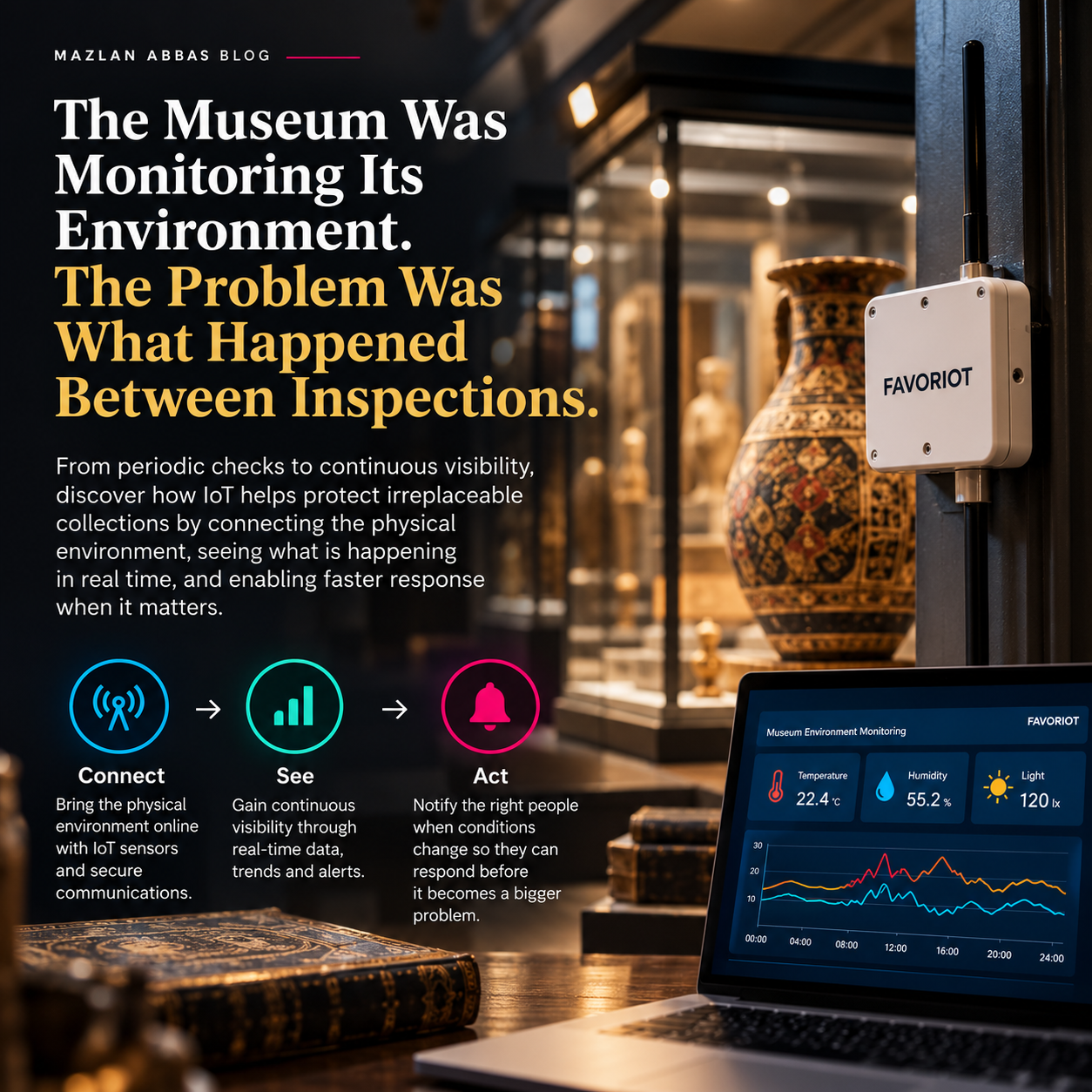
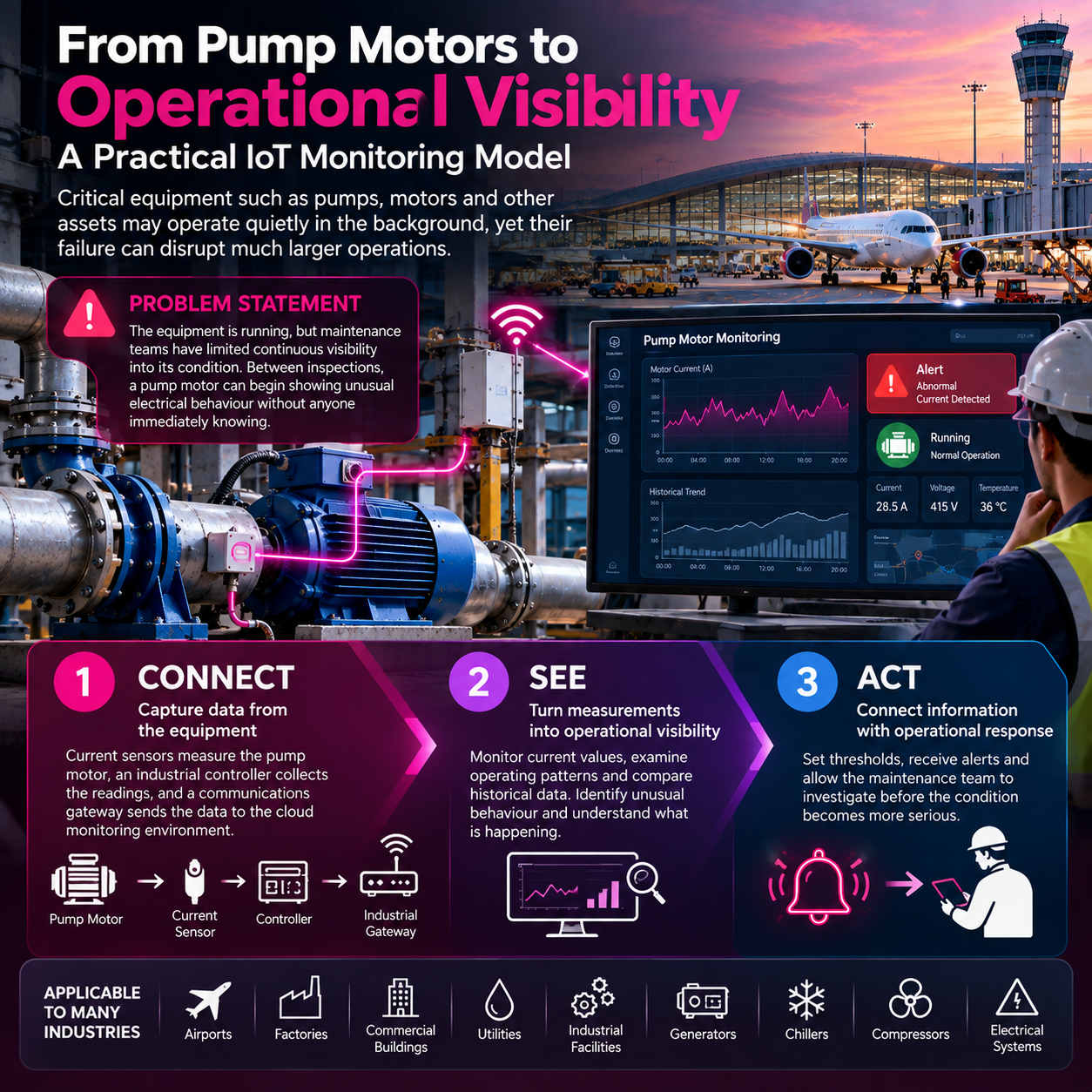
Its focus is helping organisations reduce Operational Blindness through three operational stages:
Connect
Collect trusted operational data from:
- IoT sensors
- PLCs
- SCADA
- ERP systems
- existing enterprise applications
- third-party platforms
See
Transform data into operational understanding through:
- contextual dashboards
- alerts
- analytics
- operational insights
- visibility across assets, people, and processes
Act
Support timely decisions through:
- notifications
- workflows
- automation
- coordinated responses
- continuous monitoring
- performance verification
This Connect, See, Act model enables organisations to shorten the time between detecting a problem and resolving it.
Operational Visibility Creates Organisational Resilience
Organisations with Operational Visibility do more than respond faster.
They become more resilient.
They can:
- anticipate operational risks
- coordinate teams more effectively
- improve service quality
- reduce operating costs
- strengthen regulatory compliance
- support evidence-based ESG reporting
- prepare reliable operational data for AI applications
Visibility becomes an organisational capability rather than a technology feature.
Conclusion
Operational Blindness and Operational Visibility represent two very different ways of managing operations.
Operational Blindness leaves organisations reacting to yesterday’s problems.
Operational Visibility enables organisations to understand today’s operations while there is still time to influence tomorrow’s outcomes.
As organisations continue investing in AI, automation, and digital technologies, the real competitive advantage will not come from deploying more systems.
It will come from seeing operations more clearly than competitors.
That is the role of Operational Visibility.
And that is why reducing Operational Blindness is becoming one of the defining priorities for modern enterprises.
About the Author
Dr. Mazlan Abbas is the originator of the Operational Blindness concept and the co-founder and Chief Executive Officer of FAVORIOT Sdn Bhd.
Drawing on more than three decades of experience in telecommunications, research, academia, IoT, and technology leadership, he developed Operational Blindness to describe a recurring organisational condition: critical operational reality remains unseen, misunderstood, delayed, or disconnected from action, even when digital systems and data are already present.
His work proposes that the value of IoT and AI should not be measured by the number of devices connected, dashboards created, or data points collected. It should be measured by whether an organisation can see what is happening, understand its significance, make a timely decision, and act before the decision window closes.
Dr. Mazlan continues to develop the theory, measurement methods, sector applications, and research agenda for Operational Blindness, Operational Visibility, and the emerging category of Operational Visibility Platforms.



Leave a Reply