
Why Organisations Fail to See What Matters
Most organisations believe they have enough visibility because they have deployed sensors, dashboards, enterprise systems, and reports. Yet operational failures continue to occur. Equipment breaks down without warning. Service levels decline before anyone notices. Safety incidents happen despite extensive monitoring. Customers complain about issues that never appeared on any dashboard.
These are not always technology failures. They are symptoms of Operational Blindness.
Operational Blindness describes the condition where an organisation is unable to perceive, understand, decide, or act on what is happening within its operations, even though data may already exist. The problem is not simply a lack of information. It is the inability to convert operational data into timely, coordinated decisions and actions.
Operational Blindness rarely occurs at a single point. It develops across multiple layers of an organisation. An organisation may have excellent data collection but poor interpretation. Another may understand the problem but fail to coordinate action. Identifying where blindness occurs is the first step towards eliminating it.
This article introduces the Five Layers of Operational Blindness as a framework for diagnosing where operational visibility breaks down.
Layer 1: Data Blindness
The first layer occurs when organisations cannot obtain trustworthy operational data.
This is the most fundamental form of blindness because an organisation cannot understand what it cannot measure. Decisions are often based on assumptions, periodic inspections, or outdated reports rather than continuous operational evidence.
Common causes include:
- Manual data collection
- Missing sensors
- Disconnected operational systems
- Incomplete asset monitoring
- Poor data quality
- Delayed reporting
Imagine a water utility that checks reservoir levels only once every morning. Between inspections, unexpected consumption or leaks may occur without anyone knowing. Although the utility believes it has visibility, it is effectively operating in the dark for most of the day.
Data Blindness answers one question:
Can we observe what is actually happening?
Without trusted operational data, every higher level of decision-making becomes weaker.
Layer 2: Context Blindness
Having data does not automatically create understanding.
Many organisations collect enormous amounts of information but struggle to explain what it means. Dashboards may display thousands of readings while operators still cannot determine whether a situation is normal or requires attention.
Context Blindness occurs when operational data lacks business meaning.
Examples include:
- Temperature readings without acceptable operating limits
- Energy consumption without production context
- GPS locations without route deviations
- Machine status without maintenance history
- Sensor alerts without asset criticality
Consider a manufacturing plant where a motor temperature rises from 60°C to 82°C. The dashboard shows the increase, but nobody knows whether this is acceptable, dangerous, or expected during peak production. The data exists, yet the organisation remains blind because the information lacks operational context.
The key question becomes:
Do we understand what the data actually means?
Context converts numbers into operational knowledge.
Layer 3: Decision Blindness
Even when organisations understand what is happening, they may still fail to make timely decisions.
Decision Blindness occurs when insights are delayed, ignored, or lost in organisational processes. Reports wait for meetings. Alerts require multiple approvals. Critical information reaches decision-makers too late.
This layer is common in organisations with complex management structures.
Typical symptoms include:
- Slow approvals
- Information overload
- Multiple reporting layers
- Unclear ownership
- Decision paralysis
- Conflicting priorities
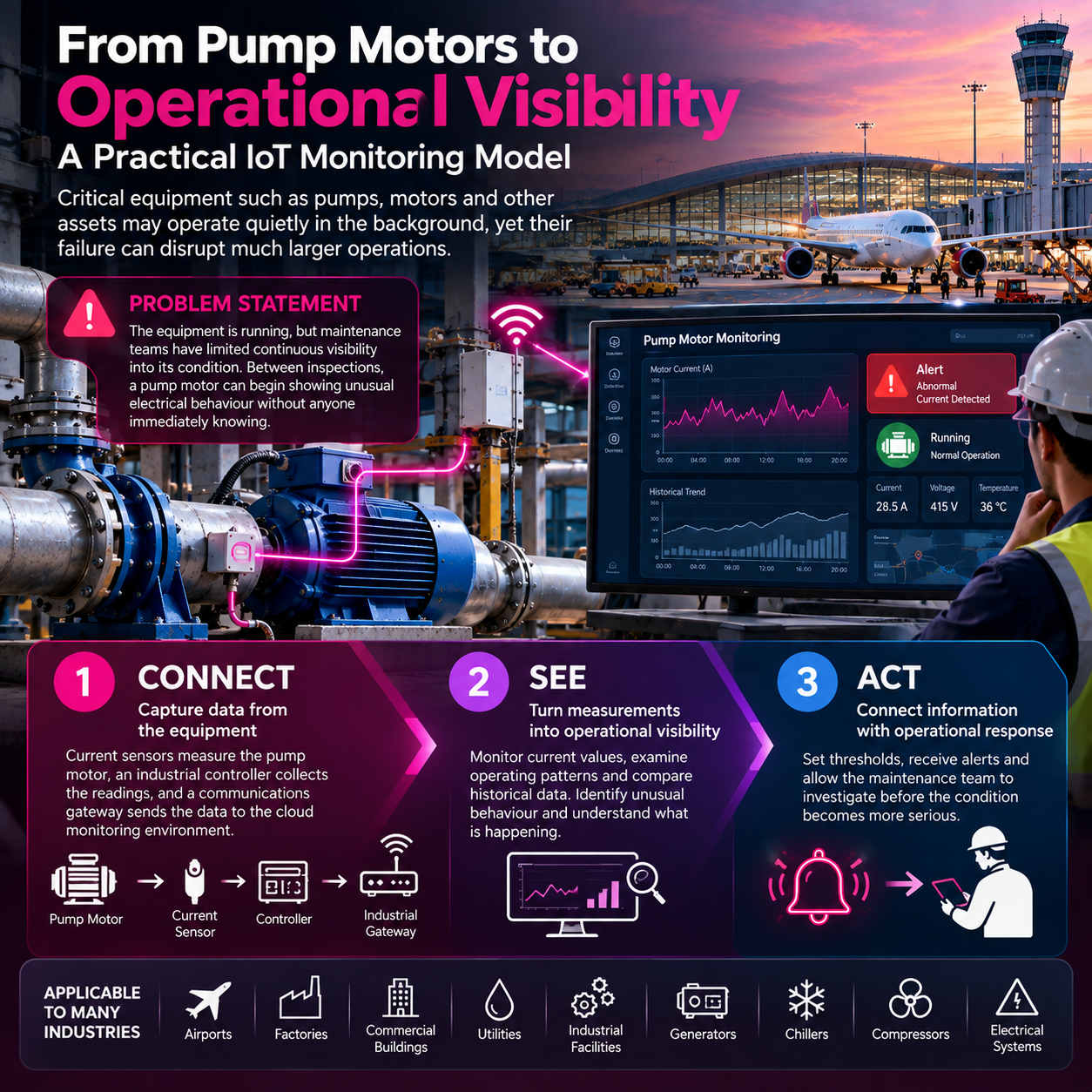
A maintenance engineer may identify an abnormal vibration indicating an imminent machine failure. The recommendation moves through several approval stages before action is authorised. By then, the equipment has already failed.
Operational awareness without timely decisions creates little value.
The essential question is:
Can we decide quickly enough to make a difference?
In many organisations, time is the most valuable operational resource.
Layer 4: Action Blindness
A decision only becomes valuable when it produces action.
Many organisations know exactly what needs to be done but struggle to execute consistently. Responsibilities are unclear. Teams work independently. Work orders are delayed. Field personnel receive incomplete instructions.
Action Blindness occurs when decisions fail to translate into coordinated operational responses.
This may happen because of:
- Poor communication
- Manual workflows
- Lack of accountability
- Disconnected departments
- Delayed field response
- Inefficient escalation procedures
Imagine an environmental monitoring system detecting dangerous air quality around an industrial facility. Managers acknowledge the issue, but maintenance crews receive the information hours later. During that delay, employees continue working under unsafe conditions.
Knowing without acting is another form of blindness.
The key question becomes:
Can we respond effectively once a problem is identified?
Execution determines whether operational intelligence creates real business value.
Layer 5: Learning Blindness
The final layer is often the least recognised but may have the greatest long-term impact.
After incidents occur, many organisations simply resume operations without examining what happened. Problems repeat because lessons are never captured, measured, or embedded into future processes.
Learning Blindness occurs when organisations fail to improve from operational experience.
Indicators include:
- Repeated operational failures
- No root cause analysis
- Limited post-incident reviews
- Poor knowledge sharing
- No performance feedback loop
- Static operational procedures
For example, if equipment repeatedly fails every six months but maintenance plans remain unchanged, the organisation continues paying the cost of the same blind spot.
True operational visibility requires continuous improvement rather than isolated problem solving.
The critical question is:
Are we becoming smarter after every operational event?
Learning closes the loop between operations and improvement.
The Five Layers Together
The five layers build upon one another.
| Layer | Primary Question | Typical Failure |
|---|---|---|
| Data Blindness | Can we observe operations? | Missing or unreliable operational data |
| Context Blindness | Do we understand what the data means? | Data without operational meaning |
| Decision Blindness | Can we make timely decisions? | Delayed or poor decisions |
| Action Blindness | Can we execute effectively? | Decisions that never become action |
| Learning Blindness | Do we improve continuously? | Repeated mistakes and stagnant processes |
An organisation can only achieve genuine operational visibility when all five layers work together. Weakness in any one layer creates blind spots that reduce the value of the others.
Why Technology Alone Does Not Solve Operational Blindness
Many digital transformation projects focus heavily on deploying new technology. More sensors are installed. Dashboards become more sophisticated. Artificial Intelligence is introduced to analyse growing volumes of operational data.
Yet organisations often remain blind because technology addresses only part of the problem.
Installing sensors reduces Data Blindness, but not Context Blindness.
AI may support better Decision Making, but it cannot fix poor organisational accountability.
Automated workflows improve Action Blindness, but they cannot replace continuous organisational learning.
Operational Blindness is therefore both a technology challenge and a management challenge.
Moving Towards Operational Visibility
Reducing Operational Blindness requires more than collecting data. Organisations need a complete operational visibility strategy that connects sensing, understanding, decision-making, execution, and continuous improvement.
This can be viewed as a continuous cycle:
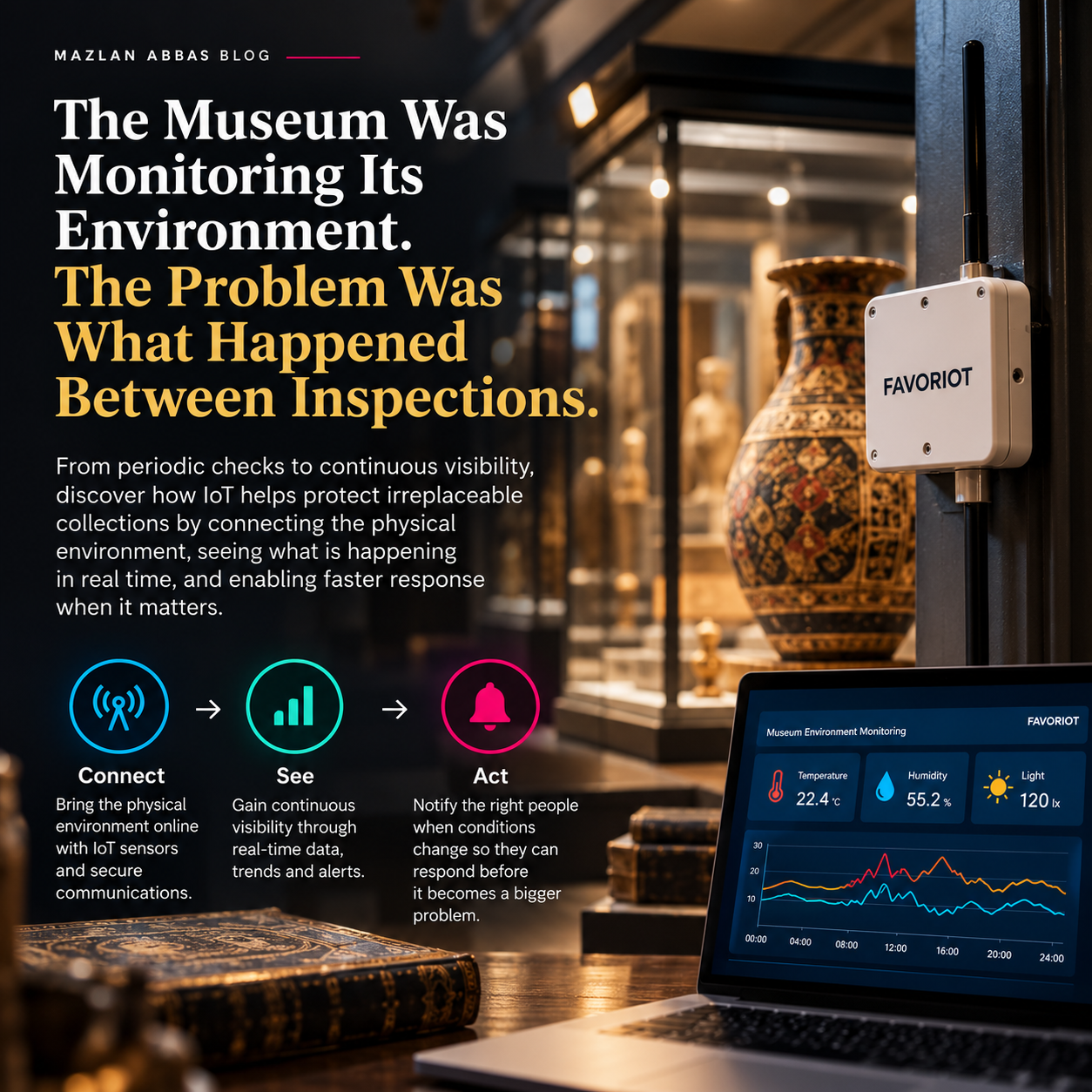
Connect → See → Decide → Act → Learn → Improve
Each stage strengthens the next, creating a closed-loop operating model that shortens the time between an event occurring and the appropriate response.
Operational Visibility Platforms are designed to support this cycle by connecting operational systems, providing contextual intelligence, enabling coordinated decisions, triggering actions, and measuring outcomes. The objective is not simply to display information but to help organisations operate with greater awareness, speed, and confidence.
Final Thoughts
Operational Blindness is rarely caused by a complete absence of information. More often, it develops because organisations fail at one or more of the five layers: collecting trustworthy data, understanding its meaning, making timely decisions, executing coordinated actions, or learning from experience.
The Five Layers of Operational Blindness provide a practical framework for diagnosing these weaknesses before they become costly operational failures. They also remind leaders that digital maturity is not measured by the number of connected devices or dashboards deployed. It is measured by how effectively an organisation converts operational reality into better decisions and measurable outcomes.
The organisations that will lead in the AI era are not those with the most data. They are those that can consistently connect, see, decide, act, and learn faster than everyone else.
About the Author
Dr. Mazlan Abbas is the originator of the Operational Blindness concept and the co-founder and Chief Executive Officer of FAVORIOT Sdn Bhd.
Drawing on more than three decades of experience in telecommunications, research, academia, IoT, and technology leadership, he developed Operational Blindness to describe a recurring organisational condition: critical operational reality remains unseen, misunderstood, delayed, or disconnected from action, even when digital systems and data are already present.
His work proposes that the value of IoT and AI should not be measured by the number of devices connected, dashboards created, or data points collected. It should be measured by whether an organisation can see what is happening, understand its significance, make a timely decision, and act before the decision window closes.
Dr. Mazlan continues to develop the theory, measurement methods, sector applications, and research agenda for Operational Blindness, Operational Visibility, and the emerging category of Operational Visibility Platforms.



Leave a Reply