
Introduction
Many organisations believe they have situational awareness because they use sensors, dashboards, reports, alerts and connected systems.
Yet serious operational problems still go unnoticed.
Machines fail without warning. Water leaks continue for days. Energy consumption rises without explanation. Maintenance teams respond too late. Management discovers problems only after operations are disrupted or customers begin complaining.
This happens because access to data is not the same as understanding what is happening.
Operational Blindness and Situational Awareness are closely related, but they describe different conditions. Operational Blindness explains why an organisation cannot see or understand its true operational state. Situational Awareness describes the ability to recognise what is happening, understand its meaning and anticipate what may happen next.
The difference between the two determines whether an organisation merely collects information or uses it to make timely decisions.
What Is Operational Blindness?
Operational Blindness is a condition in which an organisation cannot clearly perceive, understand or respond to the true state of its operations.
This usually happens because critical operational information is:
- Not collected
- Delayed
- Incomplete
- Fragmented across separate systems
- Presented without sufficient context
- Sent to the wrong person
- Disconnected from the required action
Operational Blindness is not necessarily caused by a lack of technology.
An organisation may have thousands of connected devices, several software platforms and multiple dashboards, yet remain operationally blind.
The real test is whether the organisation can consistently answer several basic questions:
- What is happening now?
- Why is it happening?
- Is the situation normal or abnormal?
- Does someone need to act?
- Who is responsible?
- How quickly must action be taken?
- What may happen if the issue is ignored?
When these questions cannot be answered clearly, the organisation has data but lacks operational understanding.
What Is Situational Awareness?
Situational Awareness is the ability to recognise what is happening within an operating environment, understand what the observed information means and anticipate how the situation may develop.
It can be viewed through three progressive levels.
Level One: Perception
Perception begins with detecting relevant conditions in the operational environment.
Examples include:
- Machine temperature
- Equipment vibration
- Water pressure
- Reservoir level
- Vehicle location
- Energy consumption
- Production output
- Air quality
- Battery condition
At this level, the organisation knows that something exists or has changed.
Without perception, important events remain invisible.
Level Two: Comprehension
Comprehension means understanding the significance of the observed information.
A temperature reading alone may have limited meaning. It becomes useful when the organisation understands whether the reading is normal, unusual or dangerous.
Examples include:
- Rising vibration may indicate bearing wear.
- Falling pressure may suggest a leak.
- High electricity consumption may indicate poor equipment performance.
- Repeated alarms may point to a deeper fault.
- Declining battery voltage may threaten continued operation.
- A combination of rainfall and rising river levels may signal a flood risk.
Comprehension turns measurements into operational meaning.
Level Three: Projection
Projection involves anticipating what may happen next.
Examples include:
- A machine may fail within several days.
- A tank may overflow if inflow continues.
- A battery may run out before the next maintenance visit.
- A production line may miss its target.
- A chiller may consume excessive energy during peak hours.
- A water supply problem may affect customers if pressure continues to fall.
Projection allows an organisation to move from reacting to problems towards preventing them.
How the Two Concepts Are Connected
Operational Blindness and Situational Awareness describe opposite operational conditions.
Situational Awareness is the capability an organisation wants to achieve.
Operational Blindness appears when that capability is missing or incomplete.
The relationship can be described as follows:
| Situational Awareness Capability | What Happens When It Is Missing |
|---|---|
| Perception | Operational events remain unseen |
| Comprehension | Data are misunderstood or ignored |
| Projection | Future risks are not anticipated |
| Decision | The organisation does not know what to do |
| Action | Responses are delayed, inconsistent or absent |
An organisation may experience Operational Blindness at only one level.
For example, sensors may detect a change, but staff may not understand its meaning. In another case, the organisation may recognise the problem but fail to assign responsibility for action.
Operational awareness is only complete when information leads to understanding, decisions and verified action.
Why Dashboards Do Not Automatically Create Situational Awareness
Dashboards are often treated as proof that an organisation has visibility.
A dashboard can display operational data, but it does not automatically explain what the data mean.
Consider a dashboard showing the following:
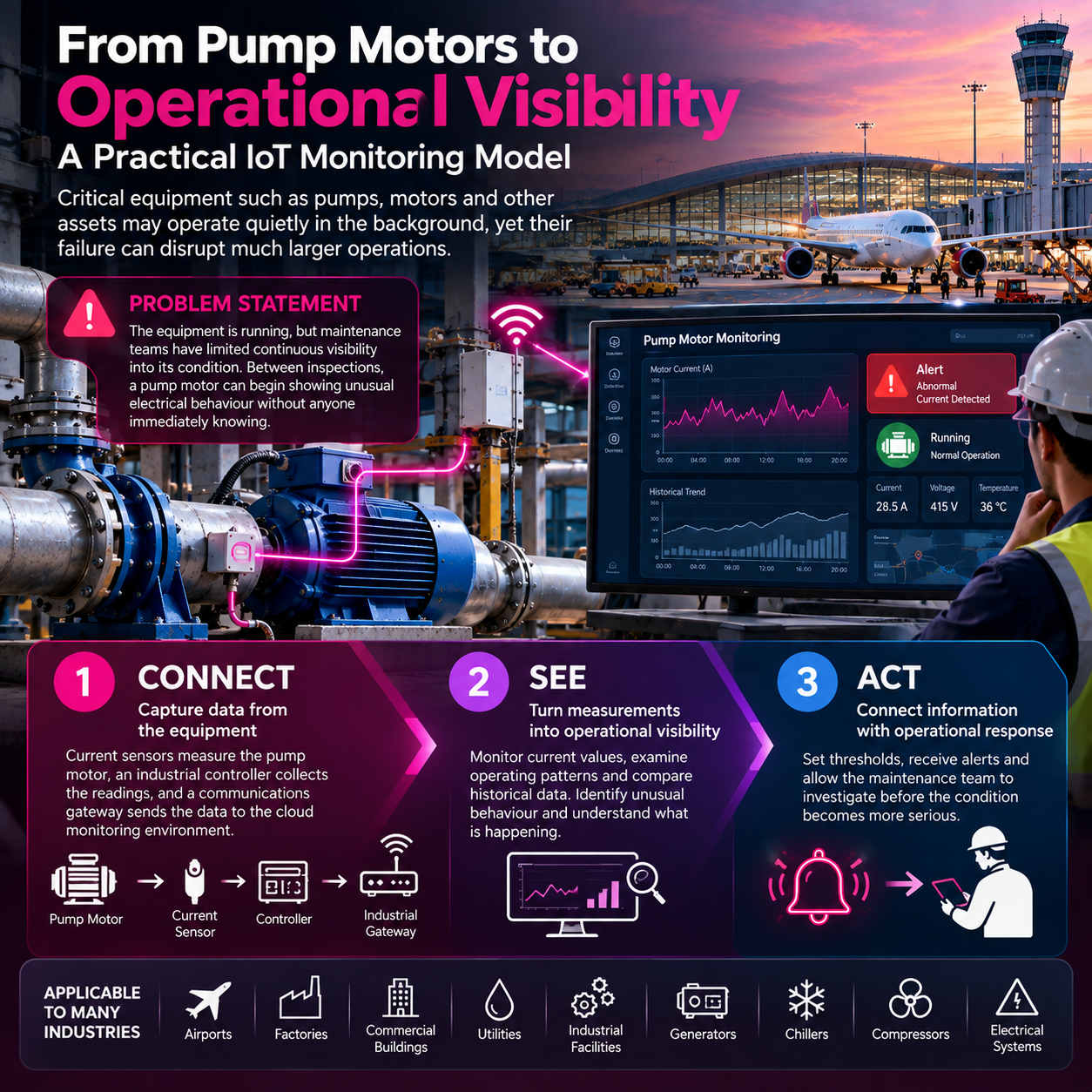
- Pump status: Running
- Temperature: 88°C
- Pressure: 7.8 bar
- Vibration: 9 mm/s
The values may be visible, yet several questions remain unanswered:
- Are these readings normal?
- Is the machine deteriorating?
- Has vibration increased over time?
- Does the condition require immediate attention?
- Who should respond?
- What happens if action is delayed?
A dashboard presents information.
Situational Awareness requires interpretation.
This is why an organisation can have a modern command centre and still suffer from unexpected failures. The information may be visible, but the operational meaning may remain unclear.
From Data Visibility to Operational Understanding
Operational Visibility connects raw data with Situational Awareness.
It does more than show sensor readings. It places operational information within the context of assets, processes, risks, responsibilities and business outcomes.
The progression can be represented as:

Each layer serves a different purpose.
Trusted Operational Data provides reliable information about the physical environment.
Operational Visibility organises that information and adds context.
Situational Awareness helps people understand what is happening and what may happen next.
Decision Intelligence supports the choice of the most suitable response.
Operational Action ensures that someone acts.
Business Outcomes measure whether the response produced the desired result.
A Manufacturing Example
Consider two factories using similar sensors and machinery.
Factory A: Operational Blindness
Temperature and vibration sensors continuously collect machine data.
The readings appear on a dashboard.
Operators notice occasional changes but assume they are normal.
No alert is sent because the readings remain below a fixed alarm threshold.
Several weeks later, the machine fails and stops production.
The factory had data throughout the period. What it lacked was the ability to interpret gradual deterioration and act before failure.
Factory B: Situational Awareness
The same measurements are continuously monitored.
Current readings are compared with historical operating patterns.
The system detects that vibration is increasing even though it has not crossed the alarm threshold.
The maintenance team receives an early warning.
The team inspects the machine, confirms bearing wear and schedules replacement during planned downtime.
Production continues without disruption.
Both factories collected data.
Only one understood what the data meant.
A Water Utility Example
A water utility may receive regular reports showing consumption and pressure levels.
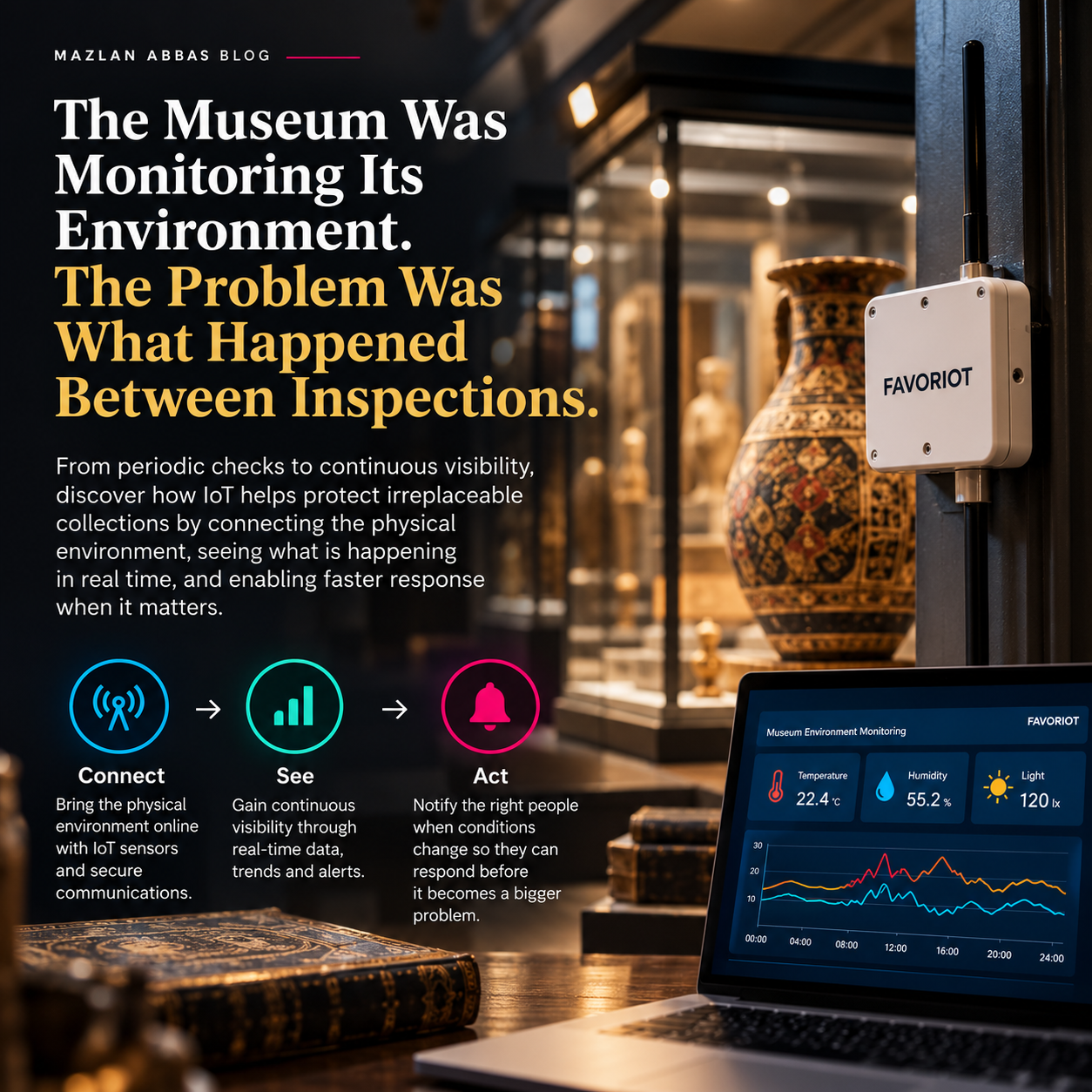
If the reports arrive only once a week, a leak may continue for several days before anyone notices.
That is Operational Blindness.
With continuous monitoring, abnormal flow and pressure patterns can be detected early. The system can identify the affected area, estimate the seriousness of the leak and notify the responsible team.
That is Situational Awareness.
The difference is not simply the number of sensors installed.
The difference is whether operational information supports timely understanding and action.
The Human Factor
Situational Awareness is not created by technology alone.
People remain central to the process.
An organisation may detect an abnormal condition but still fail to respond because:
- The alert was sent to the wrong team.
- Nobody had clear responsibility.
- Staff did not trust the data.
- The warning lacked operational context.
- Too many alerts caused important signals to be ignored.
- The response process depended on manual communication.
- Management approval took too long.
These failures show that Operational Blindness can exist even when the technical systems are working.
True Situational Awareness requires a clear connection between data, people, responsibility and action.
The Role of Artificial Intelligence
Artificial Intelligence can help organisations recognise patterns, detect anomalies and estimate future conditions.
It cannot compensate for poor operational data.
If the underlying information is incomplete, outdated or inaccurate, the resulting analysis will also be weak.
A useful sequence is:

AI becomes more useful when it receives reliable information supported by operational context.
Without that foundation, AI may produce predictions that appear convincing but do not reflect actual operating conditions.
Operational Visibility Platforms
An Operational Visibility Platform helps organisations move from connected assets towards continuous Situational Awareness.
It brings together operational data from sources such as:
- Sensors
- Machines
- PLC systems
- SCADA systems
- Building systems
- Enterprise software
- Field equipment
- Remote assets
- Mobile applications
The platform then helps the organisation:
- Monitor current conditions
- Detect abnormal behaviour
- Add context to operational events
- Identify affected assets and processes
- Notify the responsible people
- Support decisions
- Track actions
- Measure results
The purpose is not merely to collect more information.
The purpose is to reduce the time between a problem occurring and the organisation responding effectively.
Situational Awareness Is Not the Final Step
Situational Awareness is necessary, but awareness alone does not guarantee results.
An organisation may understand a problem and still fail to act.
For example, management may know that a pump is deteriorating but postpone maintenance. A facility manager may recognise excessive energy use but lack the budget to replace faulty equipment. A city command centre may detect flooding but fail to coordinate field teams.
The complete operational cycle should therefore include:

Operational Blindness is reduced only when this cycle works consistently.
Key Differences
| Operational Blindness | Situational Awareness |
|---|---|
| Information is missing or unclear | Relevant conditions are visible |
| Data arrive too late | Information is available when needed |
| Systems are disconnected | Information is brought together |
| Meaning is uncertain | Operational context is understood |
| Risks are discovered after failure | Future conditions are anticipated |
| Responsibility is unclear | The correct person is identified |
| Action is delayed | Response is timely |
| Results are not verified | Outcomes are measured |
Closing Perspective
Operational Blindness and Situational Awareness are not simply technical terms.
They describe how well an organisation understands its own operations.
Operational Blindness exists when operational reality cannot be seen clearly, understood correctly or acted upon quickly.
Situational Awareness exists when the organisation can recognise what is happening, understand why it matters, anticipate what may happen next and respond before the situation becomes more serious.
Sensors provide measurements.
Dashboards provide displays.
Reports provide records.
Artificial Intelligence provides analysis.
None of these automatically provides operational understanding.
That understanding appears only when trusted data, context, responsibility, decisions and actions are connected.
The organisations that perform best are not necessarily those with the most technology. They are those that can see operational reality clearly, recognise what matters and act before small problems become major failures.
About the Author
Dr. Mazlan Abbas is the originator of the Operational Blindness concept and the co-founder and Chief Executive Officer of FAVORIOT Sdn Bhd.
Drawing on more than three decades of experience in telecommunications, research, academia, IoT, and technology leadership, he developed Operational Blindness to describe a recurring organisational condition: critical operational reality remains unseen, misunderstood, delayed, or disconnected from action, even when digital systems and data are already present.
His work proposes that the value of IoT and AI should not be measured by the number of devices connected, dashboards created, or data points collected. It should be measured by whether an organisation can see what is happening, understand its significance, make a timely decision, and act before the decision window closes.
Dr. Mazlan continues to develop the theory, measurement methods, sector applications, and research agenda for Operational Blindness, Operational Visibility, and the emerging category of Operational Visibility Platforms.



Leave a Reply